STEM Education in Elementary School: The Foundation for Future Learning
Discover how STEM (Science, Technology, Engineering and Mathematics) education transforms the elementary classroom, fostering creativity, critical thinking and problem solving from an early age.
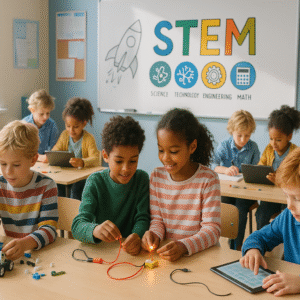
Table of Contents
What is STEM Education in Elementary School?
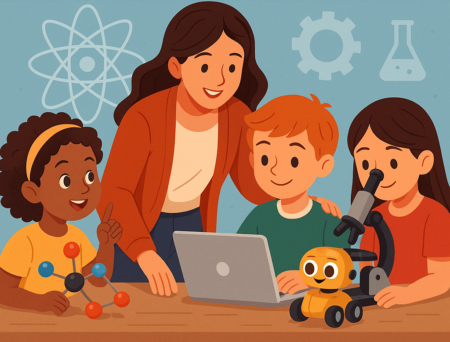
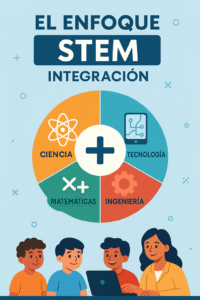
The STEM education (for its acronym in English: Science, Technology, Engineering, and Mathematics) is an interdisciplinary approach that integrates the areas of science, technology, engineering and mathematics in practical and meaningful learning experiences. At the level of primary, This educational model adapts to the cognitive abilities of children from 6 to 12 years of age, promoting active learning through experiments, projects and real-world challenges.
Unlike traditional methods that separate subjects, the STEM approach combines them to solve concrete problems. For example, in building a bridge with popsicle sticks, students apply math (measurement), engineering (design), science (forces) and technology (use of digital tools).
Benefits of the STEM Approach in the Elementary School Stage
Introducing STEM thinking from an early age has a profound impact on a student's overall development. These are the main benefits proven by educational studies:
- Development of critical thinking: Children learn to analyze problems, formulate hypotheses and test solutions.
- Improved math and science skills: Contextualized learning makes abstract concepts more understandable.
- Promotion of creativity and innovation: Open projects allow for multiple responses, stimulating originality.
- Teamwork and communication: Many STEM activities require collaboration and negotiation of ideas.
- Preparation for future employment: 21st century careers demand technology and problem-solving skills.
According to the U.S. Department of Education, In addition, students exposed to STEM as early as elementary school are 30% more likely to be interested in scientific or technical careers.

Elementary STEM Activities by Age Levels
Activities should be adapted to the cognitive maturity and motor skills of the students. Here are some practical ideas by cycle:
For 1st to 3rd elementary school (6-8 years)
- Eruptive volcano: Use baking soda and vinegar to teach chemical reactions.
- Spaghetti tower: Build structures with spaghetti and marshmallows to learn stability.
- Code with arrows: Introduction to computational thinking using address cards.
For 4th to 6th grade (9-12 years old)
- Robotics with LEGO Education or Makeblock: Program simple robots to complete tasks.
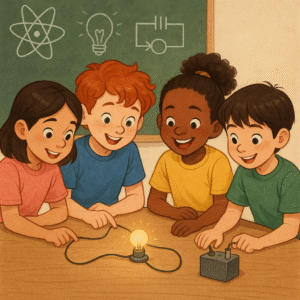
- Homemade solar power generator: To assemble a circuit with miniature solar panels.
- Mathematics applications in videogames: Using platforms such as Code.org to learn programming logic.
Resources for Teachers: Useful Tools and Platforms
Implementing STEM does not require large investments. There are many free and low-cost tools to get started:
| Resource | STEM Area | Link |
|---|---|---|
| Scratch Jr (for tablets) | Technology / Programming | scratchjr.org |
| PhET Interactive Simulations | Science and Mathematics | phet.colorado.edu |
| Tinkercad (3D design) | Engineering / Technology | tinkercad.com |
| Khan Academy Kids | Mathematics and Logic | khanacademy.org/kids |
In addition, you can integrate recycled materials (boxes, bottles, tubes) for low-cost projects. The focus is not the expensive technology, but the design and experimentation process.
How to Implement STEM Education in your School
Embracing STEM requires a cultural and pedagogical shift. Here's a step-by-step plan:
- Teacher training: Organizes workshops on active methodologies (project-based learning, design thinking).
- Space design: Create a «STEM lab» or «makerspace classroom» with workstations.
- Curricular integration: Links STEM projects with formal curriculum content (e.g., math measurement + construction).
- Collaboration with families: Involve parents in science fairs or family workshops.
- Formative evaluation: Use rubrics that value process, creativity and teamwork, not just the outcome.
Frequently Asked Questions about STEM Education in Elementary Schools
Is STEM education appropriate for 6-year-olds?
Yes, with adapted activities. At that age, the approach should be playful and experimental, such as building structures or observing natural phenomena.
Is expensive technology needed to teach STEM?
No. You can start with recycled materials, homemade experiments and free digital tools such as Scratch or PhET.
How to evaluate STEM projects?
Use rubrics that value the process: creativity, teamwork, problem solving and application of concepts, not just the final product.
Does STEM replace other subjects such as Language or Art?
No. STEM is integrated with other areas. For example, when documenting an experiment, writing is practiced; when designing a prototype, art is applied.
Are there any official STEM programs in Spain?
Yes, the Ministry of Education promotes initiatives such as «STEM for Equality» and collaborates with entities such as FECYT to train teachers.
Conclusion: STEM as a Tool for Educational Transformation
The STEM education in elementary school is not a fad, but a necessity to prepare students for an increasingly technological and complex world. By fostering curiosity, logical thinking and resilience in the face of error, we lay the foundation for critical and innovative citizens.
Start small: one activity a week, a STEM corner in the classroom, a collaboration among teachers. The long-term impact will be transformative.

 Español de Puerto Rico
 English