
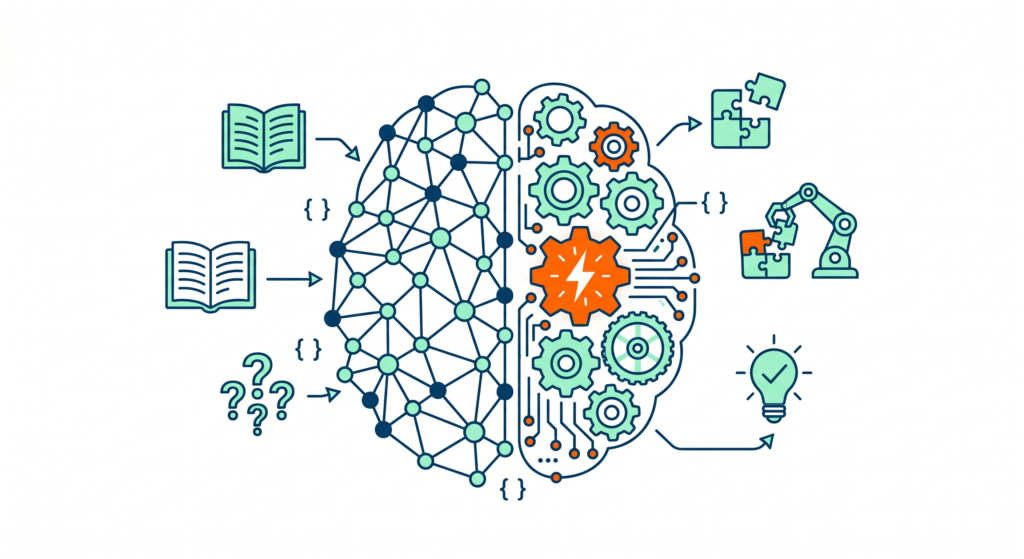
In today's educational landscape, to talk about secondary artificial intelligence It's not just about referring to a technological trend, but about a fundamental skill that students between 12 and 18 years old must develop. AI is no longer a science fiction concept but has become an everyday tool that influences how our students consume information, communicate, and learn. For a secondary school teacher, the challenge lies in demystifying this technology and presenting it as an accessible, ethical field of study full of creative possibilities within the STEM education framework.
What is secondary artificial intelligence?
When we talk about secondary artificial intelligence In a pedagogical context, we are referring to the capacity of computer systems to perform tasks that would normally require human intelligence, adapted to the level of understanding and analysis of adolescents. In simple terms, it is the branch of computer science that seeks to create algorithms and systems that can «learn» from data, recognize patterns, and make decisions or predictions.
For students aged 12 to 18, it is vital to understand that AI is not a «mind» that thinks like us, but rather an extremely advanced mathematical processor. Explain the AI for teens It involves breaking down how a machine processes millions of examples (Big Data) to find logical rules that allow it, for example, to identify whether an image shows a cat or a dog, or to predict what the next most likely word in a sentence is.
The importance of secondary artificial intelligence in the classroom
Integrate the secondary artificial intelligence In the curriculum, it is crucial for several pedagogical and social reasons:
- Critical digital literacy: Teenagers are immersed in social media algorithms. Understanding AI allows them to understand why they see certain content and how to avoid information manipulation.
- Preparation for future employment: Regardless of the career they choose, AI will be a cross-cutting tool in medicine, arts, engineering, and humanities.
- Fostering Logical Thinking Studying how a machine learns forces the student to reflect on their own thought processes and problem-solving.
- Development of Technological Ethics: It is the perfect stage to discuss biases, privacy, and the social impact of automation.
As indicated in our Editorial Calendar Secondary.xlsx, this topic is a fundamental pillar for the activities of the second quarter, where the integration of technology and ethics becomes more relevant.
Key concepts the teacher must master
To teach AI explained Effectively, the teacher must have these fundamental pillars clear:
- Algorithm: A series of step-by-step instructions. In AI, these algorithms are not static; they adjust based on the data they receive.
- Machine Learning It is the subfield of AI that allows computers to learn without being explicitly programmed for each task. It is based on pattern recognition.
- Neural Networks Mathematical structures inspired by the human brain that process information in layers to solve complex problems, such as language translation or artificial vision.
- Training and Data: AI «is what it eats.» If the training data is biased or insufficient, the AI's results will be erroneous.
- Natural Language Processing (NLP): The technology behind tools like ChatGPT that allows machines to understand and generate human language coherently.
Practical strategies for the classroom
Address the secondary artificial intelligence requires an active approach. Theory is not enough; the student must interact with the technology. Here are some pedagogical strategies:
1. The «Black Box» Approach»
Invite students to use an AI (such as an image generator) and try to guess what internal rules the machine is following. This encourages prompt engineering and analysis of results.
2. Socratic debates on ethics
Pose moral dilemmas: Who is the author of a painting created by AI? Should a self-driving car prioritize the life of the driver or a pedestrian? These debates connect technology with philosophy and social values.
3. Demystification through Error
Show cases where AI fails (hallucinations). This helps students not see AI as an absolute source of truth, but as a statistical tool that can make mistakes.
Ready-to-use activities
Here are three activities designed to work on AI for teens in a practical and simple way:
- Activity 1: Training My First AI (No-code). Use tools like Teachable Machine from Google. Students can train a model to recognize their facial gestures or different objects in the classroom. Objective: Understand the concept of «Dataset» and «Training.».
- Activity 2: The School Turing Test. Organize a writing exercise where half the class writes a short poem and the other half generates one using AI. The rest must guess which is which. Objective: Analyze the capabilities and limitations of natural language processing.
- Activity 3: Bias Audit. Search for AI-generated images under the keyword «doctor» or «secretary.» Analyze with the students if gender or racial stereotypes are repeated. Objective: Develop critical thinking about biases in data.
Recommended materials
To delve deeper into the secondary artificial intelligence, we recommend the following resources:
- Interactive platforms Teachable Machine, Machine Learning for Kids, and Quick, Draw!.
- Documentaries: «The Social Dilemma» (to discuss recommendation algorithms) or «Coded Bias» (about algorithmic bias).
- Teaching guides: The UNESCO framework on AI and education is an excellent reference for long-term planning.
Evaluation and suggested rubrics
Evaluate the understanding of the secondary artificial intelligence should not be limited to theoretical exams. We suggest a project-based assessment with the following criteria:
- Technical understanding: Does the student correctly identify the components of an AI system (data, model, output)?
- Critical analysis: Are you able to identify potential biases or ethical issues in a given case study?
- Practical application: Can you design an effective prompt to solve a specific task or improve a learning process?
- Personal reflection: How does the student think AI will impact their future career?
Common mistakes and how to avoid them
When teaching AI explained, it is common to fall into certain mistakes that can confuse students:
- Excessive anthropomorphism To say that AI «thinks» or «feels.». Solution: Use terms like «processes,» «calculates,» or «predicts.».
- Disregard the human factor: To think that AI works on its own. Solution: Emphasize that humans are collecting data, programming algorithms, and deciding on their implementation.
- Fostering fear or blind optimism: Present it only as the end of jobs or as the solution to all the world's problems. Solution: Maintain a balanced approach based on facts and real possibilities.
Conclusion
understand the secondary artificial intelligence is opening a door to the future for our students. As educators, our mission is not to turn them all into AI programmers, but into informed citizens who know how to use these tools ethically, creatively, and efficiently. By integrating these concepts into the classroom, we are giving adolescents aged 12 to 18 the keys to navigate an ever-evolving digital world.
To generate printable materials related to this topic, visit Didaktos.io.
 Español de Puerto Rico
  English