
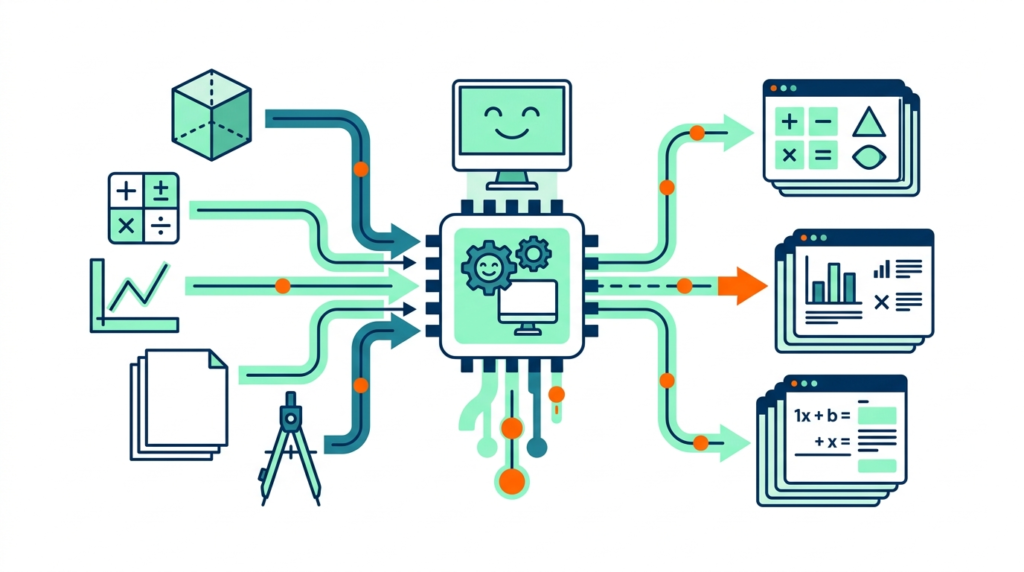
In today's educational landscape, classroom diversity is not the exception, but the norm. As secondary school teachers, we face the daily challenge of motivating students with vastly different learning paces, interests, and skill levels. Getting a 14-year-old interested in algebra or a 17-year-old to understand the utility of calculus requires more than just following a standard textbook. This is where the need to design arises middle school math exercises that are truly meaningful. Content personalization not only improves conceptual understanding, but also reduces frustration and increases students' self-efficacy.
What are secondary school math exercises?
The creation of middle school math exercises Under a personalized approach, it's a pedagogical process that involves adapting math problems and activities to the specific characteristics of a group or individual student. It's not about simply changing one number for another in an equation; it means adjusting the context, complexity level, language used, and thematic interests so that the content resonates with the student. At the secondary school level (ages 12-18), this means transitioning from abstract problems to situations that connect with their social, technological, or vocational reality.
When we talk about Printable math and personalized, we're referring to resources that allow the teacher to apply differentiated instruction. This can range from modifying the data in a problem to be about students' favorite social networks, to creating learning pathways where each student receives challenges tailored to their current skill level.
Importance of secondary math exercises in middle school
The stage from 12 to 18 years old is critical for the development of abstract-logical thinking. However, many students disconnect from mathematics by perceiving it as a distant and rigid discipline. The use of middle school math exercises adapted offers tangible benefits:
- Increase in intrinsic motivation By including topics such as sports, video games, personal finance, or graphic design, the student perceives the immediate usefulness of the subject.
- Attention to diversity: It allows students with difficulties to find accessible entry points, while highly capable learners receive challenges that keep their curiosity ignited.
- STEM Competency Development: Personalization facilitates an interdisciplinary approach, connecting mathematics with science, technology, and engineering naturally.
- Math Anxiety Reduction: An exercise designed specifically for the student's current level avoids the emotional block that comes from facing an unreachable task.
Key concepts the teacher must master
- Scaffolding: Ability to break down a complex problem into intermediate steps that adapt to the student's progress, withdrawing support as they gain autonomy.
- Teaching variables Identify which elements of a problem can be modified (numbers, type of operation, presentation format) to alter its difficulty without changing the learning objective.
- Authentic contextualization: Differentiate between an artificial word problem and a real-world problem that requires the use of personalized exercises to be resolved.
- Formative evaluation: Understanding that personalization is born from data obtained in the classroom; the teacher must know how to diagnose where each student is before designing the resource.
Practical strategies for the classroom
Implementing customization in day-to-day activities may seem overwhelming, but with clear strategies, it's possible to integrate it efficiently. A fundamental technique is the use of problem templates with fill-in-the-blanks where students can insert their own data. For example, in a statistics topic, each student can collect data on their own sleep habits to perform the analysis.
Another strategy is to create difficulty levels within the same session. We can design Printable math that they present an activities menu: basic level exercises to consolidate, intermediate level to apply, and advanced level to investigate. This empowers the student by allowing them to choose their starting point, always under the teacher's guidance.
Furthermore, the use of technology is a great ally. When planning the course, teachers can organize which curriculum topics lend themselves more to deep personalization and which require more technical and procedural practice.
Ready-to-use activities
- Activity 1: The Influencer's Budget: To work on proportionality and percentages. Students must design a budget for an advertising campaign on a social network of their choice, calculating the return on investment based on interaction rates that they research themselves.
- Activity 2: Geometry in My City Using digital mapping tools, students must select an iconic park or building in their area and calculate its real dimensions by applying scales, adapting the exercise to their immediate geographic surroundings.
- Activity 3: The Launch Parabola In the study of quadratic functions, students record a video of a basketball throw and use analysis software to fit a mathematical function to their actual movement.
Recommended materials
To optimize the creation of these resources, it is advisable to have a varied toolbox. Digital notebooks, graphing calculators, and dynamic geometry software are essential. However, the most valuable resource for the teacher is one that allows for the generation of middle school math exercises Quickly and professionally, maintaining the aesthetics and clarity that teenagers need.
Spreadsheets configured with random formulas are also excellent for generating multiple versions of the same exam, fostering authentic individual work. The use of manipulatives (logic blocks, geoboards) remains relevant in the early years of secondary school to personalize the transition from the concrete to the abstract.
Evaluation and suggested rubrics
The evaluation of personalized exercises It must be as flexible as their design. We cannot evaluate a task that has been diversified with a single pattern. The use of analytical rubrics is suggested, which value:
- Process and reasoning: Beyond the final result, the chosen strategy and the justification of the steps taken are rewarded.
- Self-management The student's ability to choose exercises that present a challenge appropriate to their skill level.
- Connection to context: How well has the student applied the mathematical concept to the personalized situation presented?.
Common mistakes and how to avoid them
- Cognitive overload Sometimes the context is so complex that the student gets lost in the story and forgets the math. Solution: Keep the context simple and familiar to the student.
- Superficial customization: Change only the protagonists' names without altering the problem structure. Solution: Ensure personalization affects problem interest logic.
- Lack of time Try to customize each exercise in each class. Solution: Prioritize the most abstract topics or those where you detect the most demotivation.
Conclusion
The creation of middle school math exercises "Differentiation is not just a pedagogical trend; it's a necessity to ensure equitable and quality learning. By transforming mathematics into a living tool, connected to our students' identities, we are breaking down historical barriers of rejection towards the subject. Start small: choose a didactic unit, identify your group's interests, and begin designing those resources that will make a difference.".
Want to create ready-to-use worksheets? Try the resource generator at Didaktos.io.
 Español de Puerto Rico
  English