

Mystery of the Floating Egg 🥚✨
A complete guide to defy gravity, understand the science of density and blow everyone's mind at your science fair!
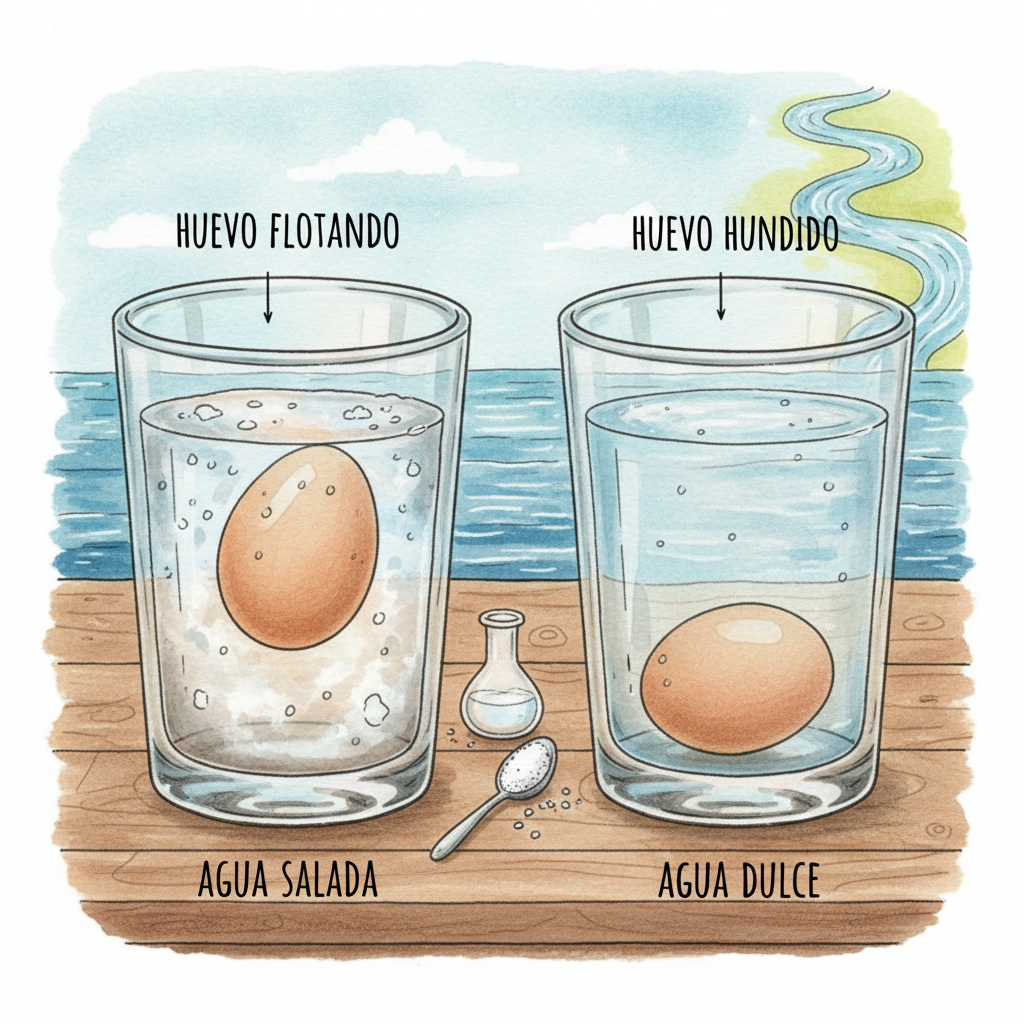
🎯 Your Scientific Missions
- General Objective: Understand and visually demonstrate how the density of a liquid affects the buoyancy of an object (our friend, the egg).
- Personal Objective: Build an impactful experiment, explain it like a true expert and feel the thrill of mastering a key scientific concept. Go for the gold medal! 🥇
🌍 What Witchcraft Is This? The Science of Density
Relax, there is no magic! It's all about the density. Imagine density as the amount of «stuff» (molecules) squeezed into a space.
- 💧 Fresh water: Like a party with few guests. There is plenty of free space.
- 🧂💧 Salt water: The same party, but now hundreds of friends (the salt molecules) have arrived! The place is packed.
An object floats if it is less dense than the liquid in which it is found. An egg is denser than fresh water, so it sinks. But... by adding salt, we make the water so dense that the egg gives up and floats!
The Dead Sea is so incredibly salty that its water is super dense, which is why people can float in it effortlessly, as if they were on an invisible couch! Your experiment recreates this same principle on a small scale.
🔬 Scientific Method: Your Plan of Attack.
Science is like a video game with levels - follow these steps to win!
- Observation: You notice that some things sink in the water (a stone) and others float (a piece of wood). A fresh egg sinks.
- Research Question: Is it possible to modify the water so that an egg, which normally sinks, can float?
- Hypothesis (Your prediction): «If I increase the density of the water by dissolving enough salt in it, then the egg will float because the density of the salt water will exceed the density of the egg.».
- Experimental Design: The fun part! You will prepare two scenarios: one egg in normal water and one in salted water to compare the results.
- Data Analysis: You will observe what happens in each glass and note the results. Did it float? How much? Did you need a lot of salt?
- Conclusion: You compare your results with your hypothesis, were you right? Explain why!
🧩 Here's What Your Lab Looks Like
Your final assembly will be simple but very visual. You will have two clear glasses side by side for a perfect comparison. One will show the egg sadly sinking, and the other, the egg floating victoriously.
Although it is a safe experiment, be careful not to spill the salt water near electronics. Also, don't drink the salt water! It tastes terrible and is not good for you.
🛠️ Scientific Arsenal: Materials List
You don't need a NASA lab - here are options for every budget!
| Material | Economy Option 🤑 | Standard Option 👍 | Professional Option 👨🔬 |
|---|---|---|---|
| Eggs | Common white eggs | Farm eggs (brown) | Several eggs of different sizes |
| Containers | 2 large plastic cups | 2 tall glass beakers | 2 graduated cylinders of 500ml |
| Water | Tap water | Bottled water | Distilled water |
| The «magic ingredient» | Common table salt | Coarse sea salt | Pure sodium chloride (NaCl) |
| Stirrer | A plastic spoon | A long metal spoon | One glass stirring rod |
🧭 Your Adventure Map: Step by Step
- Prepare the base (5 min): Fill the two containers with the same amount of water - it is important that it is the same for a fair comparison!
- The control test (1 min): Very carefully, insert an egg into the first glass. You will see that it sinks straight to the bottom. This is your «control group».
- Pro Tip: Use a spoon to gently lower the egg. This prevents it from breaking and ruining the experiment.
- Add science! (5 min): In the second glass, start adding salt. Pour about 4-5 tablespoons and stir very well until completely dissolved. If the water becomes cloudy, wait a little while for it to clear.
- The moment of truth (1 min): Now, dip the second egg into the beaker of salt water. Watch the magic of science! It should float.
- Scientist Alert! 🧪: The egg doesn't float? No problem! It means that the water is not yet thick enough. Simply remove the egg carefully, add more salt, dissolve it well and try again.
- The final challenge (Optional, 10 min): Can you make the egg stay in the middle of the glass? Try dropping the egg into the salt water and then, very carefully, pour some fresh water over the top - you could create a «suspended» egg!
🎪 Let's shine at the Fair!
A great experiment needs a great presentation - here's how!
Your Poster:
- Title Giant: Use the one we gave you or an equally eye-catching one.
- Clear Sections: Use the steps of the scientific method as your sections (Question, Hypothesis, Materials, Procedure, Results, Conclusion).
- Visual is Great: Include photos of your experiment, the ASCII diagram we gave you, or even drawings.
Interactive Ideas:
- Let the judges or visitors put the egg in the cups themselves! (With supervision).
- Have a «salt meter» (a jar with salt and a spoon) to show how much salt is needed.
Phrases to Impress Judges:
«This experiment is a practical demonstration of the Archimedes Principle, which states that a body immersed in a fluid experiences a vertical upward thrust equal to the weight of the fluid it displaces».»
«By modifying the density of the water with sodium chloride, we succeeded in altering the buoyancy force exerted on the egg, overcoming its weight and allowing it to float.»
📎 Scientist's Toolbox.
Data Recording Template
A good scientist always takes notes. Use this table for your tests.
| Test # | Amount of salt (tablespoons) | Does it float (Yes/No/Partially)? | Remarks |
|---|---|---|---|
| 1 (Control) | 0 | No | The egg sank immediately. |
| 2 | 3 | ||
| 3 | 5 | ||
| 4 (Sugar) | 5 | What will happen if you use sugar? Try it! |
Final Checklist ✅
- [I have a creative title for my project.
- [My hypothesis is clearly written.
- [I gathered all my materials.
- [I have performed the experiment several times to ensure the result.
- [I have taken photos or videos of my process.
- [My poster is clear, colorful and has no spelling mistakes.
- [I practiced my explanation out loud!
Recommended Sources for Super Minds:

 Español de Puerto Rico
 English