

GIANT FOAM ERUPTION!
The Mystery of the Fugitive Reaction
Your mission: turn simple liquids into an explosion of foam and discover the power of catalysts!
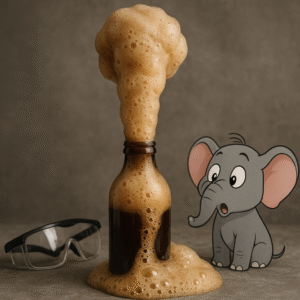
🎯 Clear and Challenging Objectives
- General Objective: Demonstrate how a chemical decomposition reaction can be dramatically accelerated by a catalyst, releasing oxygen and generating a large amount of foam exothermically (releasing heat!).
- Your Personal Objective: «By the end of this guide, you'll be able to explain what a catalyst is, how hydrogen peroxide decomposition works, and control a chemical reaction to create an amazing toothpaste...worthy of an elephant!».
🌍 Theoretical Introduction: The Science Behind the Foam!
Have you ever seen how an effervescent tablet creates thousands of bubbles in water? Well, you're about to do something 100 times more spectacular! What we are going to do is called catalytic decomposition of hydrogen peroxide. Sounds complicated, doesn't it, but it's super easy!
🤫 The Secret Protagonist: We have a molecule called hydrogen peroxide (H₂O₂). It is like water (H₂O), but with an extra oxygen atom that wants to escape.
🦸 The Superhero Accelerator: This is where our catalyst (yeast). Imagine it's a trainer that speeds up the reaction incredibly. Yeast contains an enzyme called catalase that is adept at breaking down H₂O₂.
🎉 Bubble Party: When the oxygen escapes as a gas, it is trapped by the soap we add, forming a giant, hot foam! The reaction is exothermic because it releases heat.
🤔 Did you know that...? Your own body produces catalase. It is one of the fastest enzymes and protects your cells by breaking down the hydrogen peroxide that forms naturally in your body. You are a walking science machine!
🔬 Scientific Method: Your Plan of Attack
- Initial Observation: I have seen videos of chemical reactions that produce lots and lots of foam almost instantaneously. What makes the reaction so fast?
- Research Question: How does the amount of catalyst (yeast) affect the speed and height of the foam?
- Hypothesis (Your prediction!): «I believe that if I increase the amount of yeast, the reaction will be faster and the foam will reach a higher height, because there will be more catalase releasing oxygen at the same time».
- Experimental Design:
- Independent Variable: The amount of yeast (1, 2 and 3 teaspoons).
- Dependent Variable: The maximum height of the foam (in cm).
- Controlled Variables: Amount of H₂O₂, water, soap, type of bottle, etc.
- Test Procedure: You will perform the experiment three times, once for each amount of yeast.
- Analysis of Results: You will record the data in a table and create a bar chart.
- Conclusion: You will compare your results with your hypothesis to see if you were right.
🧩 Experiment Set-up
      /¯¯¯\
     | | <-- Foam Eruption!
     | (Measure the height here)
    / ..... \
   | ..... |
   | _________| <-- Bottle (500 ml)
/¯¯¯¯¯¯¯¯¯¯¯¯¯¯¯¯¯¯¯¯¯¯¯¯¯¯\
| |
| CONTAINMENT TRAY |
\___________________________/
🔥 DANGER ZONE! 🔥
H₂O₂ can irritate skin and eyes. ALWAYS WEAR GLASSES AND GLOVES! Foam will be hot. Adult supervision required.
🛠️ List of Materials
For each key material, we give you 3 alternatives:
| Material | ♻️ Economic | 🏫 Standard | 🧪 Professional |
|---|---|---|---|
| Container | Plastic Bottle | Glass Bottle | Erlenmeyer flask |
| H₂O₂ | 3% (Vol 10) | 6% (Vol 20) | 12% (Vol 40) |
| Catalyst | Dry yeast | Active yeast | Potassium Iodide |
✅ Scientific Survival Kit:
Goggles, gloves, tray, soap, warm water, dye, tape measure, stopwatch and your notebook!
🗺️ Step by Step Guide: Your Adventure Map
Preparation (10 min ⏱️)
- Safety First! Put on goggles and gloves. Place the bottle in the tray.
- Prepare the Bottle: Pour 1/2 cup (120 ml) of H₂O₂, a tablespoon of soap and, if desired, coloring. Stir gently.
The Reaction! (5 min per attempt ⏱️)
- Activate the Catalyst: In a glass, mix your dose of yeast with 3 tablespoons of warm water. Stir for 30 seconds.
- 3, 2, 1... IGNITION! QUICKLY pour the yeast mixture into the bottle - watch the rash! 📸 Record this moment!
- Measure and Score: Measure the maximum height of the foam and note the result.
Cleaning and Repetition (15 min ⏱️)
- Clean the Zone: Pour the remains down the drain with plenty of water and rinse the bottle.
- Repeat the Adventure: Do it again with the other amounts of yeast.
💡 Pro Tip:
Use a bottle with a narrow neck for a higher and more dramatic eruption.
🚨 Scientist Alert!
Never cap the bottle after mixing. The gas pressure could cause it to explode.
🎪 Prepare your Presentation (Become a Star!)
Your Poster or Booth: Organize it with big titles, little text and lots of images - your bar chart is the star!
Make it Interactive! Use a QR code to show the video of the eruption, do a live demo (with security) or a quick quiz for the audience.
Winning Phrases for Judges:
- «In my experiment, I quantitatively investigated the effect of a catalyst...»
- «As you can see from my graph, the data strongly supports my hypothesis...»
📎 Useful Attachments (Your final kit!)
Data Recording Template:
| Test # | Yeast (teaspoons) | Maximum height (cm) | Remarks |
|---|---|---|---|
| 1 | 1 | Slow foam, not very dense. | |
| 2 | 2 | Much faster, more volume. | |
| 3 | 3 | Almost instantaneous eruption! |
Recommended Sources:

 Español de Puerto Rico
 English