

Unleash the Chemical Rage!
The Sizzling Reaction Volcano
Your mission: create an acid-base reaction so powerful that it simulates a volcanic eruption... and measure its incredible power!
🎯Your Mission Objectives
🎯 General Objective:
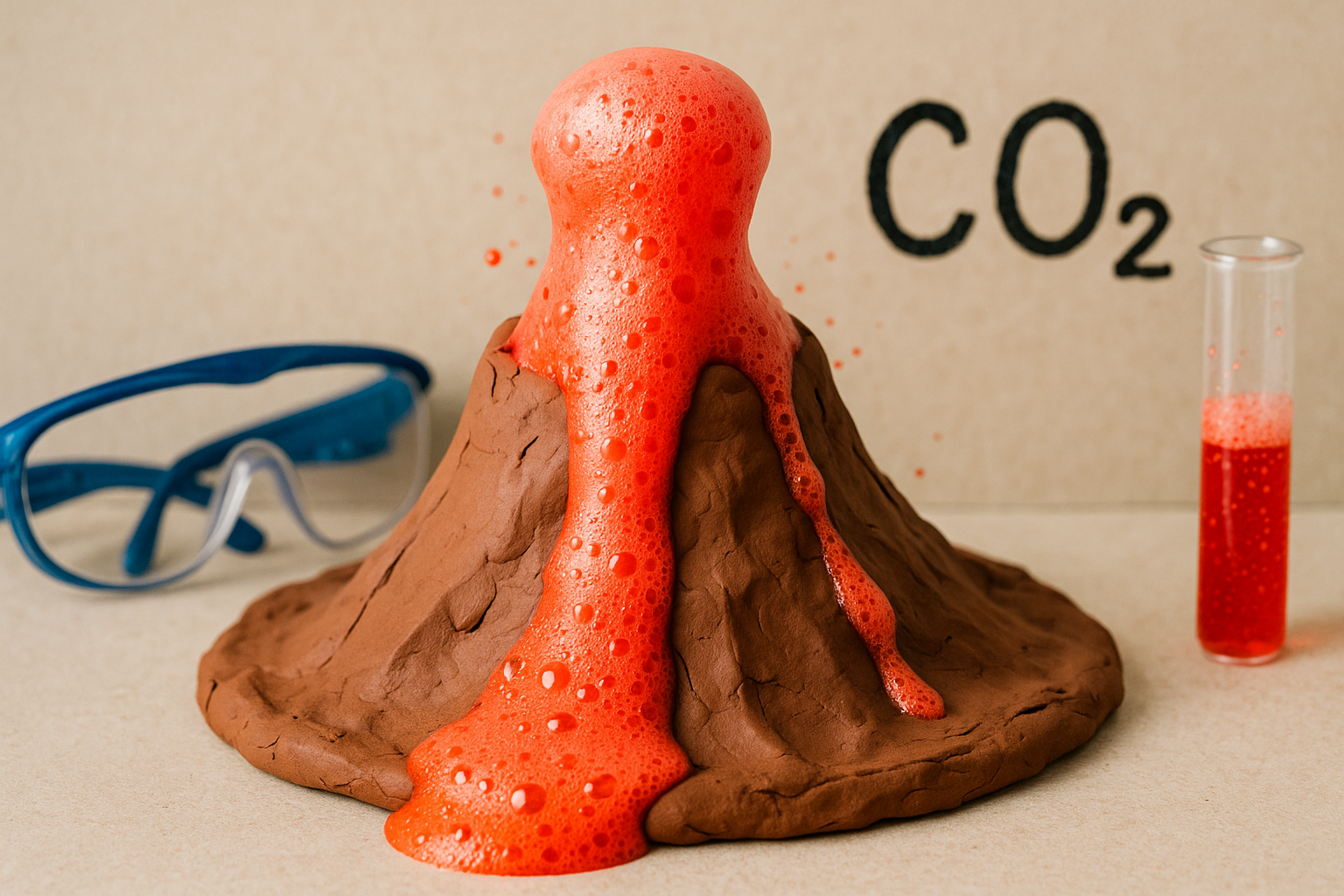
You will visually demonstrate how the chemical reaction between an acid (vinegar) and a base (sodium bicarbonate) releases a gas (carbon dioxide) with sufficient force to create an «eruption».
🏆 Personal Objective:
«By the end of this guide, you will be able to explain what an acid-base reaction is, build a volcano model from scratch, measure the results of your experiment like a pro, and present your findings with complete confidence.»
🌍The Secret of the Volcano!
Have you ever mixed ingredients in the kitchen and something... happened? 🤔 Well, you're about to trigger one of those reactions, but in a big way!
Imagine that the vinegar (our acid) is a team of super energetic players eager to pass a ball. On the other hand, the sodium bicarbonate (our base) is another team that has just the balls that the first one wants.
When you put them together, all hell breaks loose! 🤯
- The «balls» (which are actually particles called protons) are passed at full speed.
- This chemical match is so intense that it breaks down and releases something new: a gas!
- This gas is called carbon dioxide (CO₂), The same one that is in the bubbles of soft drinks.
- Since gas takes up much more space than liquids, it needs to escape. And it does so by pushing the whole mixture upwards, creating our spectacular eruption! 🌋
💡 Did you know? The reaction between vinegar and bicarbonate is a neutralization reaction. Although it may look explosive, in reality the acid and base are «canceling» each other out to form more stable substances such as water, a salt and, of course, our lead gas!
🔬Your Scientific Plan of Attack
- Initial Observation: I have seen in movies and videos that mixing baking soda and vinegar produces a lot of foam. I wonder if this «explosion» can be controlled or measured.
- Research Question: How does the amount of vinegar affect the height that the foam reaches in the volcano eruption?
- Hypothesis (Your hunch!): «I believe that if I double the amount of vinegar, the height of the eruption will also double, because there will be more acidic ‘fuel’ to react with the bicarbonate.»
- Experimental Design:
- Independent Variable (the one you change): The amount of vinegar you add in each test (e.g., 50 ml, 100 ml, 150 ml).
- Dependent Variable (the one you measure): The maximum height (in cm) that the foam «lava» reaches.
- Controlled Variables (the ones you keep the same at all times): The amount of baking soda, the size of the bottle, the amount of dye and soap, and the temperature of the vinegar.
- Test Procedure: I will perform three eruptions, each with a different amount of vinegar, and measure the height of the foam with a ruler or tape measure placed next to it. I will repeat each test 3 times to ensure that the results are reliable.
- Analysis of Results: I will record all the heights in a table and calculate the average for each amount of vinegar. Then, I will create a bar graph to see the relationship visually.
- Conclusion: I will compare my results with my hypothesis. Was I right? Why yes or why no? What did I learn in the process?
🧩Graphical Description of the Assembly
Imagine a brown mountain, about 30-40 cm high, with a wide base on a plastic tray. The mountain has a rough texture, as if it were real rock. At the top, there is a hole (the crater). If you could see through it, you would discover that inside is a 500 ml plastic bottle, with the mouth of the bottle right in the crater. Next to the volcano, there is a large ruler attached vertically to a stand so you can measure the eruption.
[ Ruler (cm) ] [ Foam Eruption (Lava) ]
     ^ ^
     | |
[Support ]  [ Crater / Mouth of the Bottle ]
                    [ Volcano Body ]
                    [ (Clay, paper, etc.) ]
                    [-------------------------]
                    [ Plastic Bottle ]
                    [ (Baking Soda + Soap) ]
                    [-------------------------]
[ Protective Anti-spill Tray ] [ (Baking Soda + Soap ] [] [ (Bicarbonate + Soap)
🌋 DANGER ZONE! Watch out here! Make sure that the inner bottle is securely fastened and does not tip over during the eruption. The base of your volcano must be wide and stable to avoid accidents - science is safe first!
🛠️List of Materials
| Key Material | Recycled Option ♻️ | Standard Option 🎒 | Professional Option 🔬 |
|---|---|---|---|
| Volcano Structure | Newsprint and paste (water + flour) - cheap and resistant! | Air-drying clay or brown/gray plasticine. | Polyurethane spray foam (expands and can be carved). |
| Reaction Chamber | 500 ml plastic bottle. | 250 ml beaker. | 250 ml Erlenmeyer flask (its shape avoids splashing). |
| Acid Reagent | White cleaning vinegar (more concentrated). | White wine vinegar for cooking. | 10% acetic acid solution (with adult supervision). |
| Reagent Base | Food grade baking soda (from the supermarket). | Sodium bicarbonate of soda. | Laboratory grade sodium bicarbonate (purity >99%). |
Extra ingredients for the «Lava»:
- Red or orange food coloring.
- Liquid dish soap (for a thicker lather!).
- Water.
Scientist's Emergency Kit:
- Adhesive tape, Scissors, Stopwatch.
- Notebook or «Explorer's Log».
- Safety glasses - Safety is non-negotiable!
- Large tray to contain the mess.
🧭Step by Step Guide
PHASE 1: CONSTRUCTION (60 min ⏱️)
- Prepare the base (10 min): Place the plastic bottle in the center of the tray - this will be the heart of your volcano!
- Shape it! (40 min): Use your chosen material (paper, clay, etc.) to build the volcano shape around the bottle. Leave the mouth of the bottle free.Pro Tip: Make the base wider than the top to make it stable.
- Paint and decorate! (10 min): Once dry, paint your volcano. Use browns, blacks and touches of red near the crater.
PHASE 2: THE ERUPTION TIME (30 min ⏱️)
- Prepare the dry mixture (5 min): Inside the bottle, add 2 tablespoons of baking soda, 5 drops of red dye and 1 tablespoon of liquid soap.Scientist Alert! Wear safety glasses from this point on.
- Set up the measurement area (5 min): Place the ruler vertically next to the volcano and ask a helper to record for scientific evidence!
- Prepare the activator (5 min): Measure the first amount of vinegar (e.g. 50 ml) into a measuring jug or glass.
- 3, 2, 1... IGNITION! (15 min): Now let's get to work! Quickly pour the vinegar into the bottle and step back. Observe and note the maximum height.
- Clean and repeat! Clean the bottle and repeat the process for the other amounts of vinegar, remember to do each test 3 times!
🎪Be a Science Star!
Organize your Poster (Scientific Poster):
Use catchy titles and clear sections: Problem, Hypothesis, Method (with pictures), Results (a big bar graph!) and Conclusion.
Ideas to be Interactive:
- Have a «Mini Rash Kit» for the public to try.
- Create a QR code that links to the video of your best eruption.
- Make a small quiz with prize stickers.
Winning Phrases for Judges:
- «My experiment demonstrates an acid-base neutralization reaction...»
- «As you can see from my graph, the data confirms/refutes my hypothesis...»
- «A possible next step would be to try different vinegar temperatures....»
Frequently Asked Questions (Get in touch!):
Why did you use soap? «To trap CO₂ in bubbles, facilitating height measurement.»
Is this what happens in a real volcano? «Not exactly. It's a chemical model to demonstrate the pressure release of a gas, a principle similar to that of real volcanoes.»
📎Useful Annexes
1. Data Recording Template:
| Quantity Vinegar (ml) | Attempt 1 (cm) | Attempt 2 (cm) | Attempt 3 (cm) | Average (cm) |
|---|---|---|---|---|
| 50 ml | ||||
| 100 ml | ||||
| 150 ml |
2. Final Checklist ✅:
- Do I have a clear title and question?
- Is my hypothesis a testable statement?
- Did I write down ALL my results in the table?
- Have I practiced my presentation out loud?
3. Self-Assessment Rubric (Be honest!):
Rate from 1 to 10 your work in: scientific method, assembly, accuracy, analysis and conclusion.

 Español de Puerto Rico
 English