
How to create learning centers
The learning centers have become a key strategy in modern classrooms, especially in contexts where fostering autonomy, active participation, and meaningful learning is sought. But how can they be designed effectively without falling into organizational chaos?
In an educational setting where each student learns at their own pace, learning centers allow for teaching diversification and catering to different learning styles. This methodology, also known as learning corners part of the active classes, it helps transform traditional dynamics into much more dynamic experiences.
In this article, you will discover step-by-step how to create learning centers in your classroom, what materials you need, and how to organize them to maximize their impact. If you are looking to improve your students' engagement and performance, you are in the right place.
Table of Contents
- What are learning centers and what are they for?
- Benefits of learning centers in active classrooms
- How to create learning centers step by step
- Practical ideas for learning corners
- Common mistakes and how to avoid them
What are learning centers and what are they for?
The learning centers They are organized spaces within the classroom where students carry out specific activities autonomously or in small groups. Each center is designed with a clear pedagogical objective and allows for working on different skills simultaneously.
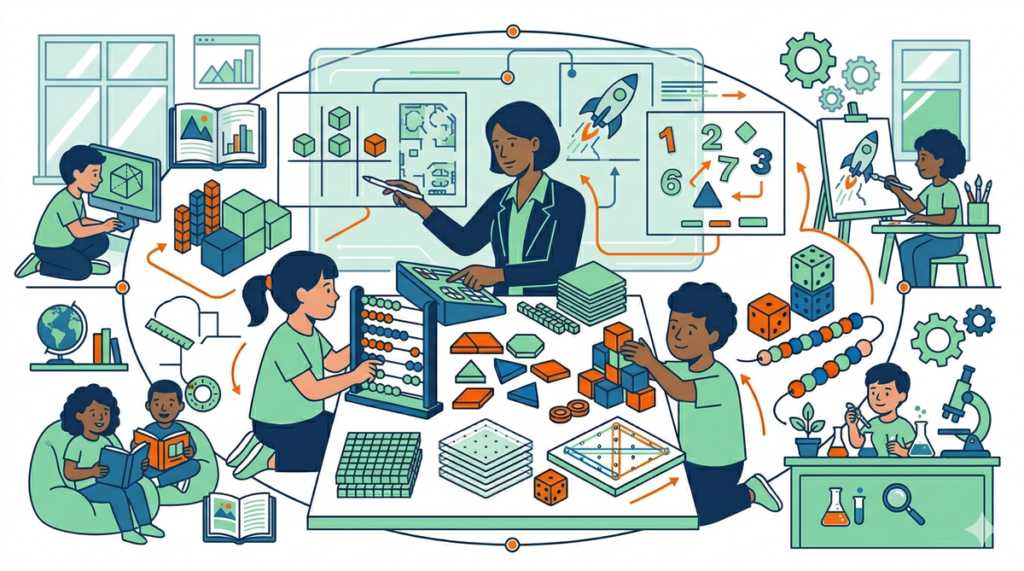
Instead of uniform teaching, this methodology promotes rotation through different corners, which facilitates personalized learning. For example, one center can focus on reading, another on manipulative math, and another on creativity or problem-solving.
Can you imagine a classroom where every student is actively involved in their own learning process? That's precisely what learning centers aim for.
Furthermore, this strategy is closely related to approaches such as the active classes and project-based learning, where the student is the protagonist.
Benefits of learning centers in active classrooms
Implement learning centers In the classroom, it has multiple benefits for both teachers and students. Not only does it improve class dynamics, but it also enhances key skills.
Among the main benefits are:
- Fostering autonomy Students make decisions about their learning.
- Attention to diversity: allows activities to be adapted to different levels.
- Greater motivation learning becomes more dynamic and engaging.
- Collaborative work Social skills are strengthened.
Furthermore, the learning corners It helps optimize the teacher's time, allowing them to dedicate more attention to specific groups while the rest work independently.
The result? A more organized, participatory, and student-centered classroom.
How to create learning centers step by step
Design learning centers effective, it's not complicated, but it does require planning. Here's a simple process to implement them successfully:
- Define clear objectives: Each center should have a specific goal, such as reading, math, writing, or experimentation.
- Organize the space: Divide the classroom into clearly defined zones. You don't need a lot of space, just visual clarity.
- Prepare accessible materials: Ensure students can work autonomously without constantly depending on the teacher.
- Set standards Define clear rules on rotation, timings, and behavior.
- Evaluate and adjust Observe how the centers function and make continuous improvements.
This approach transforms the classroom into a dynamic environment where learning flows naturally.
If you want to further optimize activity management and tracking, you can rely on digital tools such as Didaktos, which facilitate classroom organization and student progress.
Practical ideas for learning corners
One of the keys to the success of learning centers is the variety. Here are some ideas you can easily implement:
- Reading Center Books adapted to the student's level.
- Math Center Manipulative games and challenges.
- Creative Center drawing, writing, or crafts.
- Digital hub Use of tablets or educational platforms.
These learning corners allow students to explore different areas while developing key skills.
What if your students eagerly anticipated their chance to rotate centers? That's the magic of this methodology.
Common mistakes and how to avoid them
Although the learning centers they are very effective, it's important to avoid some common mistakes:
- Lack of organization can generate chaos in the classroom.
- Unclear activities: They hinder autonomy.
- Too many centers: It's better to start with a few and expand.
The key is to start simply and improve with practice. Remember that each classroom is different and requires specific adjustments.
Conclusions
The learning centers are a powerful strategy for transforming the classroom into a dynamic, inclusive, and student-centered space. Through learning corners and the active classes, it is possible to foster autonomy, improve motivation, and address diversity.
Implementing them does not require major resources, but rather good planning and a willingness to innovate. If you are looking to take the next step in your teaching practice, integrating this methodology can make a big difference.
Would you like to better manage your activities and enhance your learning centers? Discover tools like Didaktos and take your classroom to the next level.
 Español de Puerto Rico
  English