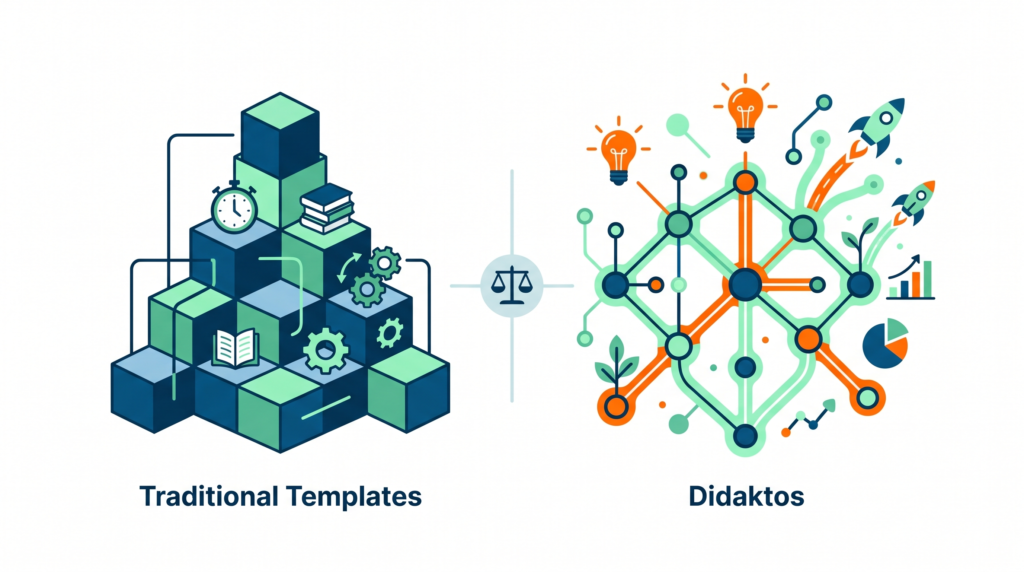
In today's educational world, efficient planning is key to teaching success. However, many teachers still rely on traditional templates that are time-consuming and limit creativity. This is where an innovative alternative emerges: Didaktos. But is it really worth the change? In this guide Didaktos vs. Traditional Templates: Full Comparison, we will thoroughly analyze both options to help you make the best decision. You will discover their differences, advantages, disadvantages, and which one best suits your needs as a primary school educator. If you are looking to optimize your time and improve the quality of your classes, keep reading because this comparison could mark a before and after in your teaching methods.
Table of Contents
- What are traditional templates?
- What is Didaktos and how does it work?
- Didaktos vs. Traditional Templates: Key Differences
- Actual benefits for primary school teachers
- Which one should you choose?
What are traditional templates?
Traditional templates have been the primary tool for lesson planning for years. These are pre-designed documents, generally in Word, PDF, or paper format, that teachers use to structure their classes.
Although they are useful, they present several limitations:
- They are neither adaptive nor intelligent.
- They require a lot of manual editing.
- They don't offer pedagogical suggestions.
- They hinder quick customization
In the current context of STEM education, where innovation and flexibility are key, these templates can fall short. How many times have you had to redo a plan from scratch?
Despite their simplicity, they are still widely used because they are familiar. However, that comfort might be holding back your productivity.
What is Didaktos and how does it work?
Didaktos is an educational platform designed to transform the way teachers plan their lessons. Unlike traditional templates, it uses advanced technology to generate pedagogical content in seconds.
Its operation is simple:
- Enter the learning objective
- You select the educational level
- The tool generates a complete plan
In this comparison Didaktos vs. Traditional Templates: Full Comparison, One of the most outstanding points is automation. Didaktos not only saves time but also improves content quality.
Furthermore, it is aligned with modern methodologies such as STEM in elementary school, Project-based learning and key competencies.
The result? More dynamic, structured, and effective classes.
Didaktos vs. Traditional Templates: Key Differences
When we analyze Didaktos vs. Traditional Templates: Full Comparison, the differences are clear and significant.
Planning time
Traditional templates require hours of work. Didaktos reduces this time to minutes.
2. Personalization
While templates are rigid, Didaktos automatically adapts content to your needs.
3. Pedagogical Quality
Didaktos integrates modern teaching approaches, while templates are completely dependent on the teacher.
4. Innovation
Didaktos is designed for the future of education, especially in areas such as importance of STEM.
Ultimately, this comparison of Didaktos vs. Traditional Templates: Full Comparison Show that educational technology can make a big difference in the daily lives of teachers.
Actual benefits for primary school teachers
Adopting Didaktos is not just about convenience, but about real impact in the classroom.
Some key advantages include:
- Significant time saving
- Improvement in class quality
- Greater focus on student learning
- Ease of integration STEM education
Imagine spending less time planning and more time teaching. Wouldn't that be ideal?
Furthermore, Didaktos allows experimentation with new methodologies without complications, something difficult to achieve with traditional templates.
In this comparison Didaktos vs. Traditional Templates: Full Comparison, it's clear that the main benefit is efficiency without sacrificing quality.
Which one should you choose?
The choice between Didaktos and traditional templates depends on your objectives as a teacher. However, if you are looking for innovation, speed, and better results, the answer is obvious.
Traditional templates can serve as a starting point, but Didaktos offers a complete solution tailored to current educational needs.
In this guide Didaktos vs. Traditional Templates: Full Comparison, We've seen that technology doesn't replace the teacher, but rather enhances their work.
👉 Start now and transform how you plan lessons:
Start for free with Didaktos
Conclusions
The comparison Didaktos vs. Traditional Templates: Full Comparison Here's a clear conclusion: Education is evolving, and so should the tools.
Didaktos not only saves time, but also improves educational quality and facilitates the integration of modern methodologies like STEM in primary school.
If you want to take the next step in your teaching practice, don't wait any longer.
🚀 Access Didaktos now and start creating classes in minutes:
https://didaktos.io/es
 Español de Puerto Rico
  English