
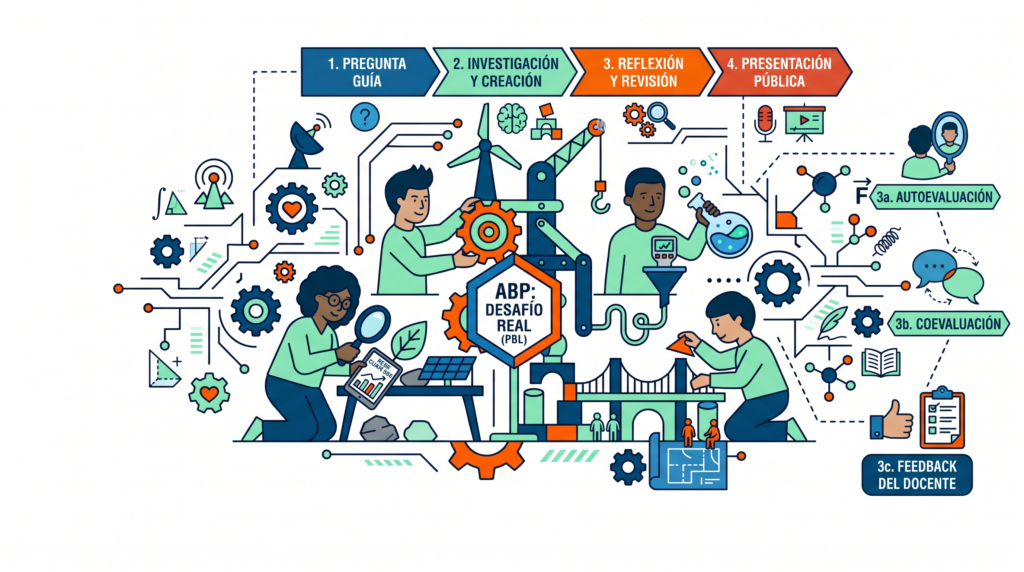
In today's educational landscape, teachers face the constant challenge of motivating adolescents who demand a real connection between what they learn and the world around them. This is where the Problem-based learning middle school it emerges not only as a teaching technique but as a teaching philosophy that places the student at the center of the action. By proposing real and complex challenges, we transform the classroom into a laboratory of ideas where theory becomes the necessary tool to find effective solutions.
The transition from traditional teaching to an active methodology may seem overwhelming, but the impact on student engagement is immediate. By working under this approach, we are not just transmitting data; we are teaching how to process, analyze, and propose. In this article, we will explore how to bring this methodology to the secondary classroom in a professional and structured manner.
What is secondary problem-based learning?
The Problem-based learning middle school It is an active methodology where the process of knowledge acquisition occurs through the resolution of a real-life, complex, and often open-ended problem. Unlike the traditional model, where the teacher delivers information and it is then applied in an exercise, in PBL, the problem is the starting point and the driving force of learning.
For students between 12 and 18 years old, this methodology implies a fundamental role change: they stop being passive recipients and become researchers, analysts, and critics. The teacher, for their part, acts as a facilitator or mentor who guides the inquiry process without providing final answers, encouraging students to identify what they need to learn to solve the proposed challenge. It is a transition from «teaching to know» to «learning to solve.».
Importance of problem-based learning in secondary school
implement Problem-based learning middle school it is crucial for various pedagogical and psychological reasons adapted to the adolescent stage:
- Development of critical thinking: Students learn to evaluate sources, contrast data, and question premises, vital skills in the age of information overload.
- Increase in intrinsic motivation When working with real-world problems (like climate change, household economics, or technological ethical dilemmas), student interest increases exponentially as they see the usefulness of what they've learned.
- Fostering autonomy ABP requires students to manage their own time and learning resources, preparing them for higher education and the 21st-century work environment.
- Social-emotional skills Team problem-solving improves communication, negotiation skills, leadership, and empathy among peers.
Key concepts the teacher must master
For the methodology to be effective and not turn into a chaotic group activity, the teacher must master certain fundamental pillars:
- The ill-posed problem: A good PBL problem should not have a single correct solution or a direct path. It should be ambiguous enough to allow for multiple approaches and discussions.
- Scaffolding: It is the temporary and adjusted support that the teacher provides while the student develops competence. It is progressively withdrawn as the student gains autonomy in their process.
- Guided inquiry: It's not about leaving the student alone; it's about guiding them through Socratic questions that lead them to discover their own knowledge gaps and seek the necessary information.
- Process evaluation: In PBL, the final outcome is important, but the research process, the evolution of thought, and collaboration are even more so.
Practical strategies for the classroom
If you want to start applying the Problem-based learning middle school, consider these strategies for structuring your sessions professionally:
First, dedicate time to designing the scenario. The problem should be connected to the official curriculum but disguised as an intriguing everyday or professional situation. For example, instead of studying «density» in isolation, pose the challenge of why certain pollutant residues float in the local river while others sink, affecting the bottom-dwelling fauna.
Second, use the «three steps of inquiry» technique: What do we know? What do we need to know? and How can we find out? This structure helps adolescents organize their thinking, which is often chaotic at first, and establish a concrete and executable action plan.
Third, encourage role rotation within work groups. Don't let the same student always take on leadership or writing responsibilities. Rotation ensures that everyone develops diverse skills, from conflict management to technical information synthesis.
Ready-to-use activities
Here are three practical proposals you can adapt to different subjects within the framework of Problem-based learning middle school:
- Activity 1: The Urban Planner's Dilemma (Geography and Mathematics). Students are given a map of a neighborhood with serious traffic congestion and a lack of green spaces. They must propose an urban restructuring with a limited budget, mathematically justifying their decisions and considering the environmental and social impact.
- Activity 2: History Detectives (History and Language). An old letter is presented as «found» in the school's basement. Students must act as historians and paleographers to determine its authenticity, the historical context in which it was written, and what it reveals about local life during that specific era.
- Activity 3: Eco-Entrepreneurs in Crisis (Biology and Economics). A fictional cosmetics company has been accused of contaminating an aquifer. Students will be divided into roles: company scientists, environmental activists, and judges. They will need to research chemical processes, propose filtration solutions, and debate their economic feasibility in court.
Recommended materials
To carry out these dynamics successfully, it is advisable to have a varied toolbox of pedagogical resources.
- Research logs Notebooks (physical or digital) where each student records their daily findings, questions, and personal reflections on the project's progress.
- Graphic organizers Concept maps, cause-and-effect diagrams (Ishikawa), and digital collaborative whiteboards for visualizing connections between complex ideas.
- Access to primary sources: Digital libraries, simplified scientific articles, or current press news that serve as a basis for research.
- Resource Generators Tools for quickly creating structured work guides that don't limit student creativity but provide a frame of reference.
Evaluation and suggested rubrics
Evaluate the Problem-based learning middle school requires moving away from the traditional memorization exam. The use of holistic rubrics that consider the following performance criteria is suggested:
Research Criterion: Evaluate the ability to locate, filter, and synthesize information from diverse sources. Collaboration Criteria: Measure the level of active participation, respect for others' opinions, and role management. Solution Criteria Evaluate the originality, technical feasibility, and theoretical grounding of the final proposal submitted.
It is vital to include self-assessment and peer assessment sessions. Adolescents are often very insightful regarding their own performance and that of their peers, which leads to deep self-reflection on their study habits and teamwork skills.
Common mistakes and how to avoid them
Many teachers get frustrated in their first attempts with this methodology. Here's how to avoid the most common mistakes:
- Error: The problem is too simple. If the student can find the answer with a quick Google search, there's no challenge. Make sure the problem requires deep analysis and the connection of multiple concepts.
- Error: No clear deadlines defined. Teenagers can get lost in endless research if there's no time structure. Set weekly milestones with small, partial deliverables to maintain momentum.
- Error: Intervening too soon. As teachers, we sometimes want to «save» the group when they get stuck. It's important to allow them to experience productive frustration; it's in that moment of searching for a way out where the most significant learning occurs.
- Error: Unlink from curriculum. ABP is not an extracurricular activity for Fridays; it should be the vehicle for covering official content. Always map which learning standards you are working on in each phase of the problem.
Conclusion
The Problem-based learning middle school It is not simply an educational fad; it is a necessary response to the demands of the 21st century. By implementing this methodology, we are equipping our students with the cognitive and emotional tools necessary to face a professional and personal future that is inherently uncertain and complex. Although the initial design requires more time from the teacher, the reward in terms of student engagement and depth of learning far outweighs the effort invested.
To generate printable materials related to this topic, visit Didaktos.io.
 Español de Puerto Rico
  English