
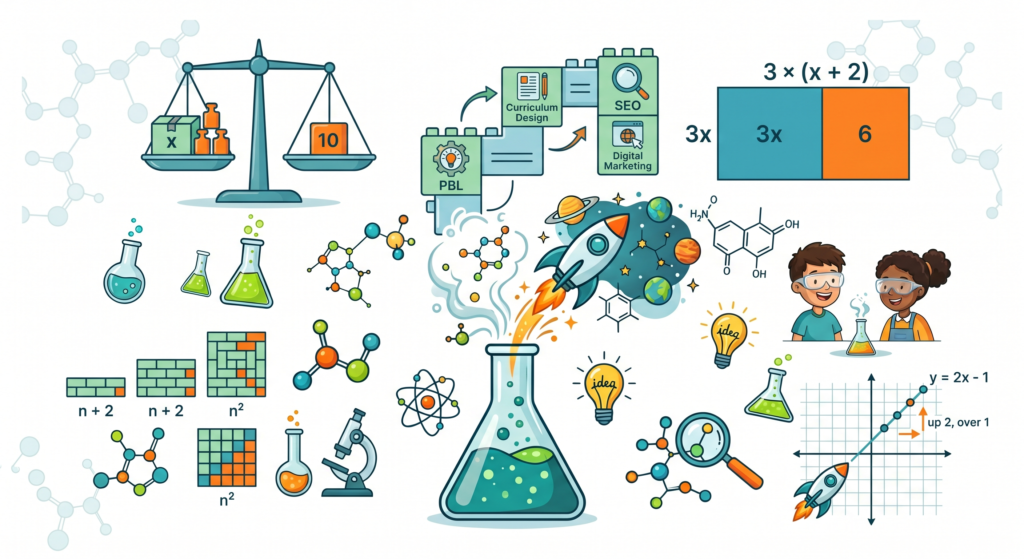
One of the biggest challenges math teachers face is the transition from arithmetic to abstract thinking. For many students between the ages of 12 and 18, the introduction of incomprehensible letters and symbols leads to frustration and the dreaded «math anxiety.» This is where the Visual Algebra Secondary it becomes a transformative pedagogical tool. By translating abstract equations into graphical and tangible representations, teachers can build a cognitive bridge that allows students to understand the «why» behind the formulas, rather than merely memorizing mechanical procedures.
In this extensive article, we will explore how to implement a visual approach in your math classes, breaking down pedagogical strategies, fundamental concepts, and practical methodologies. Our goal is to provide you with a solid framework that facilitates the teaching of Algebra for teens, ensuring that all your students, regardless of their learning style, can master this crucial subject.
What is secondary visual algebra?
The Visual Algebra Secondary It is a didactic approach that uses graphic representations, geometric models, and manipulable materials to illustrate abstract algebraic concepts. Instead of starting directly with the manipulation of variables (like the traditional x or y) on paper, this method begins the learning process by showing how those variables represent physical quantities, areas, or balance relationships in the real world.
This approach is deeply rooted in the Concrete-Pictorial-Abstract (CPA) method. In the concrete phase, students manipulate physical objects; in the pictorial (visual) phase, they draw diagrams or use graphic representations; and finally, in the abstract phase, they translate that visual understanding into traditional mathematical symbols. By applying visual algebra, concepts such as factoring polynomials, solving linear equations, or understanding quadratic functions cease to be a set of arbitrary rules and instead become logical, visual puzzles that the adolescent brain can process much more easily.
Importance of visual algebra in secondary school
The secondary education stage is a critical time in students' cognitive development. During these years, the brain is fully maturing, and the capacity for abstract thinking is still developing. Therefore, the importance of Visual Algebra Secondary It lies in its ability to adapt to the neurological and psychological needs of adolescents.
Reducing cognitive load: Traditional algebra requires students to hold multiple rules and steps in their working memory simultaneously. By using visual models, we externalize some of that cognitive load onto paper or manipulable objects, freeing up mental space for the student to focus on problem-solving.
2. Preventing math anxiety: Presenting a wall of equations to a teenager can immediately create a mental block. Visual representations are far less intimidating and foster a growth mindset, allowing the student to see math as a game of patterns and constructive shapes.
3. Deep understanding vs. memorization: Many students learn to «move the x to the other side by changing the sign» without understanding why they do it. A visual approach, like the balance scale model, teaches them the fundamental principle of mathematical equality. If they grasp the image, they will never forget the abstract rule.
4. Classroom Inclusion: Teenagers have diverse learning styles. Algebra for teens Visual instruction is especially beneficial for neurodivergent students, students with ADHD, or those with dyscalculia, as it provides an alternative pathway to standard mathematical language.
Key concepts the teacher must master
To successfully apply visual algebra, teachers must not only know the mathematical topics but also master the underlying visual metaphors. Here, we detail the key pedagogical concepts:
- The balance scale model for equations: It is imperative that the teacher master how to represent linear equations using the concept of balance. Both sides of the equals sign represent the pans of a scale; any operation performed on one side must be replicated exactly on the other to maintain balance.
- The area model for multiplication and factoring: This concept uses geometry (base times height equals area) to explain the distributive property, binomial multiplication, and polynomial factorization. It's the perfect visual alternative to the mechanical (FOIL) method.
- Multiple representations: The teacher must be able to fluidly move between four representations of the same concept: the verbal (a problem in words), the graphical (a drawing or Cartesian plane), the tabular (a table of values), and the algebraic (the equation).
- Strategic Use of Color: Mastering color coding is vital in visual algebra. For example, always use red for negative values and blue for positive ones, or assign a specific color to the variable x and a different one to the variable y.
Practical strategies for the classroom
Taking theory to practice requires intentional structuring of your classes. So that algebra activities function under this approach, we recommend implementing the following methodological strategies:
Progressive scaffolding Always start by solving a problem with real objects or manipulative blocks. Once they master this, have them draw the problem. Only when the drawing is clear and understood by everyone, introduce formal algebraic notation alongside the drawing, connecting each symbol to its visual representation.
The «Think, Draw, Share» approach: Instead of asking students to solve an equation immediately, ask them to draw what that equation looks like. Then, they should discuss their drawings in pairs. This verbalization of the visual model greatly reinforces the logical understanding of the procedure.
Gamification visualization: Transform solving equations into a geometric detective game. Use puzzles where pieces (like algebraic logic blocks) must fit together to form perfect rectangles when factoring quadratic trinomials. Learning becomes tactile and highly engaging.
Ready-to-use activities
Here are three algebra activities highly visual and effective, designed to capture the attention of students aged 12-18 and solidify their learning:
- Activity 1: «The Equation Balance» (Ages 12-14): Draw a large balance scale on the whiteboard. Use colorful sticky notes (post-its). The square notes represent the unknown «x» and the small circular notes represent numerical units (1). To solve 3x + 2 = 11, place 3 square notes and 2 circular notes on one pan, and 11 circular notes on the other. Ask students to «remove» the same amount of circular notes from both sides (subtracting 2) and then divide equally to discover the value of the square.
- Activity 2: «The Area Puzzle for Binomials» (Ages 14-16): To teach the multiplication of (x + 3)(x + 2), use graph paper. Ask students to draw a rectangle whose base is «x» (an unknown length) plus 3 units, and whose height is «x» plus 2 units. By dividing this large rectangle into sections, they will clearly visualize that the total area is x² + 2x + 3x + 6. It is a visual revelation that eliminates the need for rote memorization of formulas.
- Activity 3: «Art with Functions in Desmos» (Ages 16-18): Using graphing calculators, propose the challenge of drawing a face, a landscape, or their favorite brand's logo using only algebraic equations. Students will need to apply function transformations, limit domains and ranges, and visually understand how changing a coefficient in a quadratic function makes the parabola (the «smile») wider or narrower.
Recommended materials
To apply the Visual Algebra Secondary In a professional manner, it is highly recommended to equip your classroom with a mix of physical and technological resources. Here are the essential materials:
Algebra Tiles They are small rectangles and squares made of plastic or wood, with different colors on each side (positive/negative). They are the ultimate tool for teaching factorization, polynomial addition, and solving first and second-degree equations in a completely hands-on way.
Individual Whiteboards Providing each student with a small whiteboard and markers allows them to quickly erase and redraw visual models, reducing the fear of making mistakes on paper and pen.
Digital Tools Platforms like GeoGebra or Desmos are fundamental. They allow for the creation of dynamic simulations where students can slide a control and instantly see how the graph of a linear or quadratic equation changes.
Evaluation and suggested rubrics
Adopting a visual methodology means that assessment must also change. We can't just grade whether the final result (e.g., x=4) is correct or incorrect. We must assess the thinking process.
For your evaluation rubrics in Algebra for teens, include the following criteria:
1. Use of the Visual Model: Is the student able to draw an accurate diagram representing the equation or problem presented?
2. Symbolic Connection: Does the student correctly connect the steps of their drawing with the corresponding formal algebraic steps?
3. Justification and Reasoning: Instead of just asking for calculations, include questions on the exam such as: «Use an area model to explain why (x+2)² does not equal x² + 4.» Evaluate the clarity of their written and graphical explanation.
Common mistakes and how to avoid them
Despite their numerous benefits, the introduction of visual models in math education has some pitfalls that teachers often fall into. Take note of these common mistakes to ensure success in your classroom:
Rushing towards abstraction: The most serious error is using manipulatives for only one day and then expecting students to solve entire pages of symbolic equations the next. The brain needs time to bridge the gap between the visual and the abstract. Allow students to use drawings or blocks for as long as they need.
Inconsistent visual metaphors If one day you use apples to explain «x» and the next day you use a balance scale model, and the day after that a geometric model for the same basic concept, you will create confusion. Choose a powerful metaphor (like «Algebra Tiles» or the balance scale) and be consistent with it throughout the entire teaching unit.
Visually ignore negative numbers It is vital to have a clear visual representation for negative numbers from day one. If you use chips or colors, make sure they understand the concept of «zero pairs» (a positive chip and a negative chip cancel each other out) before moving on to complex equations.
Conclusion
Transforming abstract teaching through Visual Algebra Secondary it is one of the greatest gifts a teacher can give their students. By adopting these graphical and manipulative models, we are breaking down the barriers of math anxiety and building deep, logical, and intuitive understanding. Integrating algebra activities based on visualization not only makes the class more accessible and entertaining, but it empowers teenagers, showing them that math is not an incomprehensible language, but a fascinating way to describe the balance and shapes of our world.
To generate printable materials related to this topic, visit Didaktos.io.
 Español de Puerto Rico
  English