
Teaching is not just “explaining”: it is designing experiences for the student to understand, practice and transfer what has been learned. This guide brings together active methodologies and key approaches (PBL, problems, cooperative, flipped classroom, stations, gamification, SAD, thinking routines, social-emotional education and more), with examples and concrete steps to apply them in the classroom without in the classroom without complicating things for you.
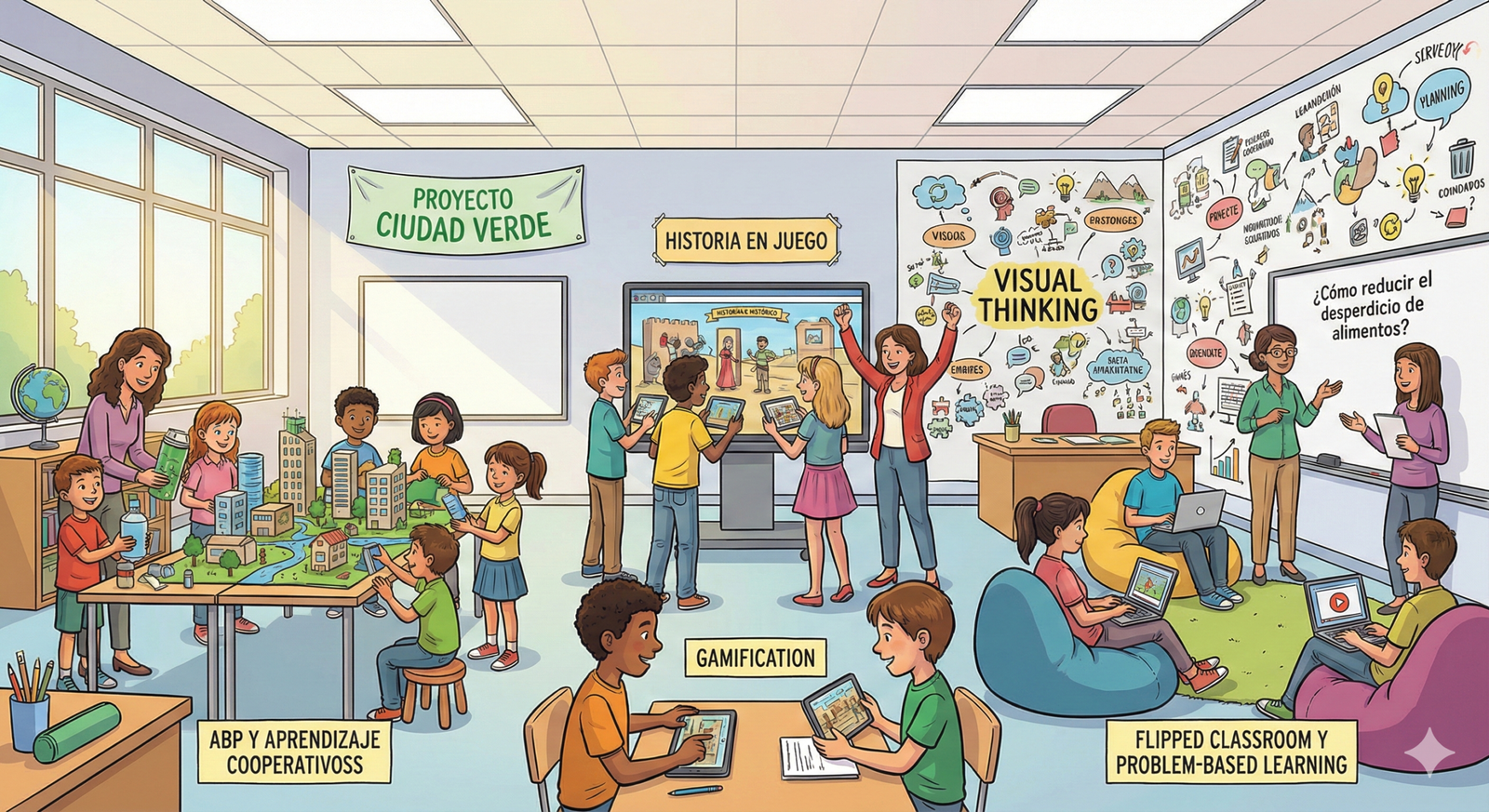
Table of Contents
- What are educational methodologies?
- How to choose the best methodology for your group
- Principles of an effective classroom (any subject)
- Methodologies explained with examples
- Formative evaluation (not relying only on exams)
- STEM Section: how to apply these methodologies in STEM projects
- 6-step route to implementation
- Resources and materials
- Frequently Asked Questions (FAQ)
What are educational methodologies?
The educational methodologies are ways to organize teaching to achieve more effective learning. They define how learning takes place (not only what is learned): what the students do, what the teacher does, what materials are used, how they work in teams, and how progress is checked.
In primary and secondary school, a good methodology helps to answer key questions: how do I maintain attention, how do I build real understanding, how do I include everyone, how do I evaluate fairly?
- Active methodologies: the student participates, explores, creates and reflects.
- Inclusive approaches: barriers (SAD) are reduced and real options are offered.
- Thinking strategies: routines and structures for reasoning with evidence.
- Socioemotional practices: classroom climate, self-regulation and collaboration.
Key idea: the “best methodology” is the one that fits your target, your time, your group and your context (materials and support).
How to choose the best methodology for your group
You don't need to apply “everything at once”. The most effective is to combine methodologies in a simple model: activation → learning → practice → evidence → closure. To make the right choice, consider these 5 variables:
Looking for insight, practice, creativity, collaboration, critical thinking or habits?
Do you have 40 minutes or 3 sessions? (Stations and mini-challenges work very well with little time).
Primary: more guided and visual. Secondary: more research, debate, data and defense of ideas.
What materials do you have? Much can be done with simple, reusable resources.
Plans options (SAD), supports and alternative formats to demonstrate learning.
Start with a “light” methodology (stations, cooperative, routines) and then scale up to PBL or problems.
Tip: if your class feels “passive,” add 1 change: a thinking routine or a mini-practice station.
Principles of an effective classroom (any subject)
Regardless of methodology, these principles increase the likelihood of success in primary and secondary school:
- Clarity: objective visible and explained in the language of the student.
- Activation: connects with the previous (question, image, example, mini-challenge).
- Scaffolding: small steps, examples, templates, checklists.
- Participation: everyone does something (they don't just “listen”).
- Practical: exercises, experiments, writing, resolution and review.
- Feedback: brief feedback during the process (not only at the end).
- Inclusion (DUA): options for learning and demonstrating learning.
- Closing: synthesis + reflection + “next step”.
Methodologies explained with examples (primary and secondary)
Here is a clear explanation of each approach, with ideas that you can apply to any subject. The key is to start small: one methodology per week, or a simple combination per session.
1) Project Based Learning (PBL)
PBL proposes that students learn while they build a final product to answer a question or challenge. It works very well when the project is divided into milestones (steps) and each milestone has a brief evidence.
- Primary: “Design a poster to save water” (observation + messages + simple measurement).
- Secondary: “Create a campaign with data” (survey, graphs and proposal with arguments).
- Product: poster / mock-up / brief report / presentation with evidence.
2) Problem Based Learning
The starting point here is a case (real or simulated situation). The student analyzes what he knows, what he needs to learn, researches and proposes justified solutions. It is excellent for critical thinking, source reading and decision making.
- Example (Social): “How to reduce school traffic” (proposals and criteria).
- Example (Science): “School garden performance drops: why?” (diagnosis and plan).
3) Cooperative learning (well-designed teams)
It's not just “team building”. It requires roles, It provides clear goals, timelines, standards, and a fair way to verify input. It is ideal for labs, discussions, projects, collaborative writing and problem solving.
- Simple roles: coordinator, registrar, verifier, spokesperson.
- Tip: short co-evaluation + individual evidence (logbook or ticket).
4) Flipped Classroom (Flipped Classroom)
The basic content is reviewed beforehand (short video or guided reading) and the class is devoted to active practice: solving, writing, experimenting and receiving feedback. It works very well if there is a short check at the beginning.
- Primary: video 3-5 min + practice at stations.
- Secondary: short reading + mini-quiz + resolution workshop or lab.
5) Station-based learning
Stations organize the class into rotations with short tasks. They help to maintain rhythm, differentiate and different styles. Very useful when you have diverse groups or need intensive practice.
- Example (Language): station reading, writing, vocabulary, review with rubric.
- Example (Mate): problems, manipulatives, challenge, strategy explanation.
6) Gamification
Use game dynamics to motivate practice and perseverance. The most important thing is that the “game” is connected to the learning learning: leveled challenges, missions, badges for skills, feedback and visible progress.
- Example: “Writing assignments” (idea → draft → revision → revision → publication).
- Tip: rewards evidence of mastery (not just participation).
7) Inquiry-based learning
It starts with questions and guides the student to investigate with evidence. In science it is natural, but it is also useful in social social studies, language (text analysis) and mathematics (discovering patterns). Structure helps: question → hypothesis/idea → search → evidence → conclusion..
8) UDL (Universal Design for Learning)
DUA reduces barriers and offers real options to participate and demonstrate learning. Keeps expectations high, but changes the “pathway” for more students to reach. Examples: accessible materials, visual supports, delivery format options, and diverse forms of participation.
- Practical rule: same rubric, different formats (poster, audio, video, mock-up).
9) Direct teaching (well used) + thinking routines
There are times when a brief and clear explanation is best, especially for fundamentals. The secret is to keep it short followed by active practice. Thinking routines help students explain and argue: I See-I Think-I Wonder, Affirmation-Evidence-Reasoning, I used to think / now I think.
10) Social-emotional education and art-based learning.
A classroom with active methodologies needs social-emotional skills: self-regulation, listening, teamwork and respect. Integrating social-emotional practices (short circles, breathing, agreements) improves coexistence and learning. The art-based approach (infographics, dramatizations, visual maps) helps to understand and express complex ideas.
Formative assessment: how to measure progress without relying only on tests
Formative assessment is a system of “small pieces of evidence” that allows you to adjust in time. In primary and secondary school it works especially well because it reduces anxiety and improves results.
Initial question, mini-quiz, prediction, brainstorming or quick example.
Checklist, observation, peer review, brief and specific feedback.
Final product + reflection: what I learned, what evidence I have, what I would improve.
Simple rubric (ready to copy)
| Criteria | Initial | In progress | Achieved |
|---|---|---|---|
| Comprende | He explains with confusion. | Explain with support. | Explain with clarity and examples. |
| Applies | Try without strategy. | Applies with some errors. | Apply correctly and justify. |
| Evidence | No clear evidence. | Includes basic evidence. | Uses evidence (data / quotes / examples) to support ideas. |
| In collaboration with | He participates little. | Collaborate with a guide. | Collaborate, respect roles and improve teamwork. |
STEM section: how to apply these methodologies in STEM education
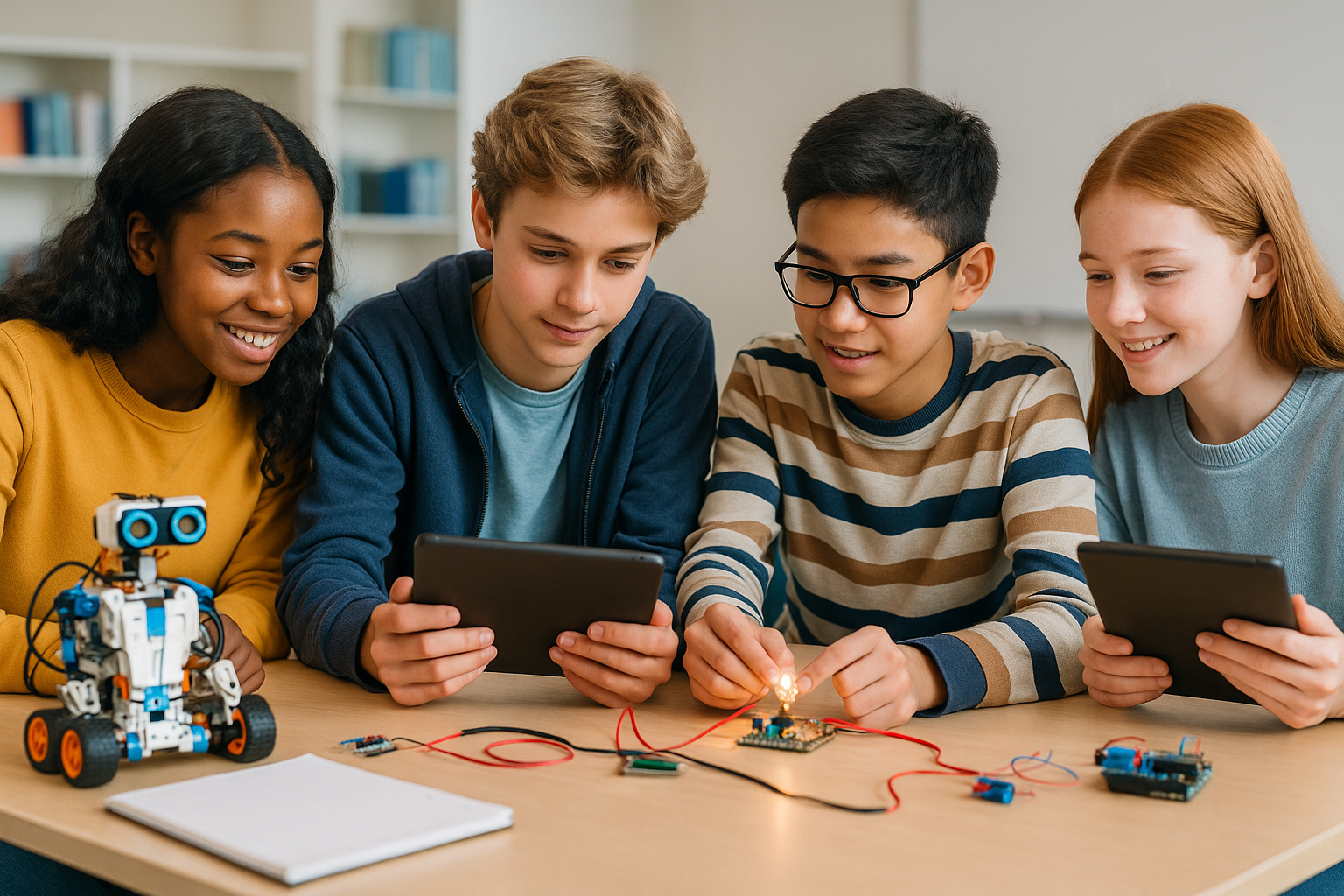
STEM is not a unique methodology: it is a integrative approach which benefits from various methodologies. What is essential in STEM is that the student explore, design, test, record data, and communicate. You can apply STEM in elementary and middle school with short projects, design challenges, and researchable questions.
- Guiding question: How can we...?
- Challenge: building/improving a prototype or explaining a phenomenon with evidence
- Data: measure, compare, record in table and/or graph
- Iteration: test → adjust → retest
- Communication: poster, demo, logbook, short presentation
- Primary: paper bridge (strength and materials) + load table.
- High primary: water filter (layers and evidence) + design improvement.
- Secondary: home energy (simple audit) + proposal with data.
- Secondary: crop and variables (light/water) + graphs and conclusions.
Winning combinations for STEM (easy to implement)
- Inquiry + stations: 3 experimentation stations + 1 analysis station + 1 communication station.
- PBL + cooperative: project with roles and checklist by milestones (design, construction, evidence, presentation).
- Inverted classroom + guided practice: basic content before + lab/challenges in class.
- DUA + competencies: same expectations, different ways of demonstrating learning.
6-step path to implement them (without overwhelming you)
This path works for any subject and for STEM. Use it for one session, one week or one unit.
| Step | What you do | Rapid evidence | Suggested time |
|---|---|---|---|
| 1) Define objective | “The student will be able to...” (observable, clear and short). | Visible objective in the classroom | 10-15 min |
| 2) Active | Question, image, mini-challenge or example that connects. | Prediction / initial idea | 5-8 min |
| 3) Teaches the minimum | Mini-lesson or modeling (what is necessary to advance). | Solved example / template | 10-15 min |
| 4) Active practice | Stations, cooperative, inquiry or problem. | Table / draft / prototype | 15-25 min |
| 5) Feedback | Reviews and corrects during (teacher, peers, self). | Checklist / feedback | During |
| 6) Closing | Synthesis and reflection: “what I learned and with what evidence”. | Departure ticket | 5-10 min |
Suggested internal links (anchor + relative URL)
- Active methodologies (guidelines and examples)
- PBA: projects ready for implementation
- SAD and inclusive education
- STEM Education (dedicated section/page)
External links (authorized sources)
Resources and materials (economic and effective)
Many methodologies do not rely on expensive equipment. What is essential is to have reusable materials, clear routines and a simple evidence system (logbook, charts, tickets).
- Role cards (cooperative) and station cards
- Templates: checklist, simple rubric, exit ticket
- Manipulatives: ruler, stopwatch, cardboard, ribbon, bottles, paper clips
- Student's logbook (paper or digital)
- Visual maps and infographics (art-based learning)
- Example models (before/after) for quality improvement
- Question bank guide by subject
- Rubrics by level (Initial / In progress / Achieved)
Frequently Asked Questions (FAQ)
What methodologies are best for primary school?
Stations, multisensory learning, guided cooperative learning, simple inquiry and mini-projects (short PBL) work very well in primary school, because they maintain pace, participation and visible evidence.
How do I adapt active methodologies for secondary school?
Increase rigor with evidence: data (tables and graphs), sources, arguments, roles, clear criteria and defensible products (presentation, short report, poster, debate). (presentation, short report, poster, debate).
How do I apply DUA without complication?
Offers 2-3 equivalent options (poster, video, audio, mockup) with the same rubric. Add simple supports: examples, templates, step-by-step instructions and accessible materials.
How do I evaluate without relying only on tests?
Uses formative assessment: exit tickets, checklist, observation, simple rubrics, logbook and brief products. Evaluates process + product.
How do I connect this to STEM education?
STEM is strengthened by combining methodologies: inquiry to investigate, PBL to create products, cooperative to work in teams, and DUA/competencies to include and evaluate fairly. Go to the STEM section for ready examples.
 Español de Puerto Rico
  English