
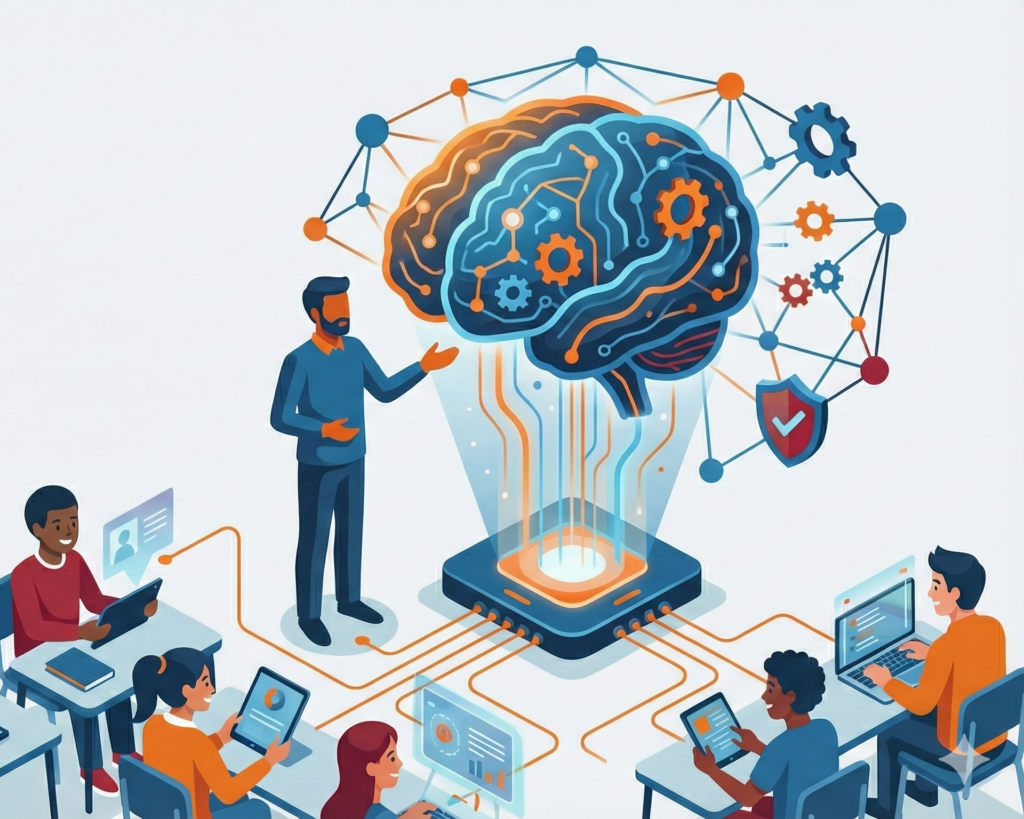
Teaching Digital Competence: The Silent Engine for Surviving the AI Revolution
Today, in the age of the Generative Artificial Intelligence, technology is no longer an exotic visitor in the school, but the very atmosphere where knowledge is breathed. In this article, we break down why your digital training is now the most reliable predictor of educational quality, surpassing even the student-teacher ratio, and how you can move from being a passive user to an architect of future learning.
Beyond Using Zoom: The New Mapping of Digital Competency
To navigate today's complexity, we must abandon the terminological dispersion of the past. We are no longer talking about simple «ICT skills»; we are talking about a structured and professionalizing framework. Today's gold standard is the European Framework for Digital Competence of Educators (DigCompEdu), adapted in Spain through the MRCDD.
The premise is revolutionary in its simplicity: it is not about mastering the «button», but mastering the pedagogical strategy behind the tool. The framework is divided into 6 interconnected areas that every modern teacher must master:
The 6 Critical Areas of MRCDD
- Area 1: Professional Commitment. It transcends the classroom. It involves using technology to coordinate with the center and communicate with families, breaking the historical isolation of the teacher.
- Area 2: Digital Contents. It's not just «Googling». It requires the ability to content curation, The company is also committed to the development of new products and services, assessing their scientific quality and respecting intellectual property and open licenses.
- Area 3: Teaching and Learning. The heart of the system. It involves orchestrating active methodologies such as collaborative or self-regulated learning mediated by technology, avoiding the replication of analogical models.
- Area 4: Evaluation and Feedback. The area with the greatest disruptive potential. Allows you to use learning analytics to identify difficulties before it is too late, moving from the «final grade» to continuous formative assessment.
- Area 5: Student Empowerment. Technology as a tool for equity. Facilitates the personalization of learning and attention to diversity through assistive technologies.
- Area 6: Student Competence Development. The meta-competency. Teachers must teach their students to be critical and creative digital citizens, not mere consumers.
2. The Illusion of Competition and the Cost of the «Talking PDF».»
There is a dangerous phenomenon known as the digital Dunning-Kruger effect. Although 90% of teachers claim to be comfortable with technology, an in-depth analysis reveals serious pedagogical shortcomings. Many confuse being an expert user of social networks with having teaching digital competence. Knowing how to upload a photo to Instagram does not qualify you to design a digital rubric or manage the privacy of minors.
Direct Impact on School Dropout Rates
This gap has real consequences. Recent studies (2023-2025) have found a direct causal relationship between the lack of digital skills of teachers and student dropout. The mechanism is psychological: the «talking PDF» methodology -forcing analog methods in digital environments- generates cognitive dissonance, boredom and disengagement in the digital native student.
On the other hand, teachers with advanced levels (B2-C1) manage to awaken an interest in intrinsic motivation by activating neurological attention and reward mechanisms through gamified and adaptive tools.
3. The Minefield: Ethics, Privacy and the «Shadow IT» Trap»
With digitization, schools have become big data processors. This is where the MRCDD Competency 1.5Data protection, privacy and security. It is not bureaucracy; it is the defense of the fundamental rights of minors.
Are you falling into the «Shadow IT»?
One of the most common mistakes is the use of shadow technology (Shadow IT). This occurs when a teacher, with good intentions but without legal knowledge, registers his students in a «free» application without the approval of the school.
- The risk: By accepting the terms and conditions without reading them, you could be giving behavioral data and cognitive profiles of minors to advertising data brokers.
- The golden rule: If the service is free, often the product is the student. The LOPDGDD establishes that autonomous digital consent in Spain is from the age of 14; before that, you require explicit parental consent.
- Data minimization: Collect only what is strictly necessary. Do you really need geolocation for a math app? If it's not essential, it's illegal.
4. Artificial Intelligence: The New Teaching Horizon
If the pandemic was an earthquake, the Artificial Intelligence (AI) is the tsunami that reconfigures the landscape. It is no longer enough to know how to search for information; it is now imperative to know how to «interrogate the machine» (prompt engineering) and verify its veracity.
The irruption of generative AI forces us to develop new critical competencies for the 2025-2030 period:
- Algorithmic Critical Thinking: Understand that AI can «hallucinate» and invent data. The teacher becomes the indispensable veracity filter.
- Evaluation of Processes, not Products: If AI can write a perfect essay in seconds, we should stop evaluating the end result and start evaluating the thought process, drafts and oral defense.
- The Teacher as a «Technological Humanist»: Skills that AI cannot replicate (empathy, emotional motivation, ethics) acquire a premium value. We must move from knowledge transmitters to life mentors.
The risk of an «AI gap» is real: a dual system where elite schools use AI to personalize learning, while disadvantaged schools ban it out of fear, leaving their students at a structural disadvantage.
Conclusion: Your Training is the Best Investment
Technology is a capital expense that depreciates; teaching competence is a human asset that is revalued. Investing in your digital training is not a fashion, it is the license to operate in contemporary education. By mastering these tools, you not only enhance your professional profile, but you protect your students and ensure that technology serves people, not the other way around.
Your opinion counts!
Which AI tool or digital strategy will you try in your classroom this week? Do you feel like a digital ‘Explorer’ or ‘Pioneer’? Tell us your level in the comments! 👇
 Español de Puerto Rico
 English