
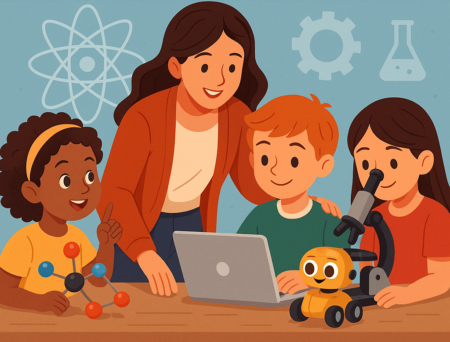
Practical, economical and fun ideas to awaken scientific curiosity in primary school children at home or in the classroom.
The science activities with homemade materials are an excellent way to bring science learning to children in a practical, inexpensive and fun way. Instead of relying on complex laboratories or expensive resources, it is possible to teach key concepts using everyday objects we have at home or in the classroom.
Can you imagine teaching chemical reactions with vinegar and baking soda or exploring density with ordinary liquids? This type of homemade experiments not only arouse curiosity, but also encourage critical thinking and creativity.
In addition, the science for children become more accessible when students can manipulate, observe and experiment on their own. In this article you will discover 20 easy-to-implement ideas that will transform your classes into memorable experiences. Ready to turn your classroom into a little science lab?
Table of Contents
Benefits of science activities with homemade materials
Implement science activities with homemade materials has multiple advantages for both teachers and families. First, it eliminates the economic barrier, allowing any student to participate without the need for specialized resources.
In addition, this approach encourages active learning. Instead of memorizing concepts, children directly experience scientific phenomena. This improves knowledge retention and strengthens skills such as observation and hypothesis formulation.
Another key benefit is motivation. Students tend to be more engaged when working with familiar elements - who doesn't get excited to see a homemade volcanic eruption?
It also allows the integration of different areas of knowledge, such as mathematics, language and technology, reinforcing an interdisciplinary approach.
In short, the science for children become more inclusive, dynamic and meaningful through these types of activities.
20 easy science activities with homemade materials
The following is a selection of science activities that you can easily implement in primary school or at home. They are simple, safe and very useful proposals to awaken interest in science.
Chemistry experiments
- Baking soda and vinegar volcano
- Inflating balloons with yeast
- Create homemade slime
- pH indicator with purple cabbage
- Salt crystals
Physics experiments
- Parachutes with plastic bags
- Air balloon race
- Telephone with glasses and rope
- Static electricity with balloons
- Construction of bridges with paper
Biology experiments and environment
- Seed germination in cotton
- Leaf observation and classification
- Mini ecosystem in bottle
- Water absorption in plants
- Small format composting
Other fun ideas
- Rainbow with water and light
- Density tower with liquids
- Floating egg in salt water
- Home water filtration
- Sundial
These activities combine fun and learning, turning any space into a laboratory. In addition, they allow the level of difficulty to be adapted according to the age of the student and the objective of the class.
Practical advice
Before starting, prepare a simple worksheet with three questions: what did we observe, what do we think will happen, and what did we learn. This reinforces scientific thinking from an early age.
How to apply science activities in primary school effectively
To make the most of the science activities, If you do not know how to do the experiment, it is important to follow some pedagogical strategies. First, pose questions before the experiment: what do they think will happen? This stimulates scientific thinking and gives meaning to the activity.
During the experience, encourage observation and recording of results. You can use experiment notebooks, visual worksheets or even drawings if you are working with younger children.
Then, promote reflection: Why did this result occur and was the initial hypothesis fulfilled? This moment is key to move from simple fun to meaningful learning.
It is also advisable to adapt the difficulty according to age. In primary school, the ideal is to prioritize exploration, curiosity and connection with everyday situations.
If you are looking for more structured resources to implement this type of proposal, you can explore educational tools such as Didaktos, where it is possible to find useful materials to enrich the teaching planning.
It's also important to encourage daily habits, such as reducing paper usage, reusing materials, or keeping common spaces clean. Small actions create big changes when they become routine.
If you're looking for more resources and tools to create educational activities quickly, you can explore platforms like Didaktos, where you'll find ready-to-apply ideas for the classroom.
If you want more ready-to-use ideas, you can also explore our collection of STEM activities for elementary school, where you'll find practical proposals that perfectly complement Earth Day.
Conclusions
Conclusions
The science activities with homemade materials are a powerful tool for teaching in a practical, accessible and fun way. They not only facilitate the understanding of scientific concepts, but also develop essential skills such as curiosity, observation and critical thinking.
Incorporate homemade experiments in the classroom or at home can make a big difference in the way children perceive science. When the experience is manipulative and hands-on, the learning becomes much more memorable.
Would you like to keep discovering resources and ready-to-use proposals? Explore more educational ideas on Didaktos and continue to enrich your classes with meaningful experiences.
Discover more resources for your classes
Find ideas, tools and educational proposals to continue innovating in the classroom.
Visit Didaktos Español de Puerto Rico
  English