Currently, the educational landscape is undergoing an unprecedented transformation. Secondary school teachers face the challenge of preparing young people between 12 and 18 years old for a job market that we do not yet fully know, but which demands high-level technical and cognitive skills. In this context, understanding What is STEM High School it is not just a pedagogical option, but an imperative necessity to ensure that our students develop the necessary competencies for the 21st century.
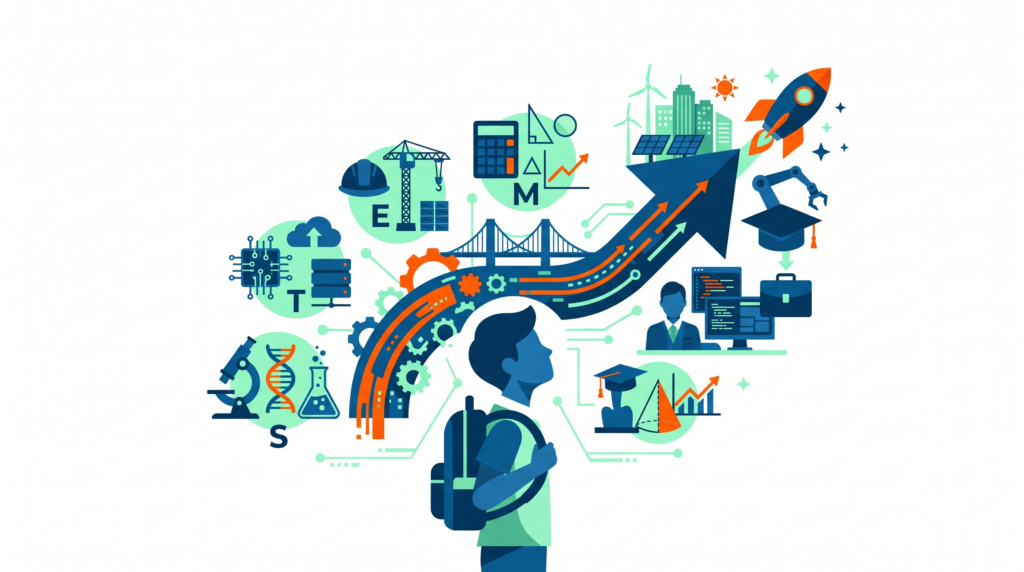
STEM is the English acronym for Science, Technology, Engineering, and Mathematics (Science, Technology, Engineering, and Mathematics). However, at the secondary education level, this concept goes far beyond the mere sum of these four subjects. It is an interdisciplinary approach that seeks to break down knowledge silos to teach adolescents how to solve complex real-world problems by integrating knowledge.
What is secondary STEM?
When we talk about What is STEM High School, we refer to a teaching-learning methodology that integrates science, technology, engineering, and mathematics into a single, cohesive curriculum. Unlike the traditional model, where each subject is studied in isolation, the STEM approach proposes that students learn through experimentation and design.
In middle and high school grades (ages 12-18), this approach is characterized by being eminently practical. It's not just about students memorizing physics formulas or math procedures, but about them understanding how engineering uses science and math to create technology that solves social or environmental problems. It is, in essence, a way to connect the classroom with daily and professional reality.
Importance of STEM in high school
The STEM Importance At the high school level, it lies in the developmental stage students are in. Between the ages of 12 and 18, students begin to define their professional identity and vocational interests. Introducing STEM in Secondary School effectively demystifies the idea that science is «difficult» or «boring,» fostering scientific curiosity that can lead to technical careers.
Besides, the STEM career outlook It is one of the sectors with the highest projected growth globally. Current companies demand profiles capable of performing data analysis, software development, designing sustainable infrastructures, or researching biotechnology. By working on these areas from secondary school, we are equipping young people with «transferable skills» such as critical thinking, resilience in the face of error, and the ability to work collaboratively, which are essential regardless of the career they ultimately choose.
Key concepts the teacher must master
To successfully implement this model, the teacher must transcend their specialty and master certain conceptual pillars that structure STEM education:
- Interdisciplinarity Ability to design activities where math learning objectives are met through a technology or science project.
- Project-Based Learning (PBL) It is the engine of STEM. Learning is born from a challenge or guiding question that requires in-depth investigation and the creation of a final product.
- Engineering Design Process (EDP): A cycle that includes defining the problem, imagining solutions, planning, creating a prototype, and improving. This cycle teaches that failure is a necessary part of learning.
- Computational Thinking More than just programming, it's the ability to break down problems, recognize patterns, and design algorithms to reach a solution.
Practical strategies for the classroom
To bring the focus STEM in Secondary School The classroom requires a role change from the teacher, who shifts from being an information transmitter to a facilitator of the process. Here are some practical strategies:
First, it's fundamental to contextualize the problems. Instead of asking students to calculate the speed of a moving object without context, invite them to design a safety system for a vehicle that must protect a «passenger egg» in a collision. This introduces engineering and design into a traditional physics class.
Second, foster cooperative work. In the real world, scientists and engineers rarely work alone. Create groups with specific roles (coordinator, researcher, designer, data analyst) so that students experience the dynamics of a real technical team.
Third, use technology as a tool, not as the end goal. You don't need state-of-the-art labs to do STEM; you can use free online simulators, sensor apps on mobile phones, or recycled materials to build engineering prototypes.
Ready-to-use activities
Here are three activity proposals designed for different high school levels that integrate STEM Importance in a practical way
- Activity 1: The Water Filtering Challenge (Ages 12-14). Students must design and build a water filter using natural materials (sand, gravel, charcoal) and recycled containers. They should measure the water's turbidity before and after, applying concepts from biology (ecosystems) and mathematics (efficiency percentages and volume).
- Activity 2: Prototyping a Sustainable City (Ages 14-16). Using 2D or 3D design tools (like Tinkercad), students design a neighborhood that optimizes solar energy use. They must calculate the sun's angle of incidence according to geographical location (geometry and geography) and propose technological solutions for water conservation.
- Activity 3: Climate Change Data Analysis (Ages 16-18). Using open databases, students must employ spreadsheets to identify temperature trends in their region over the last 50 years. They should present their findings through graphical visualizations and propose a small-scale engineering solution to mitigate a local effect.
Recommended materials
To enrich the experience of What is STEM High School, it is advisable to have a variety of resources that encourage experimentation:
Among the physical materials, basic robotics kits (like Arduino or Micro:bit), temperature and pH sensors, and simple construction materials (cardboard, balsa wood, hot glue guns) are essential. In the digital realm, the use of scientific simulation software (like PhET Interactive Simulations), block-based or code programming tools (Scratch, Python), and computer-aided design (CAD) platforms are vital.
Evaluation and suggested rubrics
Evaluating STEM projects requires moving away from traditional single-answer tests. Assessment should be formative and focus on both the process and the final product.
It is suggested to use a rubric that includes criteria such as:
1. Problem Identification Did the group understand the challenge presented?
2. Research and planning Did you use scientific sources to support your solution?
3. Prototyping and improvement How many versions of the project did you create, and how did you implement improvements after the first failure?
4. Reporting of results: Are you able to clearly explain the science behind your design?
5. Teamwork: Was the collaboration effective and equitable?
Common mistakes and how to avoid them
When implementing STEM in Secondary School, it is common to fall into certain pitfalls that can distort the pedagogical objective:
- Confusing STEM with «arts and crafts»: If there is no scientific or mathematical basis to support the construction, it is just a craft. Make sure students conduct calculations and controlled experiments.
- Ignore one of the letters in the acronym The «E» in engineering is often forgotten. Engineering is the bridge that connects science and technology; it is the process of systematic design and construction.
- Lack of connection with the real world: If the problem presented doesn't make sense to the student, they will lose interest. Look for challenges that affect their community or relate to STEM career outlook.
- Fear of disorder A STEM class is usually noisier and more active than a lecture class. This does not mean a lack of control, but rather an active and vibrant learning environment.
Conclusion
Understand What is STEM High School It is opening a door to a more human, practical education connected to global challenges. As educators, our role is fundamental in inspiring the next generation of innovators, scientists, and critical thinkers. By integrating these disciplines, we are not just teaching content, but we are building the foundation upon which our students will build their professional future.
Implementing the STEM approach may seem like an ambitious challenge, but the results in student motivation and deep learning far outweigh the effort. It is time to transform our classrooms into laboratories of ideas where mistakes are seen as opportunities and curiosity is the main driver of knowledge.
To generate printable materials related to this topic, visit Didaktos.io.
 Español de Puerto Rico
  English