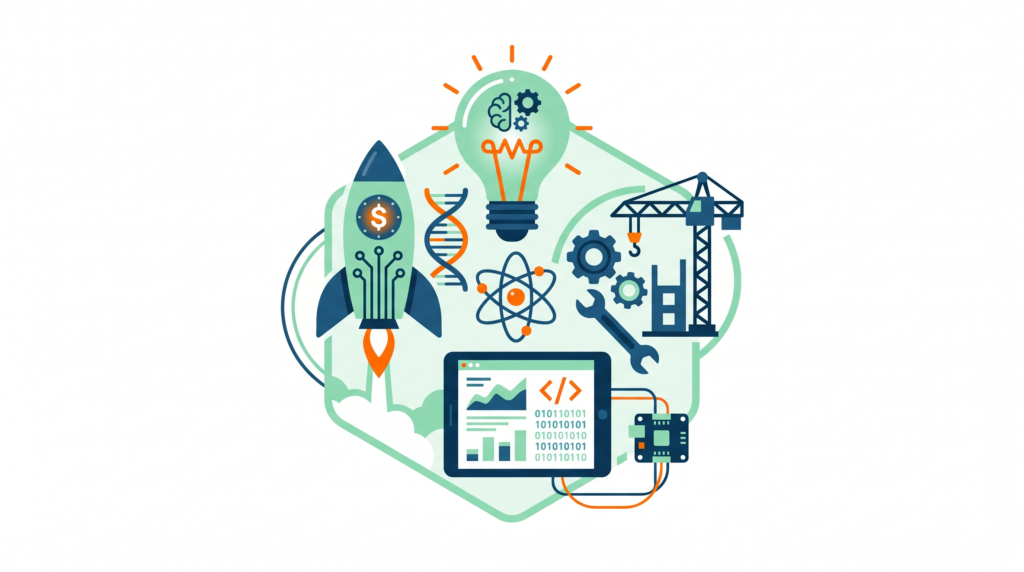
In today's educational landscape, implementing STEM projects middle school it's not just an option, but an imperative necessity to prepare students aged 12 to 18 for the challenges of the 21st century. Adolescence is a critical stage where interest in science and technology can be consolidated or lost permanently. Therefore, offering projects for teenagers Making them meaningful, challenging, and applicable to the real world is the best strategy for fostering scientific vocations and developing critical thinking.
What are middle school STEM projects?
When we talk about STEM projects middle school, we refer to an integrated teaching-learning methodology that combines Science, Technology, Engineering, and Mathematics (STEM) to solve complex problems. Unlike traditional, compartmentalized teaching, these projects break down subject barriers, allowing a high school student to use physical laws to design an engineering prototype, relying on technological tools and validating their results through mathematical analysis.
In a high school context, these projects should move beyond simple «crafts» and evolve into rigorous research. It's not just about building a bridge with popsicle sticks, but about understanding tensile and compressive forces, budgeting materials, and digitally modeling the structure before its physical construction.
Importance of STEM Projects in Middle School
Explain why it is relevant for students aged 12-18. The implementation of these projects is vital for various pedagogical and social reasons:
- Development of transferable skills Foster collaboration, assertive communication, and problem-solving skills under pressure.
- Contextualizing learning Teenagers often ask, «What is this for?» The STEM approach answers that question by connecting the curriculum to global issues like climate change, health, or urban mobility.
- Promoting Equity: Provide practical experiences that can reduce the gender gap in tech careers if designed with an inclusive perspective.
- Preparation for future employment: A large part of future jobs will require a strong foundation in these four areas, regardless of the field of specialization.
Key concepts the teacher must master
- Project-Based Learning (PBL) The vertebral structure where the project is born from a guiding question or a real problem that students must solve.
- Engineering Design Process (EDP): An iterative cycle that includes defining the problem, researching, brainstorming solutions, planning, prototyping, testing, and refining.
- Real interdisciplinarity: The ability to coordinate with teachers from other areas so that the project can be evaluated from different curricular perspectives.
- Maker Culture The use of «hands-on» tools, from recycled materials to 3D printing and programming boards like Arduino or Micro:bit.
Practical strategies for the classroom
To carry STEM practical ideas The classroom requires planning that balances student creative freedom with academic rigor. Here are some effective strategies:
Progressive scaffolding Don't launch a large-scale project on the first day. Start with single-session «micro-challenges» so students can familiarize themselves with teamwork and material usage before tackling a term-long project.
Defined roles: In work groups, assign rotating roles such as Coordinator, Materials Manager, Data Handler, and Spokesperson. This ensures that all teenagers participate actively and develop different skills.
Process Documentation: The final product is important, but learning happens in the process. It requires students to maintain an «Engineering Notebook» (physical or digital) where they record their failures, discarded hypotheses, and initial designs.
Ready-to-use activities
- The Clean Energy Challenge (Solar Cookers) Design and build a functional solar oven that can increase water temperature by at least 20°C, applying concepts of heat transfer and solar geometry.
- Sustainable Urbanism (Smart Cities) Create a neighborhood prototype that uses sensors to optimize resources like automatic lighting or smart irrigation through basic programming.
- Applied Hydrodynamics (Hydraulic Bridge) Construction of a lifting structure that uses Pascal's principle to operate via syringes and water tubes, integrating physics and mechanics.
Recommended materials
To implement these ideas, a high-tech lab isn't always required. A good basic inventory includes:
- Low-cost materials: Corrugated cardboard, wooden sticks, hot glue, PET bottles, and syringes.
- Educational Hardware Micro:bit boards (ideal for their simplicity), humidity/light sensors, and servomotors.
- Free software Tinkercad for 3D design and circuit simulation, and Google Sheets for data analysis.
Evaluation and suggested rubrics
Evaluating these projects requires a paradigm shift: we must evaluate performance, not just the final exam. The use of rubrics that consider is recommended:
- Previous research: Did you use reliable sources to understand the problem?
- Iteration: How did they improve the prototype after the first detected failure?
- Tool usage: Technical skill and safety in handling materials and software.
- Final presentation: Clarity in explaining the scientific principles applied to the final design.
Common mistakes and how to avoid them
- Overly guided projects: If the professor provides all the steps like a recipe, engineering is nullified. Solution: Let students fail and redesign.
- Forget math Often the «M» in STEM gets left behind. Solution: Ensure students perform real calculations that influence their decisions.
- Lack of time for reflection: Rushing to finish the product prevents processing learnings. Solution: Reserve exclusive sessions for results analysis.
Conclusion
Integrate Successfully STEM projects middle school In the school curriculum, transform the classroom into a laboratory of constant innovation. By providing students with challenges that resonate with their interests, we are not only teaching formulas, but we are shaping citizens capable of critical and creative thinking. Start small and allow adolescents to be the true protagonists of their learning.
To generate printable materials related to this topic, visit Didaktos.io.
 Español de Puerto Rico
  English