Strategic Guide for Elementary and Middle School Teachers
Executive Summary
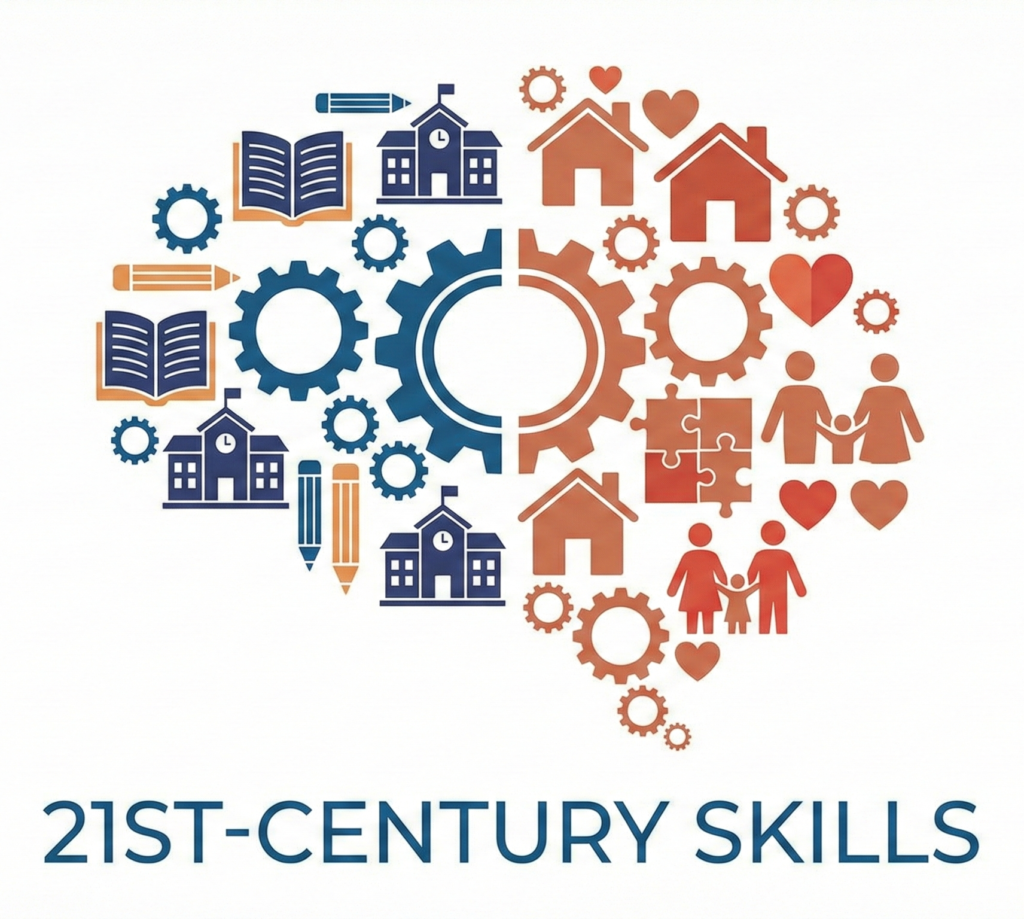
21st century skills are essential to prepare students for a changing, digital and complex world. This article offers elementary and middle school teachers an in-depth, evidence-based analysis of what these skills are and how to effectively integrate them into the classroom. It presents conceptual frameworks, real cases and actionable pedagogical strategies.
Introduction
In the classrooms of the 21st century, two realities coexist: students immersed in a digital, dynamic and global environment, and educational structures that, in many cases, still respond to the logics of the last century. This gap is not only technological, but also pedagogical and formative. The 21st century skills in education arise as an educational response to this tension, proposing an approach that prioritizes critical thinking, collaboration, creativity and digital competence.
Fundamentals: Context and Terminology
What is meant by 21st century skills?
21st century skills refer to a set of abilities that enable students to learn, adapt and actively participate in societies characterized by constant change. According to widely accepted frameworks (UNESCO, OECD, World Economic Forum), these skills are grouped into three broad categories:
- Higher order cognitive Critical thinking, problem solving, creativity, metacognition.
- Socioemotional Effective communication, collaboration, empathy, self-regulation.
- Digitals Digital literacy, computational thinking and responsible use of technologies.
Difference between skills, competencies and contents
| Term | Classroom definition | Teaching involvement |
|---|---|---|
| Contents | Disciplinary knowledge | What is taught |
| Skills | Transferable capabilities | How to think and act |
| Competencies | Integration of knowledge | Contextual application |
In-Depth Analysis
Meta-analyses such as Hattie's and studies by the National Research Council show that active methodologies, when well designed, favor the development of critical thinking and the transfer of learning. It is not a matter of eliminating content, but of teaching it in a way that requires analysis, argumentation and decision making.
- Teaching role as a designer of experiences.
- Formative evaluation through rubrics.
- Deep and meaningful learning.
Use Cases and Practical Examples
Project-based learning
Project-based learning allows the integration of curricular content with 21st century skills through the resolution of real and contextualized problems.
Structured discussions in secondary schools
Guided debates strengthen argumentation, active listening and critical thinking, especially in areas such as social sciences and language.
| Level | Strategy | Skills developed |
|---|---|---|
| Basic | Role playing | Empathy and communication |
| Media | Interdisciplinary projects | Critical thinking and collaboration |
Challenges and Future
Among the main challenges are curriculum overload, lack of specific teacher training and traditional assessment systems. The future points to models of authentic assessment, personalized learning and ethical use of artificial intelligence in education.
Conclusion
21st century skills in education are not additional content, but a change in pedagogical approach. For elementary and middle school teachers, the challenge is to integrate them in an intentional, progressive and evaluable way, starting with small transformations in daily practice.
 Español de Puerto Rico
 English