
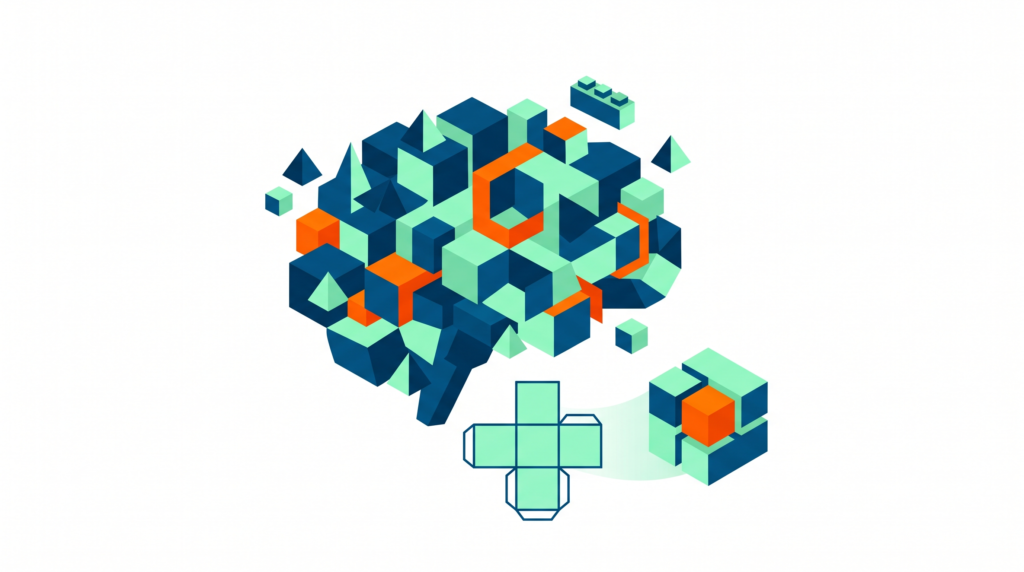
The teaching of mathematics in adolescence often faces the challenge of excessive abstraction, and geometry is no exception. Often, students between 12 and 18 years old memorize area and volume formulas without truly understanding the shapes and spaces they represent. It is here that Secondary geometry activities they are invaluable. Implementing dynamics focused on cognitive development allows students to visualize, manipulate, and understand their surroundings, transforming a theoretical class into a laboratory of Practical Geometry and discovery.
In this extensive article, we will delve into the design and implementation of pedagogical strategies that foster mental visualization. Our aim is to equip secondary school teachers with a robust theoretical and practical framework, filled with tools, dynamics, and approaches that ensure meaningful and lasting learning in the mathematics classroom.
What are secondary geometry activities?
The Secondary geometry activities They are a set of didactic experiences intentionally designed for students aged 12 to 18 to explore the properties of geometric figures and solids through direct interaction, technology, and critical thinking. Unlike traditional axiomatic geometry (based solely on theorems and paper proofs), this approach emphasizes visualization, manipulation, and real-world problem-solving.
The core of these activities is the development of Spatial reasoning. This is the cognitive ability that allows us to visualize objects in our minds, rotate them, understand their proportions, and predict how they will change if they are modified or moved in three-dimensional space. When a teacher implements these activities, they are not only teaching how to calculate the volume of a cylinder but also training the adolescent's brain to «see» that cylinder unfolded in two dimensions (its geometric net) or to imagine how it would fit inside a rectangular prism.
The Importance of Geometry Activities in Secondary School
The development of Spatial reasoning during the secondary education stage, it is fundamental, not only for success in the subject of mathematics, but for the integral future of the student. Below, we detail the reasons why these activities are crucial:
1. Foundation for STEM Careers: The ability to mentally visualize and interact with three-dimensional models is one of the most predictive skills for success in STEM (Science, Technology, Engineering, and Mathematics) disciplines. Architects, surgeons, robotic engineers, and graphic designers rely daily on a strong Practical Geometry.
2. Transition between Van Hiele levels: The Van Hiele model of education explains how students learn geometry. Many adolescents enter secondary school at a purely «visual» level (they recognize a shape because it looks like something). Good geometry activities push students towards the «descriptive/analytic» level (they understand the properties of the shape) and, finally, to the level of «formal deduction.».
3. Improved problem-solving skills: Students with a good sense of space can graphically represent complex problems, even those that appear purely algebraic. Drawing an accurate diagram is often the first and most important step to finding a logical solution.
4. Inclusion and motivation: For students who struggle with abstract algebra or pure arithmetic, visual geometry offers an opportunity to shine. By incorporating hands-on and visual activities, teachers cater to the diverse learning styles in the classroom, reducing frustration and increasing engagement.
Key concepts the teacher must master
To effectively guide students, the teacher must be an expert not only in theorems but also in spatial cognitive processes. These are the fundamental concepts to master:
- Spatial Visualization: The ability to mentally visualize movements, folds, or changes in two-dimensional and three-dimensional objects. For example, predicting the shape that will result from cutting a cross-section of a cone.
- Spatial Orientation: The ability to understand and operate on the relationships between the position of one's own body and objects in space, fundamental for reading blueprints and topographic maps.
- Projections and Views: Mastering and being able to teach how a 3D object appears from different perspectives (elevation, plan, and section)—a key skill in technical drawing and Practical Geometry.
- Isometries (Rigid Transformations): Translations, rotations, and reflections. The teacher should know how to explain them not only as coordinates on a Cartesian plane, but as physical movements of objects in space.
Practical strategies for the classroom
Taking theory to practice requires an active methodology. So that the Secondary geometry activities To make a real impact, we suggest the following strategies:
The Concrete-Representational-Abstract (CRA) approach: Never start a spatial geometry topic directly on the board. Always begin with concrete objects (boxes, blocks, 3D models). Then, move to the pictorial phase by asking students to draw these objects on isometric paper. Finally, introduce the abstract formulas to calculate their dimensions.
Use of real-world analogies: Always relate concepts to the students« everyday environment. When teaching about polyhedrons, examine product packaging at the supermarket or the architectural structure of the school itself. Ask: »Why are soda cans cylindrical and not square prisms?” This type of Practical Geometry ignite curiosity.
Fostering conjecture and debate: Instead of giving the answer, ask divergent questions. «If we double the height of this prism, does its volume also double? And if we double its base?» Let students experiment, debate in cooperative groups, and reach their own conclusions before formalizing the mathematical rule.
Ready-to-use activities
Here are three proposals: Secondary geometry activities designed to enhance the Spatial reasoning for your students, tailored to different levels of difficulty:
- Activity 1: «3D Shadow Challenge» (Ages 12-14): Using wooden or plastic cubes (like Multilink blocks), students must build irregular three-dimensional figures. Then, they need to use a flashlight (or a mobile phone's light) to project the shadows of their construction onto a wall from three different angles (elevation, plan, and profile) and draw them on graph paper. The final challenge is for one group to try and reconstruct the original 3D figure using only the shadow drawings created by another group.
- Activity 2: «Packaging Engineers» (14-16 years old): Ask the students to bring empty containers from home (cereal boxes, potato chip bags, chocolate wrappers). The goal is to carefully take them apart to study their «flat pattern» or geometric net. Then, they are challenged to design a new package for a fictional product that has the same volume but minimizes the amount of cardboard (surface area) used to save costs.
- Activity 3: «Parametric Architecture in GeoGebra» (Ages 16-18) In the computer lab, the most advanced students use GeoGebra 3D software. The challenge is to recreate a famous monument or design a modern house using only geometric solids, planes, and transformations defined by equations. They must calculate the living space and analyze how the different intersections of planes create new shapes and spaces.
Recommended materials
To transform your classroom into an environment rich in visual and tactile stimuli, we recommend incorporating the following resources:
Isometric paper and dot paper They are fundamental for students to learn to draw 3D figures on a 2D surface without getting frustrated. They greatly facilitate the understanding of perspective.
Magnetic building toys (Polydron or Magformers): They allow for the rapid construction of complex geometric bodies by joining regular polygons along their edges. They are ideal for visualizing the relationships between vertices, faces, and edges (Euler's Formula).
3D modeling software: Free tools like GeoGebra Classic, Tinkercad, or SketchUp are invaluable allies. They allow you to rotate figures in space with your mouse, making visible what is sometimes difficult to imagine.
Evaluation and suggested rubrics
The evaluation of the Spatial reasoning It should not be limited to checking if the final numerical result of a problem is correct. You must evaluate the visualization process.
In your rubrics, incorporate criteria such as the following:
Representation capacity: Does the student clearly and proportionally draw the three-dimensional figure and its 2D projections?
2. Spatial application to resolution: Does the student use visual models or diagrams to break down a complex problem into manageable parts?
3. Technical Vocabulary: Describe spatial relationships using appropriate terminology (edges, vertices, parallel planes, perpendicular faces).
An excellent assessment practice is to ask students to physically build (using cardstock or modeling clay) the answer to a theoretical geometry problem.
Common mistakes and how to avoid them
Upon implementing the Practical Geometry In high school, it is vital to know the common obstacles in order to overcome them successfully:
- Skipping the manipulative phase Many teachers believe that by age 15, students are «too old» to use blocks or cut paper. This is a mistake. The adult brain also benefits from tactile learning to solidify new and complex spatial concepts.
- Penalize bad drawing instead of bad reasoning: Some students have great spatial ideas but little fine motor skill for drawing them. Always differentiate between a crooked line and a geometric conceptual error.
- Confine geometry to two dimensions: Teaching geometry exclusively by drawing on a blackboard dooms learning. It forces students to get out of the paper and constantly look at the real world in three dimensions.
Conclusion
Develop the Spatial reasoning through Secondary geometry activities It is an essential component for the development of analytical, creative, and problem-solving minds. By setting aside formula memorization for a while and embracing construction, design, and three-dimensional manipulation, we transform mathematics into a tangible and fascinating discipline. Practical Geometry It not only prepares teenagers for exams, but empowers them to observe the world with an architectural eye, truly understanding the structures around them.
To generate printable materials related to this topic, visit Didaktos.io.
 Español de Puerto Rico
 English