
How to teach computational thinking without computers in secondary school
In the era of digital overstimulation, a paradox emerges in education: one of the best ways to understand technology is by stepping away from it. Computational thinking without computers, often referred to as CS Unplugged, has become a fundamental pillar for teachers seeking to develop critical thinking and logical skills in secondary school students (12-18 years old). Unlike in primary school, where the approach is purely playful, in secondary education, this method allows for a deeper exploration of the logical and algorithmic architecture of complex systems.
Computational thinking without computers
The Computational thinking without computers It is a teaching methodology that uses analog activities—games, physical challenges, manipulation of objects, and paper-based problem-solving—to convey computer science concepts. Its goal is not to learn how to operate a device, but to master the language of logical thinking that allows a human to design processes that can later be executed by a machine.
For a middle school teacher, teaching Computational thinking without computers It means breaking down how the «black box» computers represent today. While programming usually focuses on the syntax of a language (Python, Java, or C++), unplugged activities focus on semantics and structure. It's the difference between learning to write a sentence without spelling errors and learning to build a solid argument.
The importance of computational thinking without computers in high school
The implementation of Computational thinking without computers the age range of 12 to 18 years is critical for various pedagogical and social reasons:
- Bridging the digital divide: Not all institutions have state-of-the-art computer labs. The unplugged methodology ensures that high-level learning does not depend on hardware, democratizing access to STEM education.
- Fostering pure abstraction: Without a screen that provides immediate results (sometimes through trial and error), the student must process the logic internally. This strengthens their capacity for abstraction, a key competency for mathematics and experimental sciences.
- Digital fatigue prevention Teenagers spend a lot of their day in front of screens. Engaging in physical or tactile activities to understand computing breaks the monotony and improves knowledge retention through kinesthetic learning.
- Development of patience and attention In an offline environment, errors are detected by reviewing the mental process step-by-step, which fosters sustained attention that fast-paced digital environments tend to erode.
Key concepts the teacher must master
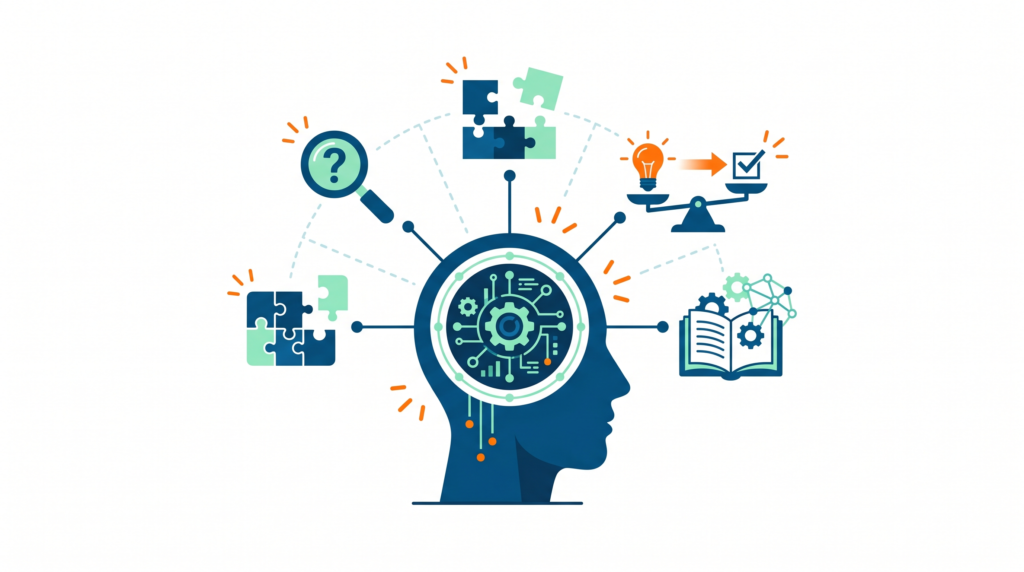
To successfully guide a session of Computational thinking without computers, the teacher must master and know how to transmit these four fundamental pillars:
Decomposition
It is the ability to break down a complex problem into smaller, more manageable sub-problems. In high school, this can be applied from planning an essay to designing a data search algorithm.
2. Pattern Recognition
It consists of identifying similarities, recurrences, or trends within information. This skill is essential for efficiency; if we know that part of a problem has been solved before, we can reuse the solution.
3. Abstraction
It's the process of ignoring irrelevant details to focus on what truly matters. In computing, this involves creating simplified models of reality.
4. Algorithms and Flow Control
The design of a logical sequence of steps to perform a task. At this educational level, it is vital to introduce concepts of conditionals (if this happens, do that) and loops (repeat this step until the condition is met).
Practical strategies for the classroom
For what Computational thinking without computers resonates with teenagers, the teacher must present challenges that stimulate their intellect and critical thinking. Here are some strategies:
The «Reverse Engineer» Approach: Present to students a daily process (like how a traffic light works or an Instagram recommendation) and ask them to design the logical algorithm that controls it using paper flowcharts. This helps them see the world as a set of programmed systems.
Parallel Processing Simulation: Divide the class into small groups and assign them a massive data processing task (e.g., sorting 500 names alphabetically). Each group must develop a method for collaborating and speeding up the process, emulating how modern multi-core processors handle information.
Ready-to-use activities
Here are three activities Computational thinking without computers designed specifically for the high school level
Activity 1: Sorting Networks
Concept Sorting algorithms and parallel processing.
Development In the courtyard, draw a network of interconnected nodes with chalk. Students enter at one end with a card that has a number. At each node, two students compare their numbers; the one with the smaller number follows the path on the left, and the one with the larger number follows the path on the right. At the end of the network, all students exit sorted from smallest to largest automatically. This demonstrates that the structure of an algorithm can solve problems without active «intelligence» at the time of execution.
Activity 2: Cryptography and Data Security
Concept Transmission protocols, encryption, and public/private keys.
Development Using Caesar cipher or column transposition methods, students should send «secret» messages to each other across the classroom. The challenge is to intercept messages from other groups and try to break the code through frequency analysis (patterns). This activity links mathematics with current cybersecurity.
Activity 3: The Blind Robot Game
Concept Syntax, debugging, and algorithmic precision.
Development One student acts as the «programmer» and another as the «robot» (blindfolded). The programmer must give exact instructions (Turn 90 degrees right, walk 3 steps) for the robot to avoid obstacles and reach a goal. If the robot crashes, the programmer must identify which instruction was wrong (debug) and restart. This teaches the importance of precision in commands.
Recommended materials
The advantage of Computational thinking without computers It's low cost. Essential materials include:
- Grid and colored paper For graphical representation and binary data.
- Physical objects Balls, playing cards, Rubik's Cubes, or building blocks (like LEGOs) for data modeling.
- Masking tape Essential for creating giant flowcharts on the classroom floor.
- Stopwatches: To introduce the concept of algorithmic efficiency (Big O notation intuitively).
Evaluation and suggested rubrics
The evaluation of the Computational thinking without computers should not be based on trial and error, but on the quality of the reasoning. It is suggested to evaluate:
- Algorithmic Precision Are the steps clearly defined and free of ambiguity? (25%)
- Debugging Capability How does the student react when they make a logical error? Are they able to identify the root cause? (30%)
- Optimization Is the proposed algorithm the most efficient in terms of time or resources? (20%)
- Knowledge Transfer Can the student explain how that concept is applied in a real computer? (25%)
Common mistakes and how to avoid them
implement Computational thinking without computers requires avoiding certain biases:
- Oversimplification Don't treat teenagers like elementary school kids. Make sure to use correct technical terms. If they're ordering data, talk about «quicksort» or «bubble sort.».
- Lack of connection to reality If the activity ends and the students don't understand how it relates to their smartphone or favorite video game, the lesson will have failed. Always dedicate time to the final reflection.
- Do not encourage error: In computing, errors are part of the process. Create an environment where «breaking the code» is seen as a learning opportunity, not an academic failure.
Conclusion
Master the Computational thinking without computers gives high school students an immense competitive advantage. It teaches them that technology is not magic, but logic, and that they have the power to design and control it. As educators, our role is to provide them with the necessary mental tools to navigate an uncertain future with a solid and structured foundation of critical thinking and problem-solving.
To generate printable materials related to this topic, visit Didaktos.io.
 Español de Puerto Rico
  English