
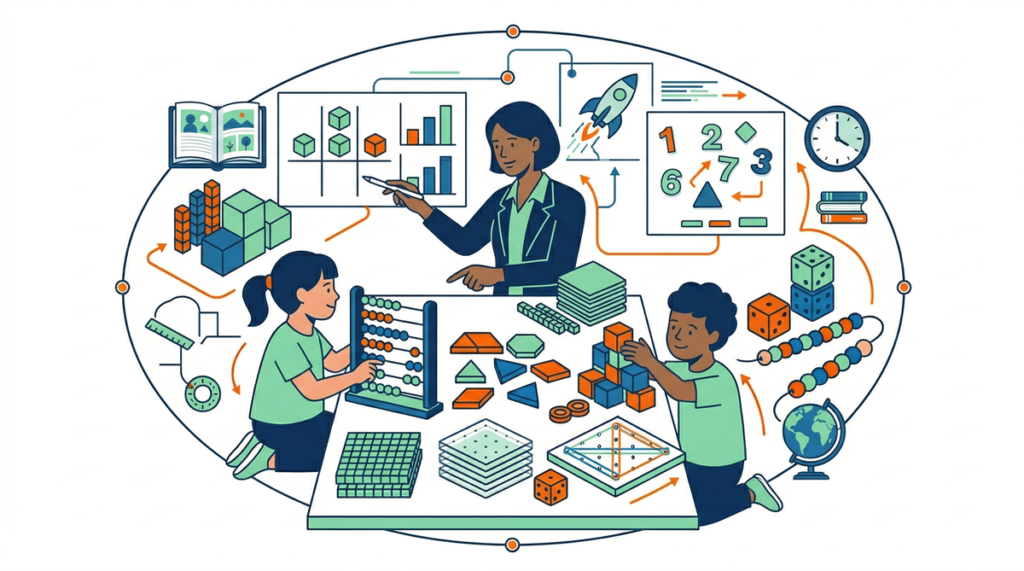
The manipulative mathematics have become one of the most effective strategies for teaching abstract concepts in a concrete and meaningful way in elementary school. Through the use of physical objects, students can experiment, explore and better understand mathematical ideas that would otherwise be difficult to assimilate.
But why does manipulative math work so well? The answer lies in how children learn: by touching, testing and building. This approach not only improves comprehension, but also increases motivation and reduces math anxiety.
In this article you will discover what manipulative mathematics is, its importance in the classroom and several practical activities that you can easily apply. If you are a teacher or parent, here you will find clear and applicable ideas to transform mathematical learning into a more dynamic and effective experience.
Table of Contents
- What is manipulative mathematics?
- Importance of manipulative mathematics in primary education
- Manipulative math activities for the classroom
- Most commonly used manipulative materials
- Tips for applying manipulative mathematics
What is manipulative mathematics?
The manipulative mathematics are an educational approach that uses physical objects to represent mathematical concepts. Instead of learning solely in an abstract way, students interact with concrete materials such as blocks, counters, strips, or geometric figures.
This type of learning allows children to visualize and better understand ideas such as addition, subtraction, fractions or geometry. For example, instead of memorizing that 3 + 2 = 5, they can put objects together and see the result for themselves.
In addition, manipulative math fosters key skills such as:
- Logical thinking
- Problem solving
- Experimentation
- Autonomous learning
Have you ever wondered why some students understand better when they “see” mathematics? Precisely, this approach responds to that natural need for hands-on learning.
Importance of manipulative mathematics in primary education
The importance of manipulative mathematics in primary school lies in its ability to make learning more accessible and meaningful. During the early years, children need concrete experiences before moving on to abstract thinking.
This approach offers multiple benefits:
- Improves understanding of complex concepts
- Increases motivation and interest
- Reduces fear of mathematics
- Encourages active participation
In addition, several studies indicate that students who use manipulative materials develop a stronger mathematical foundation. This positively impacts their long-term performance.
In the current context, where a more active education is sought, integrating strategies such as these is essential. You can even complement these practices with educational digital tools such as Didaktos, which help to reinforce learning in an interactive way.
Manipulative math activities for the classroom
Implement manipulative math activities does not require expensive materials or complex preparation. Here are some practical ideas:
1. Sums with everyday objects
Use buttons, lids, or tokens to represent quantities. Students can group and count to solve operations.
2. Construction of geometric figures
With popsicle sticks or play dough, students can create shapes and understand concepts such as sides, vertices and angles.
3. Fractions with food
Divide fruits or foods into equal parts to teach fractions in a visual and practical way.
4. Number line on the ground
Draw a line on the floor and have students jump to represent addition and subtraction.
These activities not only facilitate understanding, but also make the class a fun experience. Who said learning math had to be boring?
Most commonly used manipulative materials
There are numerous manipulative materials that you can use in the classroom or at home. Some of the most popular include:
- Cuisenaire strips
- Base ten blocks
- Abacos
- Counting sheets
- Geoplanes
However, it is not necessary to invest large amounts of money. Many materials can be created from recycled or low-cost items.
The key is to choose resources that allow students to experiment and discover for themselves. This type of active learning is much more effective than traditional memorization.
Tips for applying manipulative mathematics
To make the most of the manipulative mathematics, it is important to take into account some recommendations:
- Relates materials to clear learning objectives
- Allows free exploration before guiding the activity
- Promotes teamwork
- Combines the manipulative with the digital
Also, remember that the teacher's role is to accompany the process, not to direct it completely. Meaningful learning occurs when the student discovers for himself.
If you want to take your classes to the next level, you can explore platforms like Didaktos, where you will find digital resources that complement these strategies in an effective way.
Conclusions
The manipulative mathematics are a key tool for improving students' understanding and interest in elementary school. Through practical activities and concrete materials, it is possible to transform teaching into a more dynamic, accessible and effective experience.
Integrating this approach not only benefits immediate learning, but also builds a solid foundation for future academics. Are you encouraged to try these strategies in your classroom or at home?
If you want to continue discovering innovative educational resources, we recommend you to explore more tools at Didaktos and continue to enrich your educational practice.
 Español de Puerto Rico
  English