
Magic Sand: The Water Challenging Experiment 💧✨
Build an underwater world that refuses to get wet and leaves everyone with their mouths open.
🎯 1. Your Scientific Missions
Get ready for action! Here's what you'll achieve:
- General Objective: Demonstrate the properties of hydrophobic materials by creating your own «magic sand» and explaining why it repels water. Pure chemistry in action!
- Personal Objective: Master the scientific method like a true professional, improve your presentation skills and most importantly, have fun while doing amazing science! 🚀
🌍 2. What is this Witchcraft? The Science behind Magic
Imagine you have a super power: an invisible shield that protects you from the rain - you'll never get wet! The hydrophobic sand has a similar power.
The word «hydrophobic» comes from the Greek: «hydro» (water) and «phobos» (fear). Literally, it is sand that is «afraid» of water!
- 💧 Water, the popular girl: Water molecules (H₂O) are super sociable. They love to stick together (cohesion) and stick to other things (adhesion). That's why normal sand gets wet.
- 🛡️ Arena, the super-protected: We give our sand an invisible «suit» with a waterproofing spray. This suit is apolar, which means that it is not at all interested in binding to water molecules, which are polar.
- 🤯 The result: When you pour the sand into the water, each granite keeps its shield. The water prefers to bind to itself rather than touch the sand. This creates a layer of air around the sand, which is why you can make underwater sculptures that come out completely dry!
Did you know that...? 🤔
Hydrophobic technology is not just for toys. It's used in clothes that never stain, glass that repels rain and has even been researched to clean up oil spills in the ocean, causing the oil to sink. Your experiment has real-world applications!
🔬 3. Your Plan of Attack: The Scientific Method
Every great scientist needs a plan - this is yours!
- Observation: You've seen sand on the beach. If you put it in the water, it gets wet. But what if we could change that?
- Question: Is it possible to modify the surface of the sand so that it repels water and does not get wet when submerged?
- Hypothesis: If we cover the sand grains with a waterproofing substance (hydrophobic), then the sand will not get wet on contact with water and can be removed dry.
- Experimental Design: We will create two samples: one of normal sand (our «control group») and one of sand treated with waterproofing spray. We will immerse them in water and compare the results.
- Analysis and Conclusion: We will observe if the treated sand remains dry. If it does, our hypothesis will be correct! 🏆
🧩 4. This is what your Laboratory looks like
Your setup is simple but striking. You'll need a clean workspace where you can handle the sand and spray, and then some clear containers for the big reveal.
Watch Out Here! Caution Zone ⚠️
Waterproofing spray should be used by or under the direct supervision of an adult. Work in a well-ventilated area (outdoors is best!) so as not to breathe vapors.
🛠️ 5. Scientific Arsenal: Materials List
Here are some options to set up your experiment according to your budget.
| Material | Economy Option 💰 | Standard Option ✅ | Professional Option 🧪 |
|---|---|---|---|
| Sand | Beach sand (well washed and dry) | Colored sand for handicrafts | High purity silica sand |
| Hydrophobic Agent | Melted candle wax (with the help of an adult) | Waterproofing spray for fabric or shoes | Trimethylsilanol (expert handling required) |
| Containers | Clear plastic cups | Glass jars or small fish tanks | Laboratory beakers |
| Tools | Plastic spoon and cardboard tray | Metal spoon and aluminum tray | Laboratory spatula and steel tray |
🧭 6. Adventure Map: Step by Step Guide
-
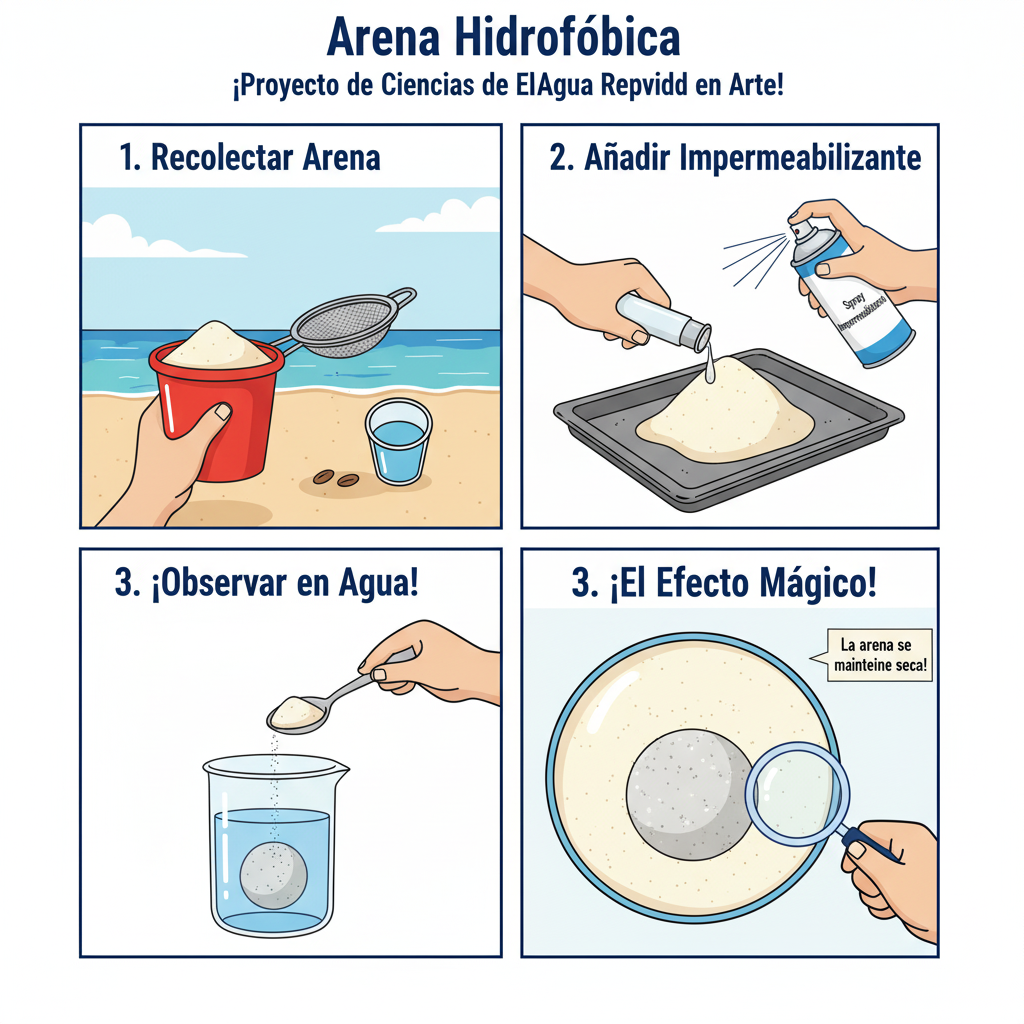
Step 1: Prepare your Arena (15 min)
Spread a thin layer of sand in a tray. If you use beach sand, make sure it is completely dry. Pro-Tip: Use sands of various colors for a «wow» effect when mixed underwater!
-
Step 2: The Magic Transformation (20 min + drying time)
In a ventilated place, an adult should spray the sand with the waterproofing spray. Be generous, mix the sand with a spoon and spray again. We want every granite to be well covered. Scientist Alert! This is the most crucial step. Poor coverage and the sand will get wet.
-
Step 3: Patience, young scientist! (Several hours)
Let the sand dry completely. This may take a few hours. Follow the instructions on the spray. Stir it from time to time so that it dries evenly.
-
Step 4: The Moment of Truth (10 min)
Fill a clear container with water. With a spoon, slowly pour your hydrophobic sand into the water - watch the magic! You'll see it clump together and form silvery structures from the trapped air.
-
Step 5: Experiment and Test (15 min)
Try making shapes with the sand underwater. Then scoop out a spoonful - see, it comes out completely dry! Now, for comparison, pour some regular sand into another glass of water. The difference will be amazing.
7. Let's Shine at the Science Fair!
Your experiment is great, now make your presentation great too!
Your Poster (Scientific Poster)
- Giant and Attractive Title: «SAND THAT DOESN'T GET WET: The Science of Water Fear».
- Uses Graphics: It includes photos of the process and a simple diagram of a water molecule (polar) and the hydrophobic layer (non-polar) on a grain of sand.
- Scientific Method in Sight: Have a clear section for your Question, Hypothesis and Conclusion.
Interactive Ideas
- Let the judges and visitors try it! Have one container with your magic sand and one with regular sand for them to compare.
- Prepare small underwater «sculptures» beforehand.
Phrases to Impress Judges
«This experiment is not magic, it is a demonstration of intermolecular forces, specifically the polarity of water and the apolar properties of the hydrophobic layer.»
«The key is in the surface tension of the water. The water molecules are so attracted to each other that they avoid contact with the hydrophobic surface of the sand, creating a fascinating air barrier.»
8. Attachments: Your Scientific Survival Kit
Data Recording Template
Use this table to record your observations.
| Sample | Behavior when entering the water | Underwater appearance | Condition when removed from the water |
|---|---|---|---|
| Normal Sand (Control) | It disperses and sinks, darkening. | It settles to the bottom, wet. | Moist, caked. |
| Hydrophobic sand | It is grouped, not dispersed. | It forms clusters with a silvery sheen (air). | Completely dry and loose. |
Final Checklist ✅
- [All materials are ready.
- [The work area is prepared and ventilated.
- [ ] I have adult supervision to use the spray.
- [My poster is complete and easy to read.
- [I have practiced my explanation out loud.
- [I'm ready to surprise the world with science!
Recommended Sources
- Science in School - «The mystery of the magic sand».»
- Aquae Foundation - Articles on water properties.
 Español de Puerto Rico
 English