
🧭 SCIENTIFIC ADVENTURE GUIDE 🧭.
🌈 The Liquid Rainbow Challenge: Master the Power of Density! 🌈
Your mission: to create a gravity-defying tower of colors and reveal the secrets hidden in each drop.
🎯 2. CLEAR AND CHALLENGING OBJECTIVES.
General Objective:
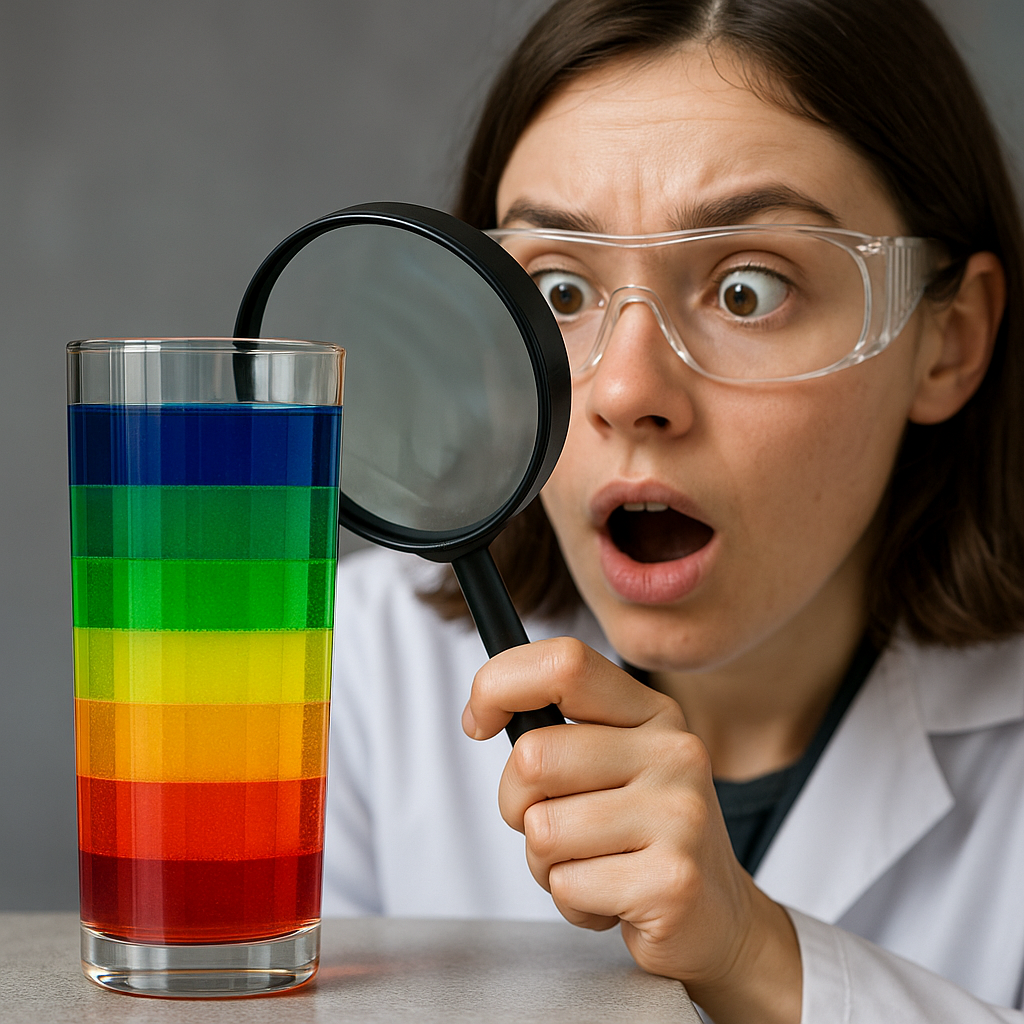
You will visually demonstrate that different liquids have different densities, which allows them to stack in layers without mixing (at least for a while!).
Personal Objective:
At the end of this guide, you will be able to:
- Explain what density is using examples from your daily life.
- To build a stable and colorful «liquid rainbow».
- Predict which liquids will float on top of others.
- Impress your friends, family and show judges with your knowledge!
🌍 3. SIMPLE AND FUN THEORETICAL INTRODUCTION
Have you ever wondered why oil floats in soup water 🤔 It's not magic, it's. density!
Imagine you have two identical backpacks. One you fill with pens 🪶 and the other with books 📚. They both occupy the same space (they have the same volume), but the book one is much heavier, isn't it? That's because books have more «matter» (mass) squeezed into that space.
- The density is basically that: how much «matter» is packed into a given space.
- A denser liquid (such as honey) will sink below a less dense one (such as oil).
- It's like an apartment building for liquids! The «heavier» ones live on the lower floors.
💡 Did you know?
The Dead Sea has so much dissolved salt that its water is super dense, which is why you can float effortlessly in it while reading a book! It is one of the most extreme examples of density in nature.
🔬 4. SCIENTIFIC METHOD: YOUR PLAN OF ATTACK.
Every good scientist follows a plan! This is yours:
- Initial observation: You have noticed that some liquids, such as oil and vinegar in a salad, do not mix well. The oil always stays on top.
- Research question: Will I be able to stack several colored homemade liquids in a glass to form stable layers, based on their different densities?
- Hypothesis: «I believe that if I pour the liquids in the right order (from the densest to the least dense), they will form a layered rainbow that will not mix, because each liquid will find its ‘floor’ according to its weight.» Dare to predict the order!
- Experimental design:
- Independent variable (what you change): The type of liquid you add at each step.
- Dependent variable (what you measure/observe): The formation (or not) of separate layers and their height.
- Controlled variables (what you keep the same): The glass, the amount of each liquid, the ambient temperature.
- Test procedure: You will follow the steps in this guide to pour the liquids carefully.
- Analysis of results: You will note the order in which you poured the liquids, whether the layers formed and anything else interesting you observe (bubbles, partial mixing, etc.).
- Conclusion: Was your hypothesis correct, did the order you predicted work, and what did you learn about the density of these liquids?
🧩 5. GRAPHICAL DESCRIPTION OF THE ASSEMBLY
Your final experiment will look like a colorful liquid tower inside a clear container. From the bottom up, you will see well-defined layers: the golden honey at the bottom, followed by the brightly colored liquid soap, then the tinted water, the pale yellow vegetable oil, and finally the contrasting colored alcohol at the top.
      +-----------------+ <-- Layer 5: Alcohol (Less dense)
      | ~~~~~~~~~~~~~~~ |
      +-----------------+ <-- Layer 4: Vegetable oil
      | ooooooooooooooooooo |
      +-----------------+ <-- Layer 3: Water with dye
      | H-H-H-H-H-H-H-H-H-H-H-H-H-H-H |
      +-----------------+ <-- Layer 2: Liquid Soap
      | /./././././././ |
      +-----------------+ <-- Layer 1: Honey (Denser)
      |=================|
      +-----------------+
        (Beaker or Test Tube)
🔥 Watch out here! Sensitive area 🔥
The most critical step is to pour each liquid. You must VERY SLOWLY and, if possible, along the inside wall of the glass. If you pour it too fast, the force of the jet can cause the layers to mix. Patience, young scientist!
🛠️ 6. BILL OF MATERIALS WITH SMART OPTIONS
| Key Material | Recycled/Economic Option ♻️ | Standard/School Option 🎒 | Precise/Professional Option 🔬. |
|---|---|---|---|
| Container | Tall, smooth plastic bottle | Tall, narrow glass tumbler | 250 ml graduated cylinder |
| Dense Liquid 1 | Honey or corn/maple syrup | Commercial bee honey | Liquid glycerin |
| Dense Liquid 2 | Liquid dish soap | Colored liquid soap | Castor oil |
| Liquid Medium | Tap water | Distilled water | Deionized water |
| Light Liquid 1 | Cooking oil (sunflower, corn) | Vegetable oil | Light mineral oil |
| Light Liquid 2 | Wound Alcohol (70%) | Isopropyl alcohol (90%) | Pure laboratory ethanol |
| Meter | Kitchen measuring cup | Measuring cup with milliliters | Pipettes and graduated cylinders |
| Dyes | - | Liquid food coloring | Specific laboratory dyes |
Your Scientific Emergency Kit:
- Adhesive tape and marker (for labeling)
- Scissors and paper napkins (for spills!)
- Stopwatch (your cell phone's stopwatch is perfect)
- Notebook or this printed guide
- A syringe without needle or a dropper (super useful for pouring!)
🗺️ 7. STEP-BY-STEP GUIDE: YOUR ADVENTURE MAP
Now let's get to work!
Step 1: Prepare your lab (10 min ⏱️)
Clean your work table. Spread out newspaper. Gather ALL your materials and put them in order.
Pro Tip: Make a list of the liquids you will use and number them from the most dense (1) to the least dense (5). The classic order is: Honey, Soap, Water, Oil, Alcohol.
Step 2: Measure and color (10 min ⏱️)
Measure the same amount of each liquid (e.g., 50 ml or 1/4 cup). If the water and alcohol are not different colors, it's your time to be an artist! Add a few drops of food coloring to each. Choose contrasting colors.
Scientist Alert! Alcohol may discolor some plastics. Use a glass beaker for staining.
Step 3: The first layer (2 min ⏱️)
Pour the thicker liquid (the honey) carefully into the center of the bottom of your container. You now have the base of your tower!
📸 Photo moment! Capture the beginning of your artwork.
Step 4: Building the tower (15 min ⏱️)
This is the key step! Take your second liquid (the soap). Tilt the container and pour the soap VERY slowly, making it slide down the inside wall. This way it will not fall hard. Repeat the process with the rest of the liquids, always in order from denser to less dense.
Pro Tip: Use a syringe or dropper to add liquids with maximum control - you'll feel like a real chemist!
Step 5: Observe and record (10 min ⏱️)
You did it! Admire your rainbow. Are the layers well defined? Are there bubbles? Any blending? Write it all down on your recording template.
📸 Final photo shoot! Take photos from various angles. Record a short video.
Step 6: The final challenge (Optional, 5 min ⏱️)
Carefully drop small objects into your tower: a grape, a piece of plastic, a small screw, a popcorn. Where does each one float? This shows that solids also have different densities! Record your results.
🎪 8. PREPARE YOUR PRESENTATION FOR THE FAIR (BE A STAR!).
Your Poster:
Organize it clearly and visually. Use large headings.
- Title: Choose a powerful one like the one in this guide!
- Problem: Can liquids be stacked?
- My Hypothesis: Write yours here.
- Materials: A list with photos.
- Procedure: A summary in 5 steps.
- Results: The most spectacular photo of your rainbow! And a table with the results of the object challenge.
- Conclusion: Was your hypothesis fulfilled and what did you learn?
Make it Interactive!
- Have your liquid tower (well sealed!) and an empty one on hand.
- Bring the small objects (grapes, screw) and let the audience drop them into a test tube with water and oil for a quick demonstration.
- Prepare a mini quiz of 3 questions with a candy as a prize.
Winning Phrases for Judges:
- «This experiment demonstrates a fundamental principle of physics, density, using materials we all have at home.»
- «More than just a rainbow, this is a column of stratified densities, where each liquid has found its balance.»
- «The key to success was not only knowing the order, but the slow pour technique, which minimizes turbulence between the layers.»
Frequently Asked Questions (Don't get caught off guard!):
Q: What would happen if you shake it? A: The layers would mix. Some, such as oil and water, would separate again (temporary emulsion), but others, such as water and alcohol, would mix permanently.
Q: Does it last forever? A: No. Over time, by a process called diffusion, the molecules of the liquids will slowly mix and the boundaries between layers will become blurred.
Q: Does it work with any liquid? A: It works with liquids that do not dissolve easily with each other (immiscible) or that have very different densities.
9. USEFUL APPENDICES (Your survival kit!)
Data Recording Template:
| Liquid | Assigned Color | Dumping Order | Clear coat? | Remarks |
|---|---|---|---|---|
| Honey | Natural | 1 | Yes | Very viscous, slow to settle. |
| Soap | Green | 2 | Yes | It slid well down the wall. |
| Water | Blue | 3 | Yes | Highly defined layer. |
| Oil | Yellow | 4 | Yes | Instantaneous separation with water. |
| Alcohol | Red | 5 | Yes | Thinner layer, some odor. |
Final Checklist ✅:
- I read the entire guide before starting.
- I gathered all my materials.
- I made my hypothesis.
- I poured the liquids in order and with care.
- I took photos and notes.
- I understood why the experiment worked.
- I cleaned my work area.
- I had fun like a real scientist!
Self-Assessment Rubric (Rate yourself from 1 to 10):
- Accuracy: Did I follow the steps carefully (1 - 10)?
- Comprehension: Could you explain density to a friend? (1 - 10)
- Presentation: Was my rainbow clean and well layered (1 - 10)?
- Curiosity: Did I try something new (such as adding objects)? (1 - 10)
Sources for Curious Explorers:
- Steve Spangler Science (n.d.). Seven-Layer Density Column. [Video online]. Available at: stevespanglerscience.com
- Khan Academy (n.d.). Density and specific gravity. [Online article]. Available at: khanacademy.org
 Spanish
 English