
Physics ⚡ Electrostatics
Levitate objects with static electricity!
A science challenge for high school (ages 12-16): hypotheses, testing, and presenting like a science fair pro.
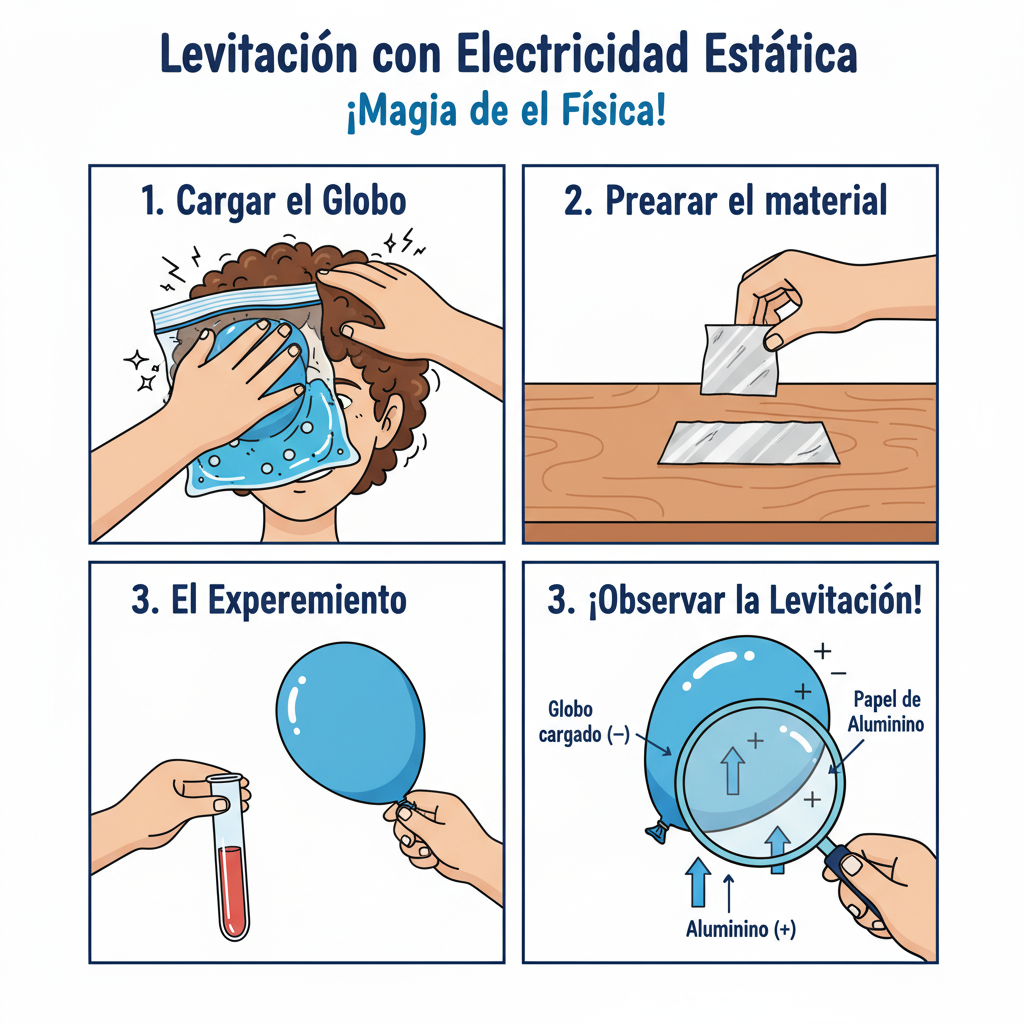
🎯 General objective.
To demonstrate that electrical charges generated by friction can exert forces capable of levitate ultralight objects (paper, tinsel, foam balls) at close range.
🙌 Personal objective
Design and optimize your assembly to achieve the longest levitation time possible, recording conditions (distance, humidity, material, number of rubs) to draw solid conclusions.
🌍 Quick and fun introduction
- When you rub a balloon with wool, you transfer electrons: the balloon remains uploaded (generally negative).
- This load creates a electric field that attracts light objects by induction o contact load.
- If the electrical force exceeds the weight, the object will levita or is suspended a few millimeters.
Did you know? ⚡ The phenomenon is called. triboelectricity, and depends on the pair of materials being rubbed (Triboelectric Series).
🔬 Scientific method: your plan of attack.
1) Observation
Light objects move when you bring a rubbed balloon close to them.
Light objects move when you bring a rubbed balloon close to them.
2) Question
What material and conditions allow more levitation time?
What material and conditions allow more levitation time?
3) Hypothesis
If I use tinsel or very thin paper and reduce humidity, levitation time will increase.
If I use tinsel or very thin paper and reduce humidity, levitation time will increase.
4) Design
Controls: balloon distance, number of rubs, type of material, ambient humidity.
Controls: balloon distance, number of rubs, type of material, ambient humidity.
5) Test
Performs ≥ 3 trials per condition. Timed levitation time (s).
Performs ≥ 3 trials per condition. Timed levitation time (s).
6) Analysis
Compare averages, graph and conclude. Is your hypothesis confirmed?
Compare averages, graph and conclude. Is your hypothesis confirmed?
🧩 What does the setup look like?
Use a simple support (cardboard or glass) to hang strips of tissue paper o tinsel. Bring a loaded balloon close and observe if the strips lift/suspend.
Tall stand (cup/carton)
       ╔═══════════╗
       ║ ║ ← Thread/tape.
       ╚════╦══════╝
            │
         (strips)
            |
            v (charged balloon)
           ~~~~~ ⭕ → → →
           ~~~~~
           ~~~~~ (zoom in without touching)
Watch out here! Avoid using near flame o sensitive electronics. People with latex allergyreplace the balloon with rod/plastic.
🛠️ BOM with smart options
| Material | Economic option | Standard option | Professional option |
|---|---|---|---|
| Object to levitate | Confetti/tissue paper strips | Tinsel (Christmas metallic thread) | Thread mylar ultrathin or lightweight antistatic tape |
| Charging source | Latex balloon | Plastic comb/rod (PVC) | Acrylic rod + specific fabric of triboelectric series |
| Friction surface | Wool/felt | Dry microfiber cloth | Specific synthetic leather (e.g. synthetic cat fur) |
| Support | Glass/carton + tape | Wooden support with clip | Articulated arm with stable base |
| Measurement | Cell phone timer | Ruler + digital stopwatch | Hygrometer + logging app |
| Registration | Notebook | Printed sheet | Spreadsheet (Google Sheets) |
🧭 Step-by-step guide: your adventure map
- Preparation (5-10 min): Cut strips of paper (1×10 cm) and hang them from the support. Tip Pro: reduce humidity (ventilate or use dry air). Scientist alert! High humidity discharges the balloon faster.
- Charge (1-2 min): Inflate and knot the balloon. Rub it vigorously 15-20 times with wool. Tip Pro: more surface area = more load.
- Test 1 (2-3 min): Bring the balloon within 1-2 cm of the strips without touching. Time the levitation time. Repeat 3 times.
- Variables (10-20 min): Change material (paper/tinsel/mylar), distance (1-3-5 cm) and number of rubs (10/20/30). Record everything.
- Optimize (10 min): Choose the best combination. Tip Pro: recharges the balloon between rehearsals. Security: away from screens/sensitive electronics.
- Analysis (10-15 min): Calculate averages. Graph time vs. material/distance - do you confirm the hypothesis?
🎪 Prepare your presentation
- Poster 1-2-3: Problem and hypothesis (1), Method and variables (2), Results and conclusion (3).
- Visuals: Photos of the assembly, data table and a clear graph.
- Demonstration: Levitate live for a few seconds (location permitting).
📎 Useful appendices
📊 Data logging template.
| Essay | Material | Distance (cm) | Rubbed (n) | Humidity (%) | Levitation time (s) | Remarks |
|---|---|---|---|---|---|---|
| 1 | Paper | 2 | 20 | 45 | 1.8 | — |
| 2 | Tinsel | 2 | 20 | 45 | 3.1 | — |
| 3 | Mylar | 1 | 30 | 43 | 4.0 | — |
✅ Checklist
- Defined measurable hypothesis.
- I controlled variables (distance, rubbing, humidity).
- I did ≥ 3 trials per condition.
- I recorded times and conditions.
- I explained results with electrostatic concepts.
🔗 Recommended sources
- Triboelectric series (physics educational resources).
- NGSS/CCSS basic physics for high school.
- Safety manuals for school laboratories.
 Español de Puerto Rico
 English