
Cook with the Sun! The Epic Guide to Your Solar Pizza Oven
Transform a simple pizza box into a powerful cooking machine using only the sun's energy - get ready to amaze everyone at the science fair!
🎯 Your Scientific Missions
Every great scientist has a goal - here are yours!
- General Objective: Design and build a functional solar oven using recycled materials to demonstrate the principles of heat transfer and solar energy.
- Personal Objective: Understand how clean energy from the sun can be an amazing alternative and get to melt chocolate on your marshmallows to celebrate your success! 🍫
🌍 The Science Behind the Sun's Rays
How can a cardboard box heat food? It's not magic, it's science! Think of it this way: your solar oven is like a car on a summer day.
- Greenhouse effect: Sunlight enters through the plastic (the car window), but the heat generated inside can't get out so easily. It gets trapped, heating everything up!
- Absorption: The black background of your oven (like dark asphalt) absorbs sunlight and converts it into heat - that's why black clothes are warmer!
- Reflection: The aluminum foil works like a giant mirror, bouncing and concentrating more of the sun's rays into the box, as if you were using a magnifying glass to focus the light!
💡 Did you know?
The International Space Station uses gigantic solar panels to get all its power - your little oven uses the same principle that keeps a laboratory in space running! 🛰️
🔬 Your Plan of Attack: The Scientific Method.
Being a scientist is all about following a plan - this is yours to conquer the experiment!
- Observation: The sun heats things up. A closed box heats up faster.
- Key Question: Can I build a device with homemade materials that concentrates the sun's heat enough to cook something simple?
- Hypothesis: If I build a pizza box with a plastic lid, a black bottom and an aluminum reflector, then I can generate enough heat to melt cheese or chocolate on a sunny day.
- Experimental Design: It's time to build! We will follow the steps in this guide to create our oven and measure the inside temperature on a sunny day.
- Data Analysis: We will note the temperature every 10 minutes and observe the changes in the food. Did it melt? How long did it take?
- Conclusion: Did our hypothesis work? What could we improve? This is where you become a real expert!
🧩 This is what your Creation looks like
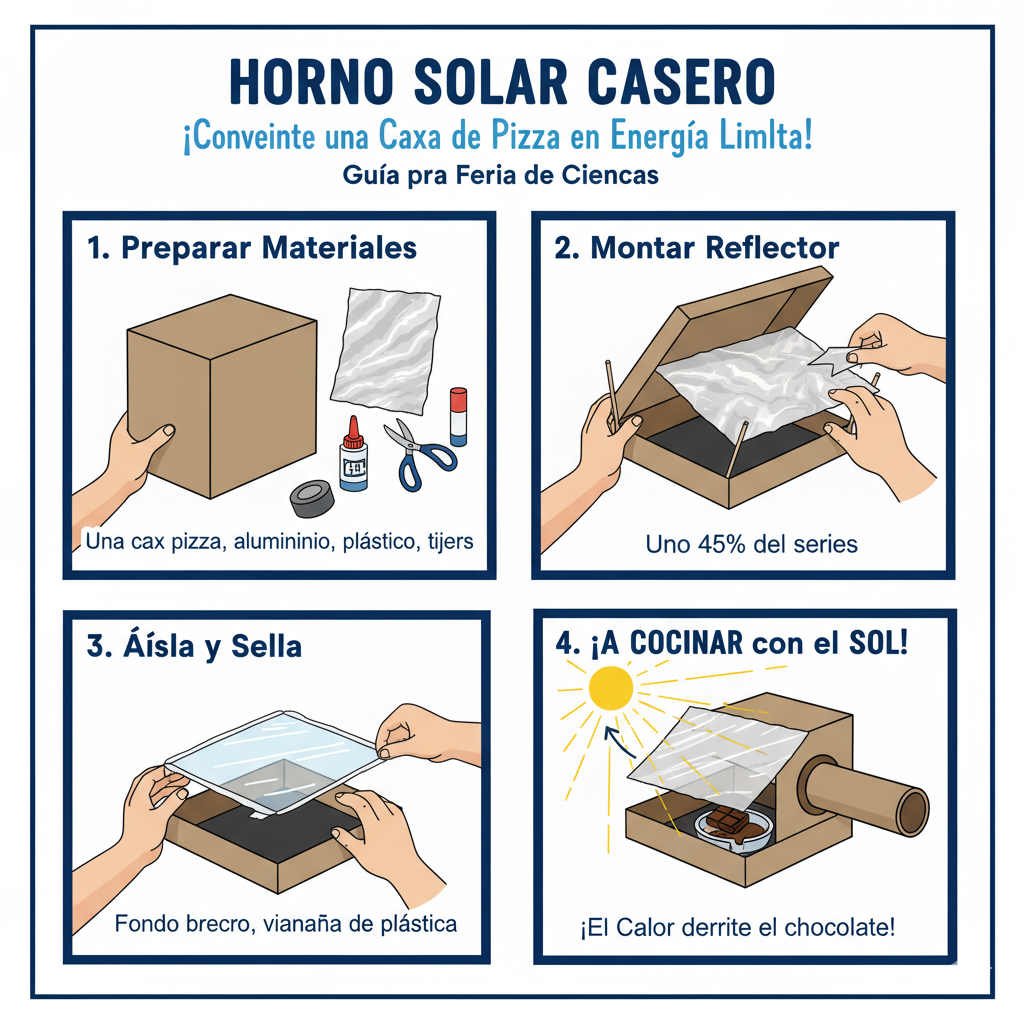
Your finished solar oven is a marvel of home engineering. It will have a plastic «window» in the top lid to let light in, and an aluminum covered reflector fin to direct more sun in. The inside will be lined with black to absorb maximum heat - all in a simple pizza box!
Here is an outline to give you an idea:
      +------------------+
     / Reflector /|
    / (aluminum) / |
   +------------------+ |
   | | Window (plastic) | |
   | +------------------+ |
   | | | Black Interior | |
   | | (food) | / /
   | +------------------+/
   +--------------------+
         Pizza Box
⚠️ Watch Out Here! Caution Zone ⚠️
Although it is a cardboard oven, it can get quite hot! Ask an adult for help using a box cutter or scissors. Never leave the oven unattended for too long and be careful when taking out the food, it will be hot!
🛠️ Scientist's Arsenal: Materials List
Choose your tools according to your mission and budget - there's no excuse not to get started!
| Essential Material | Economy Option ♻️ | Standard Option 👍 | Pro Option ✨ |
|---|---|---|---|
| Pizza Box | A clean box from your local pizzeria (ask for an unused one!) | New pizza box purchased online | Double corrugated cardboard box, more resistant |
| Transparent Window | Wrapping plastic (kitchen film) | Plastic bag for oven or freezer | Acetate or thin acrylic film |
| Absorbent Surface | Black cardboard | Matte black acrylic paint | Black felt or black construction paper |
| Reflective Surface | Aluminum kitchen foil | High strength aluminum foil | Reflective mylar film |
| Reflector Support | A pencil or ruler | A wooden skewer or skewer | Wooden rod or stiff wire |
| Cutting Tool | Heavy-duty scissors (with supervision) | Cutter or exacto (with adult supervision!) | Professional cutter with cutting base |
🧭 Your Adventure Map: Let's Build!
Follow these steps and your solar oven will be ready for action.
- The Window to the Sun (15 min): Draw a square on the lid of the pizza box, leaving a border of about 3 cm on each side. Very carefully and with the help of an adult, cut out three of the four sides of the square, leaving the side that is attached to the back of the box uncut. You have just created the reflective flap!
-
The Reflector Shield (10 min): Line the inside of the flap you just cut out with aluminum foil. Glue the foil with glue stick or tape, making sure it is as smooth as possible - any wrinkles can deflect the sun's rays!⭐ Pro Tip: Use the brighter side of the aluminum facing outward for maximum reflection.
- Creating the Greenhouse (10 min): Open the box. On the inside of the lid, tape your clear material (plastic wrap, bag, etc.) to seal the hole you made. Use masking tape to keep it tight and airtight.
-
Catching the Heat (15 min): Line the inside base of the box with the black material (cardboard, paint, etc.). This will be the surface that will absorb the solar energy and convert it into heat.🔬 Science Alert!: Black is the best color for absorbing all wavelengths of visible light, efficiently transforming them into thermal energy (heat).
- Final Adjustment (5 min): Close the box. Lift the reflective flap. Use the pencil or stick to hold it at an angle of about 45 degrees, so that it points the sun's rays directly toward the window. Your oven is ready!
- Cooking (30-60 min): Place your oven in direct sunlight. Put something to cook inside, such as a s'more (cookie, chocolate, marshmallow) or some nachos and cheese. Orient the reflector to capture as much light as possible. Now, wait and record your data!
🎪 Shine at the Science Fair!
Building the oven is only half the fun - now it's time to present it as a science star!
Your Poster (Scientific Poster)
- Title Giant: Use the title of this guide or create an even more eye-catching one.
- Clear Sections: Use the headings in this guide (Objectives, Method, etc.) to organize your poster.
- Graphics and Photos: A picture is worth a thousand words! Include photos of the construction process and a graph showing how the temperature rose in your oven.
Interactive Ideas
Don't just talk the talk, walk the walk! Have your solar oven on hand. If the day is sunny, do a live demonstration! If not, you can show a video on a tablet of the oven in action. Have s'mores or nachos ready for the judges and audience to taste the results of your experiment.
Phrases to Impress Judges 🎤
- «This project not only demonstrates principles of thermodynamics, but also offers a sustainable and educational solution for cooking food.»
- «By using recycled materials, my solar oven exemplifies how ingenious engineering can address small-scale energy challenges.»
- «The data collected show a clear correlation between the incidence of solar radiation and the increase in internal temperature, validating my initial hypothesis about the effectiveness of the greenhouse effect.»
📎 Scientist's Toolbox.
Here are some extra resources to make your project flawless.
Data Recording Template
Use a table like this one to record your observations. Be methodical.
| Time | Indoor Temperature (°C) | Outside Temperature (°C) | Observations (weather, food conditions) |
|---|---|---|---|
| 12:00 PM | 25 °C | 28 °C | Sunny, cloudless day. Solid chocolate. |
| 12:10 PM | 35 °C | 28 °C | The chocolate begins to shine. |
| 12:20 PM | 48 °C | 29 °C | Visibly melted chocolate! |
Final Checklist ✅
- Is my hypothesis clear and testable?
- Do I have all the materials ready?
- Have I asked an adult for help with the dangerous parts?
- Is my oven properly sealed so as not to lose heat?
- Have I prepared my table to record the data?
- Is my sign clear, neat and visually appealing?
- Have I practiced my presentation out loud?
Recommended Sources to Explore
Want to know more? Curiosity is a scientist's super power!
- NASA Climate Kids: Super clear articles on energy and climate.
- National Geographic Kids: Videos and experiments on solar energy.
- YouTube channel «Mark Rober»: For fun and creative engineering inspiration!
 Español de Puerto Rico
 English