

The Secret Flow of Bubbles: Create Your Own Liquid Galaxy!
Your mission: Discover the mysteries of density and chemical reactions... and become a master of lava lamps!
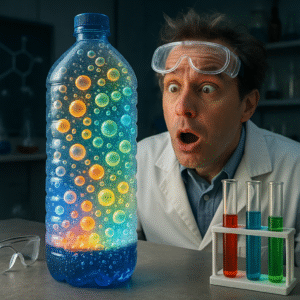
Your final experiment will look as amazing as it does in the photo!
🎯 Clear and Challenging Objectives.
- General Objective: You will visually demonstrate the principles of density y polarity of liquids, and you will observe a chemical reaction which generates gas to drive the movement.
- Personal Objective: “By the end of this guide, you will be able to explain why oil and water don't mix, how a simple pill can create a hypnotic movement, and how to present your experiment like a true science professional.”
🌍 Simple and Fun Theoretical Introduction
Hello, scientific adventurer! Before we begin, let's understand the magic we're about to create.
Imagine that liquids have their own «personality». Some are «heavier» or dense than others. In our case, the water is denser than the oil. That's why, when you put them together, the water goes to the bottom, as if to say, «Get out of the way, I'm going first!».
But also, they are like two teams that don't like each other: they don't mix! This is called polarity. Water is polar and oil is apolar. You will never see them being friends. 💧🤝 तेल
And the bubbles? This is where the chemistry comes in. We will use an effervescent tablet (like an aspirin or antacid). When it touches the water, BANG! 💥 A reaction takes place that releases a gas called carbon dioxide (CO₂).
How does it all work together? The gas is super light and travels upward, but on its way it «catches» colored water droplets and takes them for a ride through the oil. When it reaches the surface, the gas escapes and the water, which is still heavier, falls back down!
🔬 Scientific Method: Your Plan of Attack.
- Initial Observation: I have seen lava lamps and find them hypnotic, could I create a similar effect with homemade materials and understand why it works?
- Research Question: How does the amount of effervescent tablet affect the speed and duration of bubble movement in a homemade lava lamp?
- Hypothesis: I believe that if I add a larger piece of effervescent tablet, the bubbles will move faster and the reaction will last longer, because more carbon dioxide will be released all at once. Dare to predict!
- Experimental Design:
- Independent Variable (the one you change): The size of the effervescent tablet piece.
- Dependent Variable (the one you measure): The number of bubbles rising per minute and the total time the effect lasts.
- Controlled Variables (the ones you keep the same): The amount of water, the amount of oil, the type of bottle, the ambient temperature.
- Test Procedure: You will follow the steps in the «Adventure Guide» to build three identical lamps. To each one you will add a different amount of lozenge and record the data.
- Analysis of Results: You will record your measurements in a table. Did you see a clear difference? Did the bubbles move faster with more tablet? Did the effect last longer?
- Conclusion: Based on your data, was your hypothesis correct or incorrect? Any result is a good result! What's important is what you learned.
🧩 Graphical Description of the Assembly
Your lava lamp will look like a magic potion in a glass tower. It is a tall, transparent bottle. The bottom quarter is filled with a vibrant colored liquid (the water). The rest, almost to the rim, is filled with a thick, golden liquid (the oil). You will see a clear line separating the two liquids.
Do not fill the bottle to the brim. Leave about 3-4 cm of free space at the top. The reaction can generate foam and you don't want your liquid galaxy to overflow. Keep the lid close but don't close it while the reaction is active!
🛠️ Bill of Materials with Smart Options
| Key Material | Recycled/Economic Option | Standard/School Option | Precise/Professional Option |
|---|---|---|---|
| Container | 1 or 2 liter clear plastic bottle (clean!) | Large glass jar (canning type) | 1000 ml graduated cylinder |
| Dense Liquid | Tap water | Distilled water (for clarity) | Distilled and deionized water |
| Light Liquid | Cooking oil (sunflower, vegetable) | Baby oil (more transparent!) | Light mineral oil |
| Reagent | Generic effervescent tablets | Alka-Seltzer® original | Sodium bicarbonate + Citric acid |
| Dye | Drops of liquid food coloring | Gel food coloring | Liquid pH indicators |
Scientist's Emergency Kit:
- Adhesive tape (for everything!)
- Scissors
- Stopwatch (your cell phone's stopwatch is perfect!)
- Notebook or «Adventure Log» and pencil.
- Tray or plastic tablecloth to protect your table.
🧭 Step-by-Step Guide: Your Adventure Map
- Prepare your liquid foundation - 5 min ⏱️ Pour water into the bottle until it fills approximately one-fourth (1/4) of its capacity. Pro Tip: If you want the effect to be more dramatic, use cold water.
- Give color to your world! - 2 min 🎨 Add about 8-10 drops of your favorite food coloring to the water. Stir gently until the color is uniform.
- The unbreakable barrier - 5 min 💧 Carefully pour the oil into the bottle until it is almost full. Leave about 3-4 cm of space at the top. Scientist Alert! Wipe up any oil spills immediately to avoid slipping.
- The moment of truth - 1 min 💥 Be prepared! Take your effervescent tablet and break it into pieces (so you can better control the reaction).
- 3, 2, 1... Ignition! - 15 min 🚀 Drop a piece of the tablet into the bottle. Watch the magic! Take pictures and videos! This is the best time to document your experiment. Measure and aim! Count how many «bubbles» rise in one minute and time the duration.
🎪 Prepare your Presentation for the Fair (BE A STAR!)
Organize your Poster
It should be visual and direct. Include: Title, Question, Hypothesis, Materials, Method, Results (with a graph!) and your Conclusion.
Make it Interactive!
- Have your lamp ready for a live demonstration.
- Create a mini-quiz on cards for the audience.
Winning Phrases to Impress:
«This experiment demonstrates the density principle, which is fundamental to phenomena such as ocean currents.»
«By controlling the variables, I was able to obtain measurable data to validate my hypothesis.»
📎 Useful Attachments (Always take them with you!)
Data Recording Template:
| Test # | Tablet Quantity | # Bubbles (first min) | Total Duration | Remarks |
|---|---|---|---|---|
| 1 | 1/4 tablet | The bubbles were small... | ||
| 2 | 1/2 tablet | The reaction was more vigorous... | ||
| 3 | 1 whole tablet | There was a lot of foam at the beginning... |
Final Checklist:
- Do I have all my materials?
- Is my adventure log ready to write down?
- Have I read all the security alerts?
- Do I have my camera/mobile ready to record?
- Have I prepared my poster with all the information?
- Have I practiced my explanation out loud?

 Español de Puerto Rico
 English