
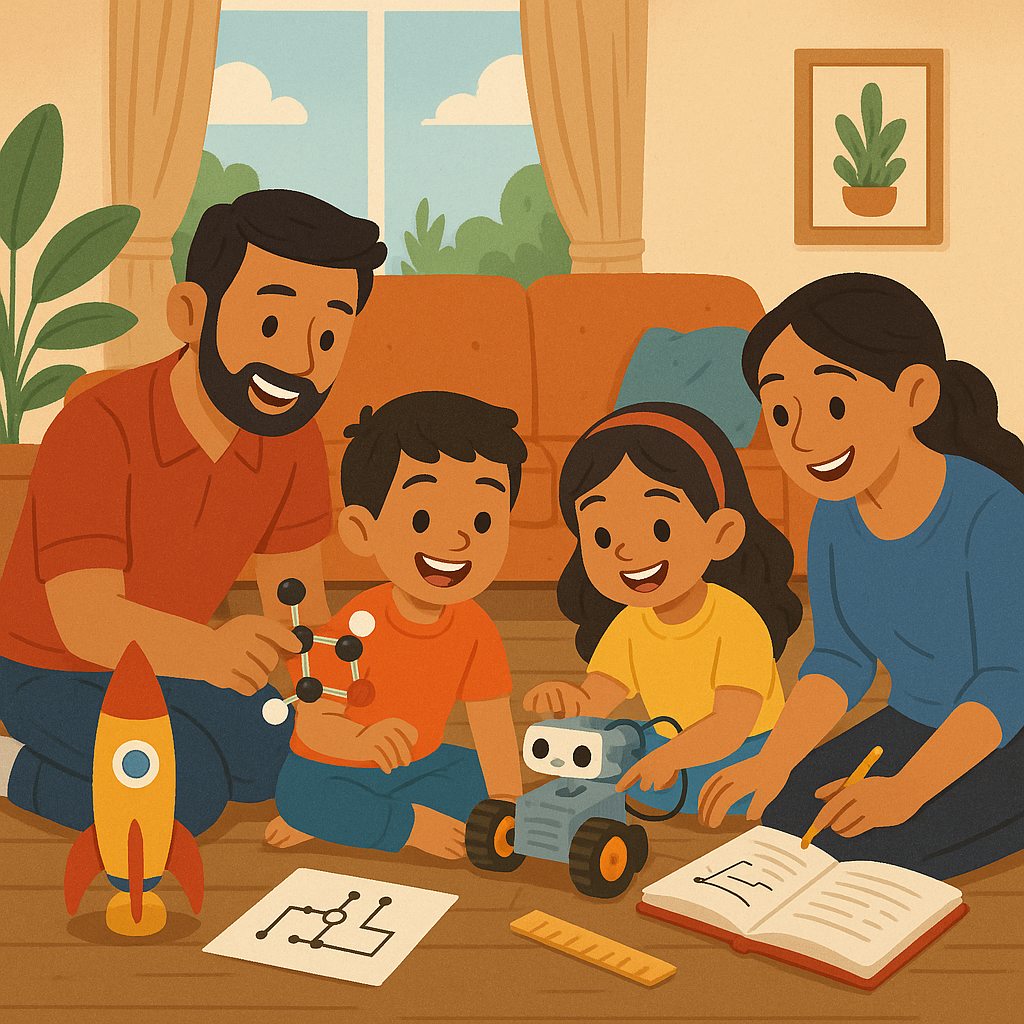
Fun science at home
Definitive guide to explore STEM as a family with safe activities, inexpensive materials and step-by-step projects.
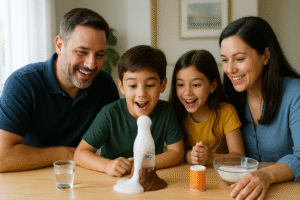
1. Why the home is a natural laboratory
The house offers real contexts to observe, measure and explain everyday phenomena: mixtures in the kitchen, changes of state in the freezer, plants in the yard or energy in the devices. This allows a situated learning, where curiosity becomes questions and questions become small investigations.
- Immediate relevance: what is learned is applied instantly (food, cleaning, gardening, recycling).
- Active learning: materials handling, decision making and recording of results.
- Affective bond: family collaboration that reinforces habits and autonomy.
This guide organizes fun science at home with age-appropriate activities, an accessible starter kit and science projects ready to use, prioritizing safety and enjoyment.
2. Principles of safety and success
- Continuous adult supervision: especially with heat, cutting, electricity or effervescent substances.
- See, think, do“ rule: look at the material, think about the procedure, then act carefully.
- Basic protection: goggles, gloves, stable surface, ventilation.
- Labeling and ordering: identified containers, clean area, responsible disposal.
- Simple documentation: hypotheses, steps, measurements, conclusions on a sheet of paper or notebook.
In addition, it implements micro-pauses to verify understanding and reduce impulse errors.
Basic kit of materials
With just a few elements you can cover dozens of safe home experiments. Prioritize reuse and avoid unnecessary purchases.
- Clear cups/bottles, measuring spoons, syringes without needles.
- Baking soda, vinegar, salt, sugar, oil, food coloring.
- Cardboard, tape, school scissors, popsicle sticks, white glue.
- Small magnets, paper clips, balloons, straws, rubber bands.
- Flashlight, AA batteries, cables with alligator clip, LED.
- Seeds (lentils) and cotton to germinate.
- Economical thermometer, stopwatch (mobile), ruler/meter.
- Coffee filter, paper towel, aluminum foil.
- Containers with lids for storing mixtures and samples.
- Children's safety glasses and nitrile gloves.
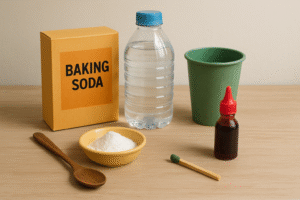
4. 15 STEM activities by age
Objective: offer short, scalable and safe ideas. Each activity incorporates a guiding question and a variation to extend.
Preschool (4-5 years)
- Paper towel rainbow: How does the water come up through the paper? Capillarity. Variation: use sugared or salted water.
- Float boat: What materials float? Density. Variation: add coins and compare.
- Germination in cotton: What does a seed need? Growth. Variation: with/without light.
Initial (6-8 years)
- Soft volcano: Why do baking soda and vinegar foam? Acid-base reaction. Variation: different proportions.
- Bag parachute: What stops the fall? Air resistance. Variation: weight of the object.
- Chromatography of markers: What colors is a color made of? Separation. Variation: different markers.
Intermediate (9-11 years old)
- Bridges of sticks: Which shape supports more weight? Structures. Variation: triangles vs. arcs.
- Homemade compass: How does a needle find north? Magnetism. Variation: weak/strong magnet.
- Simple solar distillation: Can we “clean” water with the sun? Evaporation/condensation. Variation: initial salinity.
Secondary (12-14 years old)
- LED circuit with battery: What closes a circuit? Electricity. Variation: homemade resistors (graphite pencil).
- Flywheel: Why does it roll further? Moment of inertia. Variation: weight distribution.
- Acid-base indicator with purple cabbage: How does pH change? Chemistry. Variation: pH mapping of domestic liquids .
Advanced (15-18 years)
- Safe home microbiology*: How do colonies grow on food? Observation. *Observation only, no open culture.
- Sensor programming (simulated): How to measure temperature with Arduino/APP simulated? Data.
- Optimization of a catapult: Which parameter maximizes range? Modeling.
5. Step-by-step guided projects
5.1 Stable and safe homemade volcano
Key words: safe homemade experiments, fun science at home, chemical reactions.
- Prepare the base: clay or cardboard mold with small bottle in the center.
- Dry mix: 2-3 tablespoons of baking soda + 1 teaspoon of detergent.
- Color: drops of dye in the bottle (optional).
- Eruption: add 100-150 ml of vinegar. Observe and record heights or duration.
- Expansion: change proportions and plot results (height vs. bicarbonate).
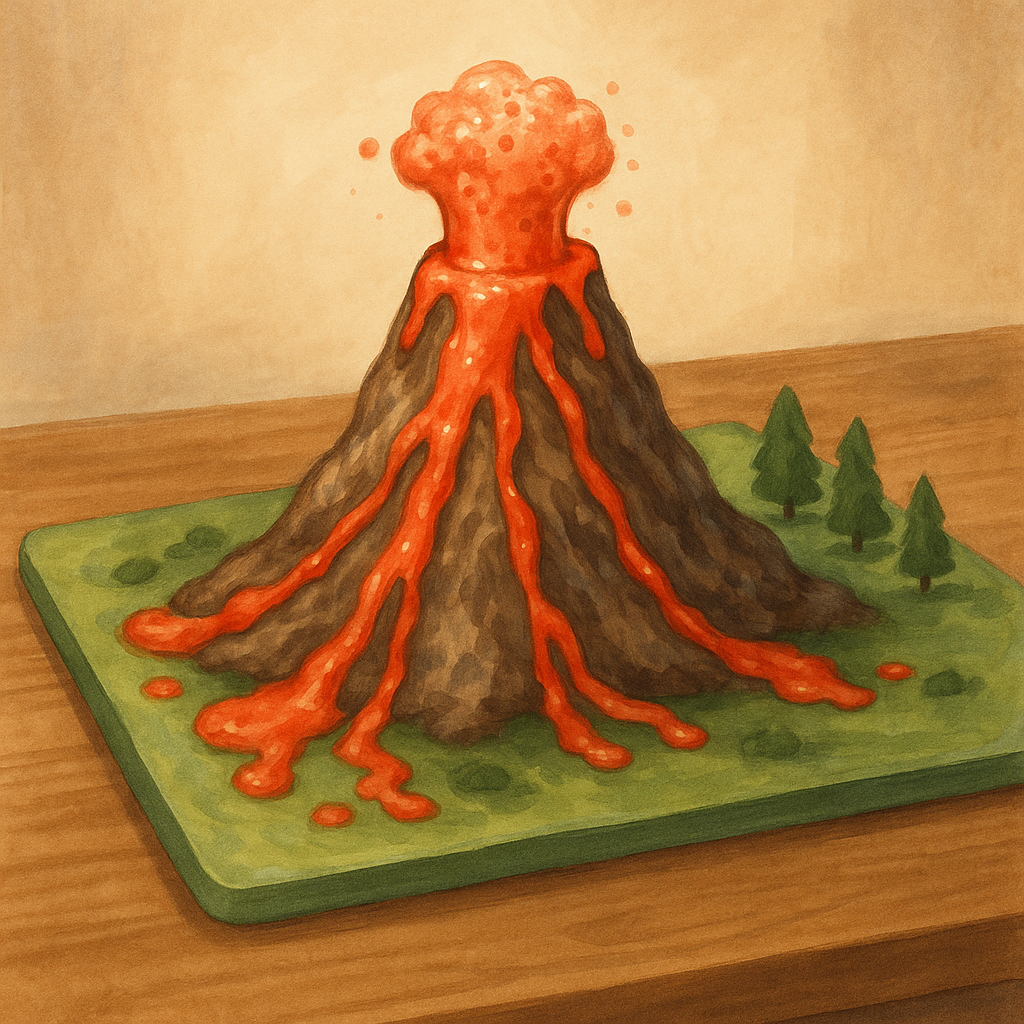
Explanation: CO₂ released by the acid-base reaction creates foam. The detergent traps bubbles and prolongs the eruption.
5.2 Simple circuit with LED
- Connect the long side of the LED to the positive pole of a AA battery with tape.
- Connect the short side to the negative side using a wire. Light!
- Challenge: add a “switch” with a paper clip or aluminum foil.
Explanation: current flows when the circuit is closed. Varying the resistance changes the brightness.
5.3 Chromatography with coffee
- Draw a line with a marker on a coffee filter.
- Place the base in water without completely submerging the line.
- Observe pigment separation and record times.
Explanation: pigments travel at different speeds by affinity with the solvent.
6. Light evaluation and rubrics
Evaluates with focus on process, scientific thought and communication, not in perfection of the result.
- Planning (25%): defines objective, materials, risks and steps.
- Execution (25%): follows instructions, records times and measurements.
- Analysis (25%): interprets results, compares with hypotheses.
- Communication (25%): explains with drawings, photos and brief conclusions.
Download a printable rubric and a children's laboratory journal template.
7. Integrates science with health, environment, sports and finance.
- Health: experiments on hand hygiene (innocuous), label reading and sugars.
- Environment: mini-compost, waste separation, artesian water filter.
- Sports: measures beats before/after jumping; analyzes times and averages.
- Finance: STEM kit budgeting and informed purchasing decisions.
These connections strengthen the STEM early childhood education and daily applicability.
8. Common mistakes and how to avoid them
- No clear objective: define the question before starting.
- Too many materials: less is more; it brings the phenomenon into focus.
- Rigid expectations: allows surprise to guide the discussion.
- Do not record data: uses simple tables (time, quantity, observation).
- Ignore security: glasses, order and supervision at all times.
9. Reliable resources and templates
Interns (On our website)
External (Recommended)
10. Frequently Asked Questions
What basic materials should I buy first?
Prioritize baking soda, vinegar, dyes, coffee filters, clear cups, syringes without needles, small magnets, balloons, LEDs and tape. That covers 70% of the initial proposals.
How do I adapt activities to different ages?
Keep the phenomenon, change the level of explanation and the type of record: drawings (small), simple tables (primary) and graphs/percentages (secondary).
How do I evaluate without it becoming a “test”?
Uses light rubrics with 4 criteria (planning, execution, analysis, communication) and positive feedback focused on improvement.
What do I do if an experiment “doesn't work”?
Excellent opportunity to analyze variables: quantities, times, material, temperature. Document changes and try again.
Where can I find safe and reliable activities?
Check our verified experiments and reliable sources such as those listed in the resources section.
 Spanish
 English