

Flowers that change color 🌈💐
Discover how the “painted” water travels through the xylem and transforms white petals into vibrant shades - ideal for your science fair!
🎯 General objective.
Demonstrate the transport of water and solutes through the xylem in cut stem plants (white flowers), evidenced by the change of color in the petals.
💪 Personal objective
Explain in your own words how such phenomena as perspiration, cohesion-tension y capillarity allow the dye to rise from the glass to the flower.
🌍 Theoretical introduction (fast and fun)
Plants absorb water through their stems via microscopic tubes called xylem. Thanks to the perspiration (the water evaporates through the leaves), a “tension” is created that pull more water upwards. The cohesion holds the water column together and the capillarity helps the liquid to rise through narrow spaces. If the water contains dye, it travels with it and dyes the petals.
- 🔬 Perspirationwater vapor outflow through stomata in leaves.
- 🧲 Cohesion-tensionThe water molecules attract each other, forming a continuous column that is “pulled” upwards.
- 🧪 Capillaritywater rises through thin tubes (xylem) by adhesive and cohesive forces.
🔬 Scientific method: your plan of attack.
- Observation: White flowers sometimes change color when placed in dyed water.
- Question: What variables (dye type, concentration, temperature, stem cut) affect the speed and intensity of color?
- Hypothesis: If I increase the concentration of dye, then the petals will be dyed faster and more intensely.
- Experimental design: Vessels with different dye concentrations (low, medium, high) are compared, using similar flowers and constant conditions.
- Experimentation: Color appearance times are measured and an intensity scale (0-5) is assigned per petal/vessel.
- Analysis: The results are plotted and an evaluation is made as to whether the hypothesis is fulfilled.
- Conclusion: It summarizes which condition produced the greatest change and why.
- Communication: The poster is presented with photos, data table and explanation of xylem-transpiration.
🧩 What the assembly looks like
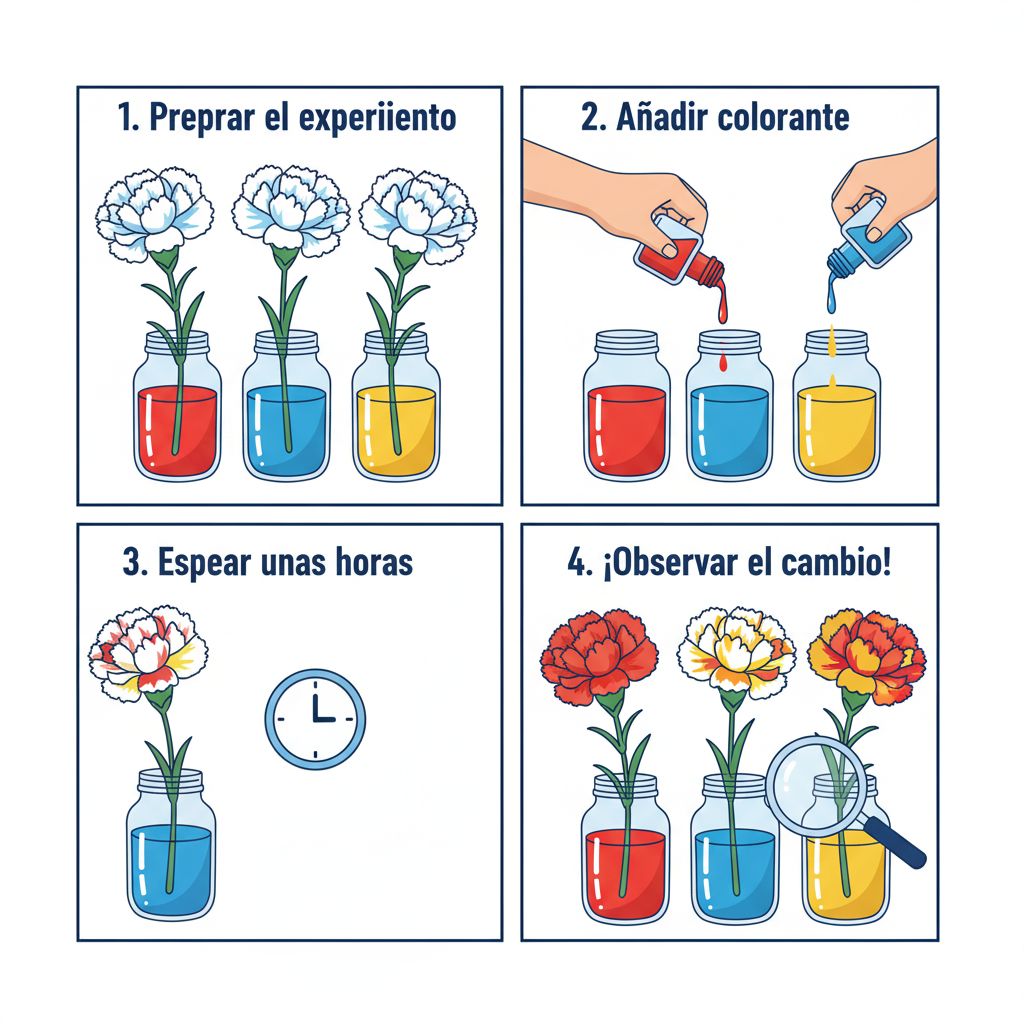
Place several transparent glasses with water and colored dyes of different colors. Put a white flower (carnation, chrysanthemum or white rose) in each glass. Identify each beaker with its concentration. Observe the change in the petals over time.
                (Flower) (Flower) (Flower) (Flower)
                  | | |
                 ||| ||| |||
              ___|||___ ___|||___ ___|||___
             Glass | | | Glass | | Glass | | | Glass | |
             || Blue | | Red | | | Green ||
             |________| |________| |________|
⚠️ Watch out here! Danger zone
- Use food dyes; avoid toxic dyes.
- Handles scissors/knife to cut stems with adult assistance.
- Do not stain surfaces by accident: protect the table with paper or plastic tablecloth.
Safety first
🛠️ BOM (with smart options)
| Material | Economic Option | Standard Option | Professional Option |
|---|---|---|---|
| White flowers | White supermarket carnation | White chrysanthemum | White florist's rose (superior quality) |
| Dye | Basic food coloring | Washable school ink | Educational laboratory dye concentrates |
| Glasses or jars | Clear plastic cups | Common glass beakers | Graduated flasks with lids (measuring volumes) |
| Water | From the faucet | Filtered | Distilled (better control) |
| Tools | Kitchen scissors | Cutter/Exacto with cutting base | Florist knife + gloves |
| Extras | Paper labels | Indelible marker | Ruler + stopwatch + camera for recordings |
Saving Tip: reuse clean glass jars (jam, coffee) to see the color better.
🧭 Step-by-step guide: your adventure map
- Prepare the area (5 min): Protects the table and brings everything together. Scientist alert! Avoid splashing of colorant.
- Mix colors (5-10 min): Fill the glasses with the same volume of water. Add different concentrations (low, medium, high) and label.
- Cut the stems (5 min): At ~45° angle under water (if you can), to improve absorption. Cutting with adult.
- Place the flowers (1 min): One per cup, ensuring that the stem is submerged.
- Observe and record (1-6 h): Every 15-30 min take pictures and rate the color intensity (0-5). Pro Tip: always use the same light.
- Compare conditions (30 min): Change one variable: water temperature, flower type or stem length.
- Analyze (20 min): Which glass colored faster? Does it match your hypothesis?
- Concludes (10 min): Explain with xylem, transpiration and capillarity why it happened.
🎪 Winning poster
- Clear title + before/after image.
- Xylem diagram and keywords (transpiration, cohesion).
- Simple table and graph with your data.
🧠 Interactive
- Displays a flower live changing color.
- Invite the jury to predict which glass will dye the most.
- Mini magnifying glass to see veins and petals.
🗣️ Phrases to impress
- “The xylem works like a water highway by cohesion-tension.”
- “The perspiration creates the force that drives the water upward.”
- “The capillarity Helps to bring liquid up in very thin tubes.”
📎 Useful appendices
Data logging template
| Glass | Color / Concentration | Time (min) | Color intensity (0-5) | Notes / Observations |
|---|---|---|---|---|
| A | Blue / Low | 0 | 0 | Initial photo |
| A | Blue / Low | 30 | 1 | Slight edges |
| B | Red / Medium | 30 | 2 | Increased contrast |
| C | Green / High | 30 | 3 | Petals more marked |
Checklist
- I defined hypotheses and variables.
- I labeled all the glasses with concentration.
- I recorded data with constant intervals.
- I took comparable photos (same light/distance).
- I included an explanation of xylem and transpiration.
- I prepared conclusions and possible improvements.
Recommended sources
- High school biology books (transport in plants).
- Educational resources on xylem/phloem and transpiration.
- Dissemination articles on capillarity and cohesion-tension.

 Español de Puerto Rico
 English