
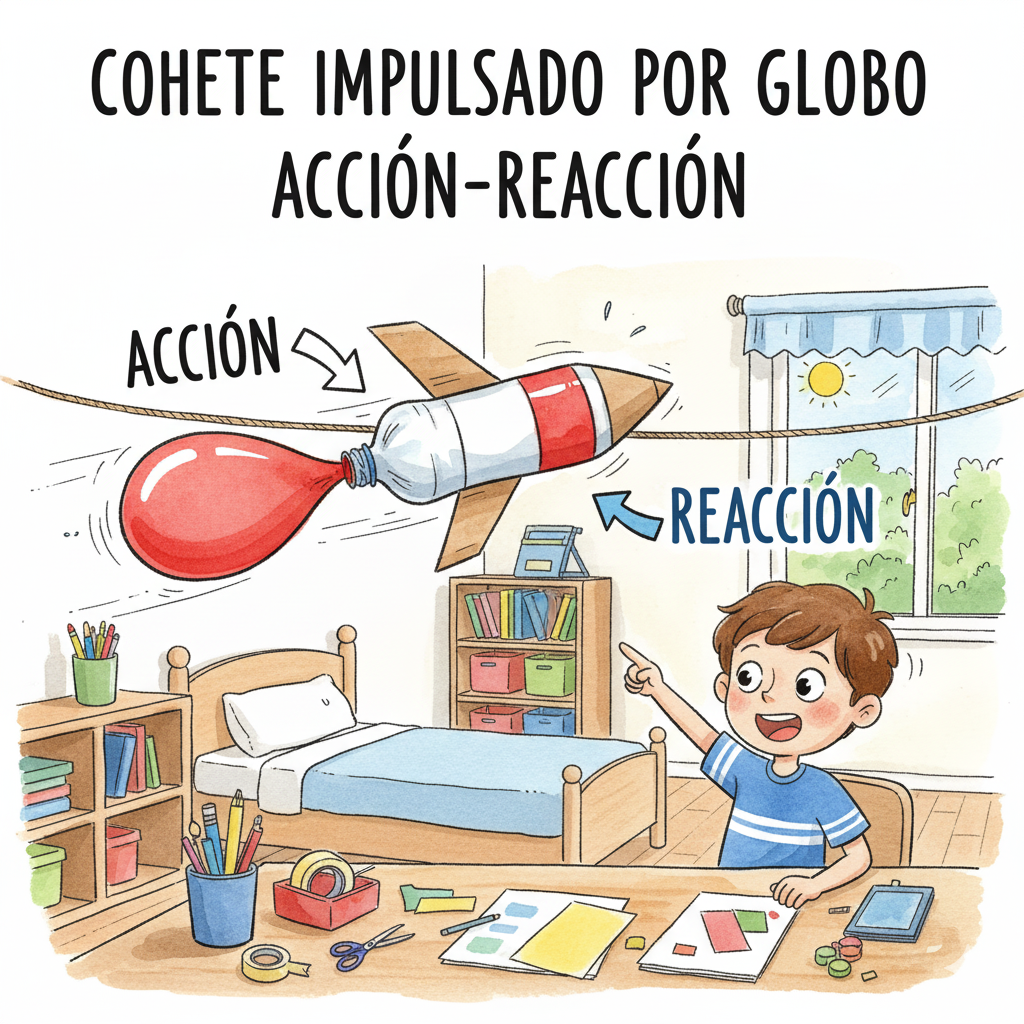
Balloon-powered rocket: take off with Newton's third law!
Build, test and present a simple rocket that demonstrates action-reaction. Learn scientific method, record data and dazzle your jury. ✨
Customize colors with your logo
Replace the logo URL and set the CSS variables to :root.

🎯 Clear and challenging objectives.
Overall objective
Demonstrate the action-reaction principle (Newton's Third Law) by building a rocket propelled by air expelled from a balloon.
Personal objective
Design your most efficient version of the rocket by optimizing mass, straw shape and string tension to maximize distance traveled.
🌍 Simple and fun introduction to theory
When you let go of the balloon, air escapes backwards and pushes the balloon forwards - this is how it works action-reaction. In real rockets, the engine gases exit the nozzle at high speed and generate thrust.
- 💨 Thrust: force that propels the rocket.
- 🧪 Friction and friction: the rope and the air slow it down.
- ⚖️ Mass: the lower the mass of the “rocket”, the easier it is to accelerate it.
🔬 Scientific method: your plan of attack.
- Observation: the balloon moves when it is released because the air comes out backwards.
- Question: how does the rope tension and the shape of the globe to the distance traveled?
- Hypothesis: if I use a tighter rope and an elongated balloon, then the rocket will travel a greater distance.
- Experimental design: independent variable (balloon tension/shape), dependent (distance), controlled (string length, slope, tape, straw, mass).
- Data collection: measures distance and time in 3-5 attempts per condition.
- Analysis: average and compare conditions.
- Conclusion: accept or reject your hypothesis and explain why.
🧩 Graphical description of assembly
The rocket is a balloon attached to a straw that runs along a string stretched between two supports.
Schematic (side view):

[Bracket A]===========================[Bracket B].
      |
      | taut rope
     ( ) inflated balloon →→→→ movement
      |
     | | straw
      |
   adhesive tape
🛠️ Materials with smart options
| Material | Economic | Standard | Professional |
|---|---|---|---|
| Balloon | Common globe #9 | Elongated balloon (sausage type) | High resistance latex balloon |
| Straw | Plastic straw | Rigid smoothie straw | Low friction PTFE tubing |
| Rope/yarn | Fishing line | Nylon rope 2-3 mm | High tension monofilament |
| Adhesive tape | School tape | Transparent tape | Double-sided tape |
| Supports | Two chairs | Lightweight tripods | Brackets with clamps |
| Instruments | Metric ruler | Tape measure | Laser meter + stopwatch |
| Security | — | Safety glasses | Goggles + nitrile gloves |
🧭 Step-by-step guide: your adventure map
-
Prepare the track (5 min): Thread the rope through the straw and tie the ends to the brackets. Tighten well.Pro Tip: a tighter rope reduces lateral friction.
-
Assemble the rocket (5 min): inflate the balloon (without knotting), hold it and tape it to the straw.Scientist Alert! Do not release the balloon until ready to measure.
- Mark the start (2 min): places a tape at the starting point and another one every 50 cm.
- Take-off (1 min per test): release the balloon. Measure distance y time until it stops.
-
Repeat (10-15 min): performs 3-5 attempts with the same type of balloon. Change one variable (e.g., different balloon) and repeat.Pro Tip: label each condition (G1, G2, ...) and use colors in your table.
- Analyze (10-15 min): Which one traveled the farthest? Does it match your hypothesis?
🎪 Prepare your presentation for the fair.
Poster ideas
- Large title with 🚀 icon and clear subtitle.
- Photo of the assembly + clean ASCII schematic.
- Simple graph: variable vs. distance (use colors from your palette).
- Hypothesis, method, data table and conclusion in blocks.
Phrases that impress judges
- “I controlled variables and repeated tests to reduce error.”
- “My design improves thrust and reduces lateral friction.”
- “The evidence supports/rejects my hypothesis for these reasons...”
📎 Useful appendices
Data logging template
| Condition | Attempt | Distance (m) | Time (s) | Remarks |
|---|---|---|---|---|
| G1 | 1 | |||
| G1 | 2 | |||
| G1 | 3 | |||
| G2 | 1 | |||
| G2 | 2 | |||
| G2 | 3 |
Checklist
- Defined independent and controlled variables.
- 3-5 attempts per completed condition.
- Averaged data and prepared graph.
- Conclusion written and linked to the hypothesis.
- Safe demonstration area and goggles ready.
Recommended sources
- Educational resources from space agencies and science museums (intro to Newton's laws and thrust).
- School library or STEM learning platforms for youth.
 Español de Puerto Rico
 English