Content
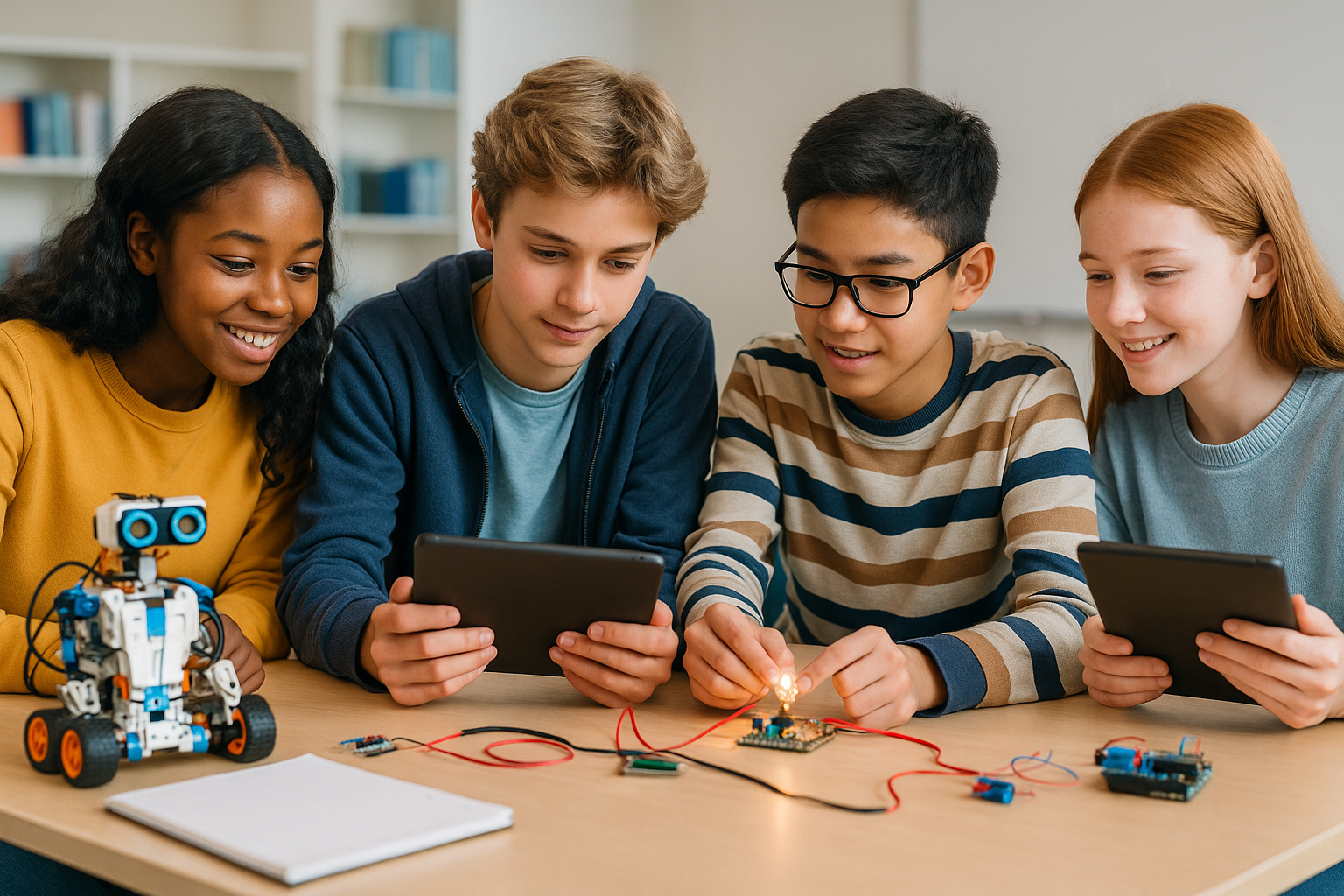
Secondary STEM Education: The Key to the Future of Learning
Discover how to integrate Science, Technology, Engineering and Mathematics into your classroom with practical strategies, innovative projects and ready-to-use resources.
What is STEM Education?
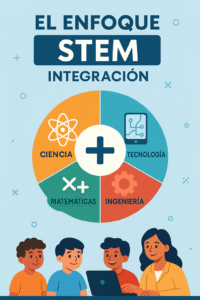
The STEM education (for its acronym in English: Science, Technology, Engineering, and Mathematics) is an interdisciplinary approach that integrates the areas of science, technology, engineering and mathematics in practical learning experiences focused on solving real problems.
At the level of secondary, This educational model allows students to connect abstract concepts with real-world applications, fostering critical thinking, creativity and collaborative work.
Why Implement STEM in Secondary School?
The secondary school stage is critical for the cognitive and vocational development of young people. Introducing the STEM education at this level prepares students for the challenges of the 21st century, aligning with the demands of the labor market and technological innovation.
- Awakens scientific and technical vocationsMany students discover a passion for engineering or programming through hands-on projects.
- Narrowing the gender gap in science: Inclusive programs motivate more girls to explore STEM careers.
- Improved academic performanceActive learning increases understanding and retention of content.
- Prepares for the future of workAccording to UNESCO, 65% of children today will work in jobs that do not yet exist, many of them linked to emerging technologies.
In addition, the approach STEM promotes soft skills such as communication, conflict resolution and decision making, which are essential in any profession.
Benefits of the STEM Approach in the Classroom
Embracing STEM education not only transforms what is taught, but also what is taught. how it is taught. Here are the main benefits:
Critical Thinking
Students analyze complex problems, propose solutions and evaluate results.
Collaborative Work
Projects require multidisciplinary teams, encouraging cooperation.
Innovation and Creativity
Young people design prototypes, test ideas and learn from mistakes.
Real Application of Knowledge
Mathematics is no longer just formulas: it is used to program robots or model structures.
5 STEM Projects to Implement in Secondary Schools
Here are practical and scalable ideas to apply in the classroom, even with limited resources:
-
Autonomous mobile robot with Arduino
Level: 2ND-4TH ESO | Duration: 4 weeks
Students build a robot that avoids obstacles using ultrasound sensors. It integrates programming, electricity and basic physics. -
Design of bridges with popsicle sticks
Level: 1ST-2ND ESO | Duration: 2 weeks
Apply principles of structural engineering and strength of materials. They test the maximum load with weights. -
Mobile application for recycling
Level: 3RD-4TH ESO | Duration: 6 weeks
They use tools such as MIT App Inventor to create an app that educates about local recycling. -
Smart vegetable garden with sensors
Level: 1ST-3RD ESO | Duration: 8 weeks
They monitor humidity, light and temperature with sensors connected to a Raspberry Pi. -
Rocket launch simulation
Level: 4th ESO-Baccalaureate | Duration: 3 weeks
They use physics equations and software such as Tinkercad to model trajectories.

Active Methodologies in STEM Education
The success of the STEM model depends on how it is taught. These methodologies are key:
- Project Based Learning (PBL)Students solve a real problem over several weeks, integrating content from different subjects.
- Design ThinkingA 5-phase process (empathize, define, ideate, prototype, test) to develop user-centric solutions.
- Flipped ClassroomTheoretical content is studied at home (videos, readings), and STEM practice is done in class.
- GamificationUse of game mechanics (points, levels, challenges) to motivate learning.
These strategies transform the teacher into a learning facilitator, not a transmitter of knowledge.
Free Resources for STEM Teachers
Implementing STEM may seem challenging, but there are many free and open source tools available:
- STEM Learning (United Kingdom) - Lesson plans and teacher training.
- NASA STEM Engagement - Scientific materials and space challenges.
- Code.org - Programming courses for students and training for teachers.
- Tinkercad - 3D design and virtual circuits, ideal for beginners.
- How to evaluate STEM projects (internal guide) - Rubrics and evaluation criteria.
We recommend starting with short projects and collaborate with other teachers (science, math, technology) to create interdisciplinary experiences.
Frequently Asked Questions about STEM Education
What is the difference between STEM and STEAM?
STEM includes Science, Technology, Engineering and Mathematics. STEAM adds Arts, integrating creativity, design and expression into science projects.
Can STEM be applied without advanced technology?
Yes! STEM does not require robots or 3D printers. Projects with recycled materials, basic chemistry experiments or designing educational board games are also STEM.
How to evaluate a STEM project?
Use rubrics that consider: scientific process, creativity, teamwork, presentation and solution of the problem. The grade should not be based only on the final result.
Is STEM appropriate for all high school levels?
Yes, simple projects (such as building a bridge) can be done from the first year of ESO, and at higher levels, more complex challenges can be tackled with programming or scientific modeling.
Where can I get inexpensive STEM materials?
Look for educational kits on AliExpress, local science fairs, or collaborate with technology companies. You can also use recycled materials: cardboard, bottles, wires, etc.
 Español de Puerto Rico
  English