
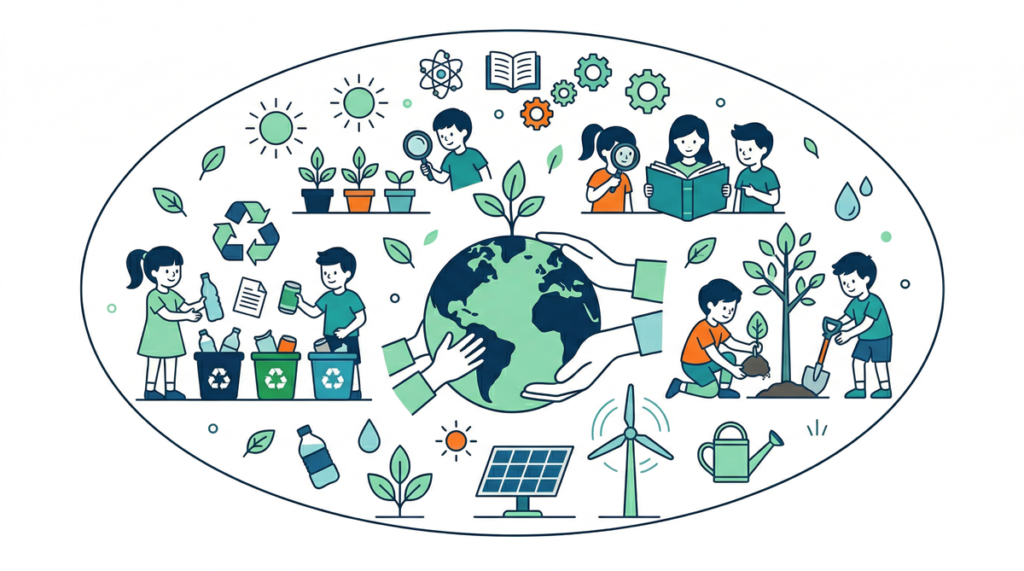
Earth Day is a perfect opportunity to teach environmental values in the classroom in a practical and meaningful way. Through Earth Day activities, teachers can foster ecological awareness from an early age, helping students understand the importance of caring for the planet. But how can we ensure these lessons are truly memorable?
The key lies in combining creativity, active participation, and connection to everyday life. From recycling projects to simple experiments, there are multiple ways to integrate environmental education in primary school without needing large resources. Furthermore, these experiences not only teach science but also responsibility and critical thinking.
In this article, you will discover a selection of Earth Day activities specifically designed for elementary school, easy to implement, and aligned with active methodologies. Ready to transform your classroom into a more sustainable and conscious space?
Table of Contents
- Importance of working on Earth Day in primary school
- Easy and Practical Earth Day Activities
- Creative projects to foster environmental awareness
- How to integrate environmental learning into the classroom
Importance of Earth Day activities in primary schools
Working on Earth Day activities in elementary school allows for the development of fundamental values such as respect for nature and social responsibility. At this stage, children are forming habits, so it's the ideal time to introduce concepts like recycling, sustainability, and environmental care.
Environmental education is not just about transmitting information, but about generating experiences. When students actively participate, learning becomes meaningful. For example, hands-on activities help to understand problems like pollution or climate change in a tangible way.
Moreover, integrating these dynamics into the classroom fosters key skills like teamwork, creativity, and problem-solving. Can you imagine the impact of small changes made by an entire class?
Incorporating this type of content also connects with areas like natural sciences and civic values, creating very enriching interdisciplinary learning.
Easy and Practical Earth Day Activities
There are many Earth Day activities you can implement with ease. Here are some simple ideas to apply in elementary school and promote environmental education in a dynamic way.
- Waste classification: brings different materials into the classroom and asks students to classify them into recyclable and non-recyclable.
- Create recycled paper: A hands-on activity that allows you to understand the reuse process.
- School garden: Planting seeds helps to understand the plant life cycle.
- Eco-posters: The students can design messages to promote environmental care.
These activities are not only educational, but also motivating. In addition, they allow you to adapt the content according to the age and level of the group. The best part? Many of them require materials you already have in the classroom or at home.
Creative projects for Earth Day
If you're looking to go a step further, you can propose more comprehensive projects based on Earth Day activities. These proposals allow for deeper learning and the development of key competencies such as critical thinking, collaboration, and creativity.
One example is creating an eco-project where students identify an environmental problem in their community and propose real solutions. You can also organize awareness campaigns within the school, create collaborative murals, or design useful objects from recycled materials.
This type of activity reinforces the idea that every action counts. Furthermore, it turns students into protagonists of their own learning and into small agents of change within their educational community.
How to integrate environmental learning into the classroom
Integrating Earth Day activities should not be limited to a specific date. Ideally, environmental education should be incorporated transversally throughout the year so that learning is more lasting and meaningful.
You can link these activities to subjects like science, language, or art. For example, students can write stories about caring for the planet, analyze data on resource consumption, or create crafts by reusing everyday materials.
It's also important to encourage daily habits, such as reducing paper usage, reusing materials, or keeping common spaces clean. Small actions create big changes when they become routine.
If you're looking for more resources and tools to create educational activities quickly, you can explore platforms like Didaktos, where you'll find ready-to-apply ideas for the classroom.
It's also important to encourage daily habits, such as reducing paper usage, reusing materials, or keeping common spaces clean. Small actions create big changes when they become routine.
If you're looking for more resources and tools to create educational activities quickly, you can explore platforms like Didaktos, where you'll find ready-to-apply ideas for the classroom.
If you want more ready-to-use ideas, you can also explore our collection of STEM activities for elementary school, where you'll find practical proposals that perfectly complement Earth Day.
Conclusions
Conclusions
Earth Day activities are a powerful tool for teaching values, developing skills, and fostering environmental awareness in elementary school. Through practical and creative activities, students can understand their impact on the world and become responsible citizens.
Incorporating these activities into the classroom does not require large resources, but rather intention, planning, and creativity. Investing in environmental education today is sowing sustainable habits for the future.
If you want to discover more ready-to-use educational resources, visit Didaktos and keep exploring new ways to innovate in your teaching.
 Español de Puerto Rico
 English