
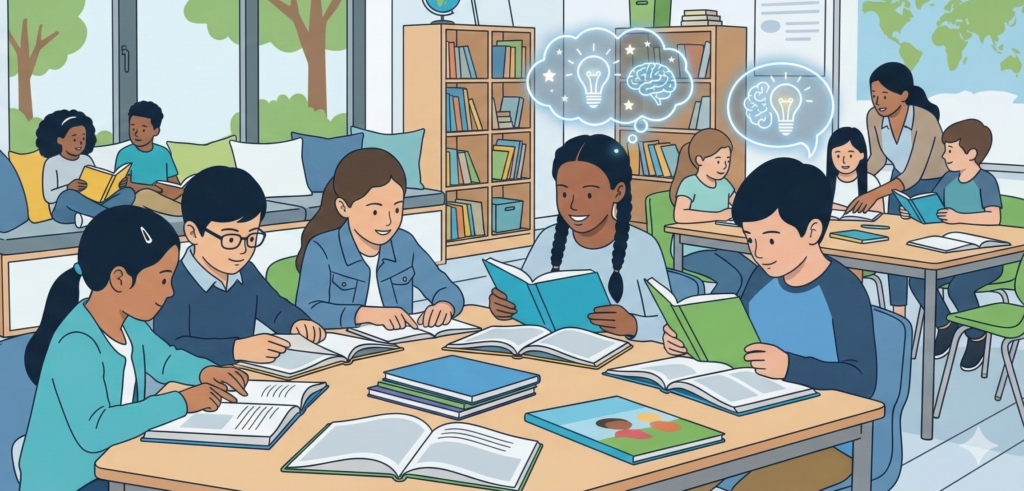
As teachers, we know that the biggest challenge is not that students read, but that they understand what they read. The primary reading comprehension is the foundation on which all future learning is built. If your students decode words but don't get the message, this article gives you the pedagogical keys and practical tools to transform that mechanical reading into meaningful learning from day one.
The Pedagogical Context: Beyond Decoding
In education, we often confuse reading with the simple ability to transform graphemes into phonemes. However, the real reading comprehension is a complex cognitive process. It involves active interaction between the reader, the text and the context.
For a primary school child, comprehension means constructing a mental model of what the text is saying. It is not a passive act; it requires inferring, predicting, connecting with previous knowledge and evaluating the information. When we work on this competence, we not only improve their performance in language, but we also enhance their critical capacity in mathematics, science and daily life.
Practical strategies for the classroom
Developing this skill requires intentionality. It is not enough to simply assign readings; we must teach reading comprehension strategies specific. Below, we break down a practical approach divided into three key moments of reading.
1. Before reading: Activation
Successful comprehension begins before reading the first word. We must prepare the learner's cognitive ground.
- Pre-reading and prediction: Show only the title and images. Ask: «What do you think this will be about?».
- Brainstorming: Activates vocabulary related to the topic.
- Purpose of reading: Clearly define what they should be looking for (e.g., «We read to find out why the character is sad»).
2. During reading: Monitoring
This is where students learn to self-regulate. If they get lost, they must know what to do.
| Strategy | Student action | Target |
|---|---|---|
| Visualization | Create a «mental movie» of the scene. | Connecting text with imagination. |
| Clarification | Stop at an unfamiliar word and use the context. | Do not block the reading flow. |
| Internal questions | Ask yourself, «Does this make sense?». | Verify understanding in real time. |
3. After reading: Consolidation
It is time to verify what has been learned and to expand it by means of reading comprehension activities varied.
Pro: Avoid «true or false» quizzes as the only assessment. Ask students to draw the alternate ending or explain the text to a peer who has not read it.
Tools that facilitate constant practice
💡 A resource that can save you time.
One of the greatest difficulties we encounter when applying these strategies is the need to have a variety of texts adapted to different reading levels. Preparing differentiated material for each student can consume hours of weekly planning.
For this reason, many teachers are using educational text generators that allow them to create personalized readings in minutes. Tools such as Didaktos offer the possibility of generating coherent texts on any topic you are working on in class, including comprehension questions.
The interesting thing about this approach is that you can keep the freshness of the content without sacrificing planning time. This way, you concentrate on what really matters: accompanying your students in the process of understanding.
Explore readings generatorConclusion
The primary reading comprehension is not an innate gift, it is a trained skill. By combining conscious pedagogy (before, during and after) with resources that optimize your time, we can ensure that no student is left behind. We invite you to try these strategies this week and share the results with your teaching team.
 Español de Puerto Rico
  English